TestSprite, the testing backbone of AI-native development, today announced the launch of TestSprite 2.1, its most powerful release to date. As AI coding agents become the default way software is built, verification has emerged as the missing layer of the agentic workflow: the gap between how quickly code is generated and how confidently it can be shipped. TestSprite 2.1 closes that gap with a 4-5x faster AI testing engine, dramatically improved test coverage, a new visual Test Modification Interface, and a GitHub integration that automatically enforces quality on every pull request. Nearly 100,000 development and QA teams now use TestSprite to validate software built with AI coding tools like Cursor, GitHub Copilot, and other popular IDEs.
With an estimated 90% of web developers now using AI for code generation, the pace of AI-authored code has far outrun the ability to verify it. TestSprite’s own benchmarks illustrate the scale of the problem: AI-generated code initially passes only 42% of comprehensive test cases, but that figure jumps to 93% after a single iteration with TestSprite’s agentic testing agent.
What’s New in TestSprite 2.1
TestSprite 2.1 addresses the four biggest pain points developers face when testing AI-generated code: speed, coverage, control, and continuous enforcement.
- 4-5x Faster AI Testing Engine: TestSprite rebuilt its AI testing engine from the ground up. What previously took 20 minutes now takes just 5. Whether developers are testing authentication flows, search functionality, or complex user journeys, TestSprite generates comprehensive test cases in minutes, rivaling AI code generation speeds for the first time.
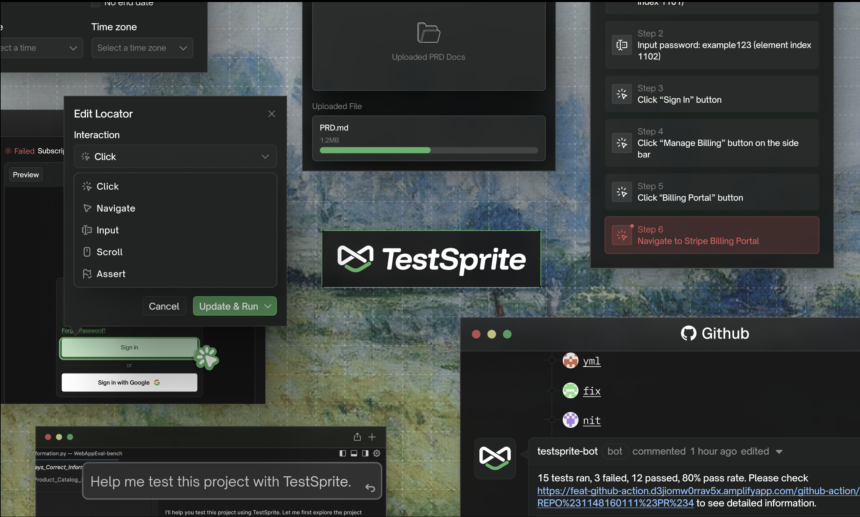
- GitHub Integration with Automatic Pull Request Testing: TestSprite 2.1 closes the loop between local development and production-ready code with a first-class GitHub integration. Available as an easy-config GitHub App or a GitHub Actions workflow, it automatically runs the full test suite against preview deployments, on Vercel, Netlify, Render, Railway, Fly.io, and other platforms, on every pull request. The TestSprite bot posts a detailed pass/fail summary directly on each pull request, and teams can enable merge blocking to prevent failing code from ever reaching production.
- Dramatically Improved Test Coverage: TestSprite 2.1’s enhanced AI understands complex application architectures, generating test cases covering edge cases, error states, and user flows that developers and AI coding tools might have missed. The platform covers extensive front-end and back-end testing, including API functional testing, security, error handling, and authentication.
- Visual Test Modification Interface: The new Test Modification Interface gives developers full visual control over AI-generated test cases. Developers can click into any test step to see a snapshot of that exact moment in execution, then change interaction types (click, navigate, input, scroll, assert), update input values, adjust timeouts, or point-and-click to swap page element locators. When a change impacts the overall test flow, TestSprite automatically regenerates all subsequent steps while preserving earlier customizations, keeping test suites accurate as applications evolve.
How TestSprite Fits Into the Way Teams Actually Work
The workflow starts inside the IDE. Developers tell the TestSprite MCP (Model Context Protocol) server, directly inside Cursor, GitHub Copilot, or other AI coding environments, to test a new feature, a code diff, or an entire project, in plain English. TestSprite reads the codebase and any product specifications provided, generates a structured test plan, writes the test code, and executes it automatically. The generated test suite is saved to the project’s repository alongside the code, with no separate testing infrastructure or manual test writing required.
Once those tests are in the repository, the GitHub integration takes over as the continuous enforcement layer. On every pull request, whether opened by a developer or triggered by an AI coding agent, TestSprite automatically runs the full test suite against a live preview deployment and posts a pass/fail summary directly on the pull request. Teams can enable merge blocking so that any pull request introducing a backward-incompatible change, a broken user flow, or a regression is stopped before it reaches production. The result: as more developers and more AI-generated code enter the codebase, TestSprite’s test suite grows with it, and the GitHub integration ensures every change is held to the same standard before it ships.
Addressing the AI Code Quality Crisis
The rise of AI coding agents has created a fundamental new challenge: developers are now responsible for validating massive volumes of code they didn’t write. Tools like Cursor and GitHub Copilot can generate thousands of lines of code in a single session but ensuring that code meets production requirements demands independent verification.
TestSprite’s approach is structurally different from both legacy testing tools and the AI coding agents themselves. Rather than replacing Selenium or Playwright, for example, TestSprite serves as an independent verification layer purpose-built for AI-generated code, validating whether the output actually fits the developer’s original intent.
“AI coding tools have unlocked a new speed of development. But speed without verification isn’t velocity: it’s risk. Verification has always been the missing layer of the agentic workflow, and it doesn’t get filled by the same tools that generate the code. TestSprite is that layer: an agentic AI testing agent that handles verification so your team can develop at 10x the speed without sacrificing confidence in what ships,” said Yunhao Jiao, CEO and Co-founder, TestSprite.
Momentum and Traction
TestSprite has grown to nearly 100,000 development and QA teams, up from 35,000 at the time of the company’s $6.7 million seed round in October 2025, led by Trilogy Equity Partners. The platform’s user base includes teams from Google, Apple, Adobe, Salesforce, ByteDance, Microsoft, and Meta. Total funding raised is approximately $8.1 million.
“As a Cursor user building Insforge, I’m generating code faster than ever, but that also means bugs can compound just as fast. TestSprite catches what Cursor misses. The fact that it runs automatically on every pull request means my team can move quickly without second-guessing what just merged,” said Hang Huang, CEO, Insforge.
Pricing and Availability
TestSprite 2.1 is available immediately at www.testsprite.com. Developers can access the free tier to experience agentic AI testing, with paid plans for teams and enterprises. Pricing remains unchanged from previous versions.
About TestSprite
Based in Seattle, Washington, TestSprite provides the missing layer of the agentic development workflow: an agentic AI testing agent that handles verification, enabling development teams to ship at AI-native speed. Its testing agent integrates directly into developers’ AI IDEs via MCP, generating comprehensive test plans, executing frontend and backend tests, and running automatically on every pull request through GitHub, eliminating manual testing bottlenecks and turning CI/CD into a high-velocity engine. TestSprite’s agentic agent understands product intent, not just code structure, validating whether AI-generated output actually matches what the developer intended to build. Today, TestSprite powers the workflows of nearly 100,000 development and QA teams from leading companies, including Google, Apple, Adobe, Salesforce, ByteDance, Microsoft, and Meta. Learn more at www.testsprite.com.
Press Contact:
Carmen Hughes
Ignite X
carmen@ignitepr.com
650.576.6444