It’s been a wild year for tech innovation, and last January we previewed many of its most compelling new products at the Las Vegas Convention Center. As always, we searched the halls and rooms far and wide to examine cutting-edge gadgets and prototypes from more than 4,000 companies. To wrap up the show, we brought you our definitive list of the Best Tech of CES 2025—the 21 products that delighted us the most, and seemed destined to influence the rest of the industry in the months and years to come.
CES is once again just a few days away, and we’re all set to fly to Las Vegas. (Indeed, our joint digital media division, Group, is choosing the official CES 2026 best-in-show winners, in partnership with the Consumer Technology Association.) But before we pack our bags, we asked our experts to look back at the best innovations they picked from last year’s show. We wanted answers to the most critical questions: What were our choices like in the real world as actual production models? Did they measure up when we tested them, or did they disappoint? Did they even come out at all? Here’s what our experts discovered.
CES 2025’s Best Laptop: Asus Zenbook A14
(Credit: Joseph Maldonado)
When we first saw the Asus Zenbook A14, we were impressed by its slim, lightweight design, distinctive magnesium-alloy construction and Ceraluminum design, and long-lasting battery—enough to name it the best laptop of CES 2025. When we reviewed it in May, I was still wowed by all of those details, but the Qualcomm Snapdragon X Plus was a bit underwhelming, even for a Copilot+ PC. But even with low test scores, the Zenbook A14 still earned a 4-star rating as an excellent ultraportable system. It may not have won an Editors’ Choice award, but it’s currently listed as both the Best Windows Ultraportable Laptop Under $1,000 and the Best Budget OLED Laptop, making it a smart buy for many.—Brian Westover
CES 2025’s Best Desktop PC: MSI Vision X AI 2nd

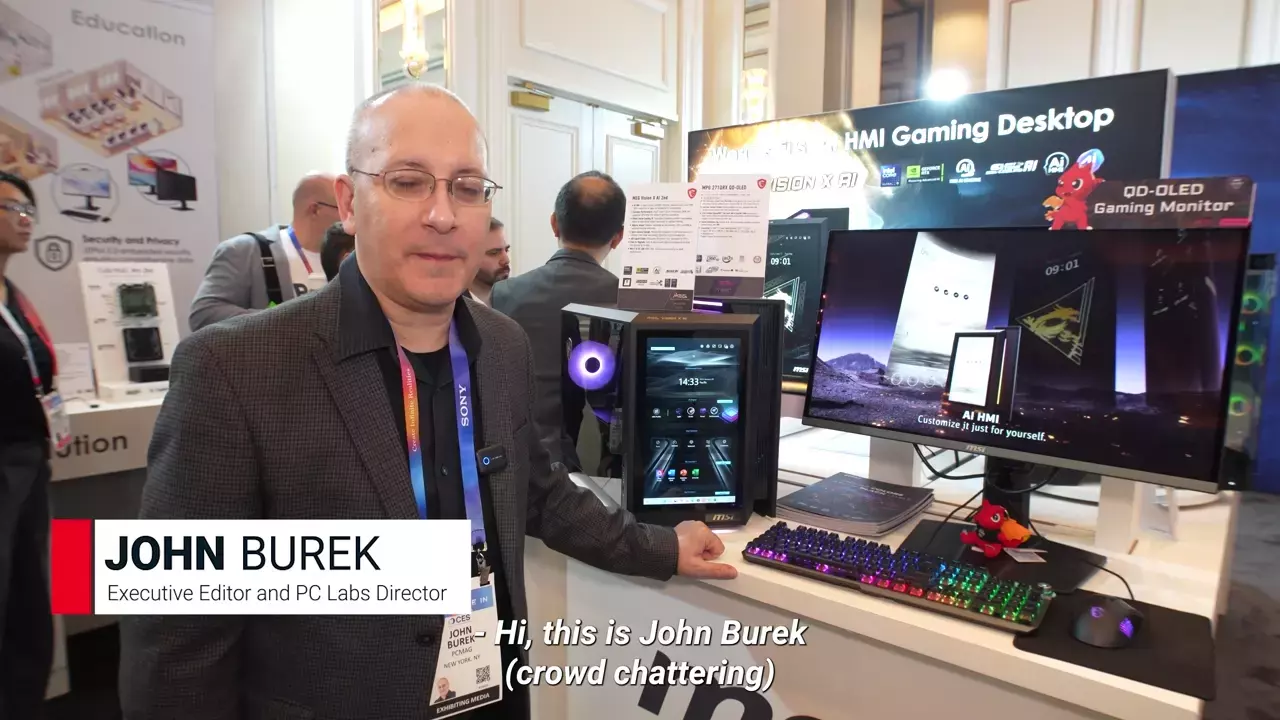


Hands On With MSI’s MEG Vision X AI Desktop: Now, Your PC Tower’s a Monitor, Too
We first got a look at the (confusingly named) Vision X AI 2nd at Computex 2024, before seeing it again in a more developed state at CES. It’s a sizable and powerful gaming desktop in its own right, but its calling card is a 13-inch touch display on the front panel. This full HD panel can be used to show system diagnostics, apps, or even as a second monitor. The “AI” and “2nd” in its name refer to the NPU-bearing Arrow Lake 200 processors inside, while top-end Nvidia GPUs power gaming and graphics workloads.
The main update about how this fared in 2025? It finally went on sale as a finished product, though stock is limited and configurations cost many thousands of dollars. (MSI is currently selling one model on its website for $5,499). We didn’t review it ourselves yet, but it is now available for interested enthusiasts. —Matt Buzzi
CES 2025’s Best Gaming Gear: Lenovo Legion Go S


(Credit: Joseph Maldonado, Lily Yeh)
The Lenovo Legion Go S is a system full of potential, but when I finally got my hands on the Windows 11-powered handheld, its gaming performance ultimately let me down. The AMD Ryzen Z2 Go processor proved too underpowered to deliver substantial gains over its predecessor and inherited much of its predecessor’s clunkiness. However, Lenovo rectified most of the system’s flaws with the release of a SteamOS variant. With Windows 11 out of the picture, games performed far better than they did on the Windows-powered Go S, and it’s our recommendation for Steam Deck users looking to upgrade their system. —Zackery Cuevas
CES 2025’s Best Prototype: MSI Project Zero X
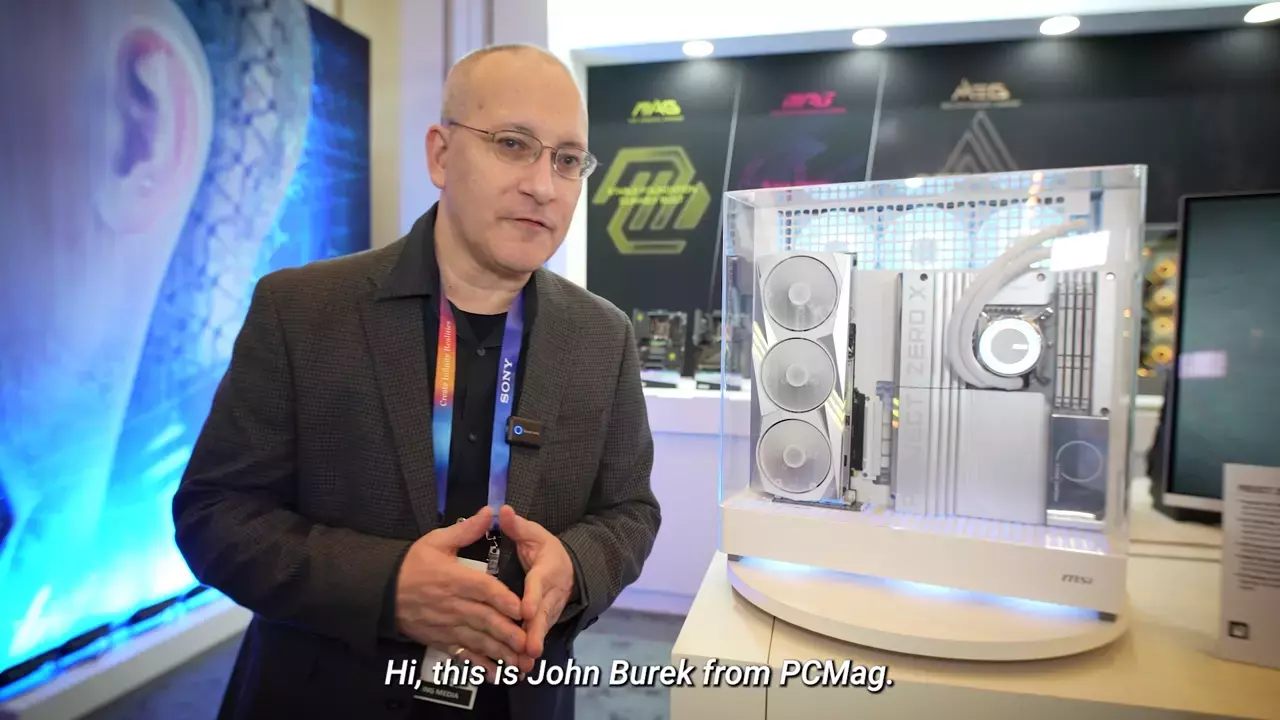
Sneak Peek: MSI’s Project Zero X Takes Clean PC Builds to the Absolute Extreme
MSI’s Project Zero X was an experimental “what next?” iteration on the company’s Project Zero, an initiative for PC building that enables super-minimalist, clean-looking desktop PCs. Project Zero uses motherboards with connectors on the underside of the PCB to let you hide all the PC’s internal cables behind the board. CES 2025’s Project Zero X took that to another level, with the whole board front covered in fancy heat sinks and the usual rear-edge panel of I/O ports—for monitor, audio, USB, and the like—relocated to the actual back of the board too, letting you put this PC, say, up against a wall with nary an external cable in sight, either.
Predictably, though, Project Zero X has not seen the light of day beyond a trade show. The board we saw is highly proprietary, as was the outer chassis. With no sign of new Zero X-style boards or cases, the original “Zero” is all you can buy today. We’ll be on the lookout for any Zero X developments at CES 2026, though. —John Burek
CES 2025’s Best Tablet: Lenovo Legion Tab Gen 3


(Credit: Iyaz Akhtar)
Lenovo’s Legion Tab Gen 3 impressed us at CES 2025 and again in May when we reviewed it. This gaming-focused tablet is small yet powerful, thanks to a Qualcomm Snapdragon 8 Gen 3 processor with a dedicated vapor chamber to manage thermals and 12GB of RAM to run applications. We really like its pixel-rich screen, which measures 8.8 inches and has 2,560-by-1,600-pixel resolution and a smooth 144Hz refresh rate for fast gaming action. In our review, we called it a “small tablet with big power,” and that’s exactly the experience it delivers at a reasonable $389. —Iyaz Akhtar
CES 2025’s Best Mobile Device: HMD OffGrid

(Credit: Lily Yeh; HMD)
The HMD Offgrid showed a lot of promise at its CES 2025 debut. This puck provides basic satellite SOS functionality for any smartphone across North America, Europe, Australia, and New Zealand. The idea is to allow for connectivity in backcountry regions where traditional cell service isn’t available, enabling emergency communications if needed. While the puck itself is inexpensive at $149.99, the associated service fees tally up quickly, according to subscriber reviews. Moreover, those who purchased and used the Offgrid suggest that customer support is limited and connectivity is inconsistent. Although the product is still available for sale, it appears that it never gained traction. The good news is that many US-based smartphone users have access to emergency satellite-based SOS services from their carrier, or even directly from Apple (if they have an iPhone). —Eric Zeman
CES 2025’s Best Smart Home Tech: Roborock Saros Z70

(Credit: Roborock)
For something as seemingly future-tech as a robotic arm on a vacuum, the Saros Z70 didn’t take long to come to market. I reviewed it mere months after it wowed us at CES. In practice, the robot arm needs another generation or two to bake, as it currently only works with a few objects and only on hard floors. It’s more of a novelty than a useful extra, and the underlying robot vacuum itself isn’t worth the premium $2,599 list price. —Andrew Gebhart
CES 2025’s Best Privacy Product: Ultraloq Bolt Mission UWB + NFC

(Credit: Maria Diaz/ZDNET, Lily Yeh)
The Ultraloq Bolt Mission isn’t out yet. Ultraloq is still around, and so we might find out more about this lock and its release date at the upcoming show. It still sounds cool, with its unique combination of ultrawide-band and NFC tech that lets your door sense your precise location for automatic unlocking. The company’s name holds prestige, as it has another lock on top of our current best list. So, I’m holding out hope that this one hits retailers soon and lives up to its promise, even if the eventual delivery is later than we initially hoped. —Andrew Gebhart
CES 2025’s Best Wellness Tech: Ozlo Sleepbuds

(Credit: Ozlo)
Combining noise cancelling with a comfortable design, the $349 Ozlo Sleepbuds are meant to help you seal yourself away from the world when it’s time to get some shuteye. They did indeed launch after impressing us at CES. Two of our sister sites, ZDNET and Mashable, have reviewed the buds. Ozlo won an Editors’ Choice award from the former and a score of 3.8 (out of five) from the latter, with both praising their comfort and docking them for the slow launch of their promised sleep tracking feature. —Andrew Gebhart
CES 2025’s Best Wearable: Circular Ring 2


(Credit: Circular)
Adding to the growing category of smart rings with cool new features like taking an ECG and detecting atrial fibrillation from your finger, the Circular Ring 2 was also promising at CES for its simplified, app-based system for judging your ring size. The Circular Ring 2 did come to fruition in 2025, but our sister site ZDNET noted some meaningful shortcomings that made its appealing $249 price less attractive, such as a laggy app, slow syncing, and inaccurate data. —Andrew Gebhart


Get Our Best Stories!
Your Daily Dose of Our Top Tech News


By clicking Sign Me Up, you confirm you are 16+ and agree to our Terms of Use and Privacy
Policy.
Thanks for signing up!
Your subscription has been confirmed. Keep an eye on your inbox!
CES 2025’s Best Smart Glasses: XReal One Pro


(Credit: Will Greenwald)
The XReal One Pro stood out at CES 2025 for its still-impressive 57-degree field of view, but that isn’t why it ended up earning our Editors’ Choice for AR smart glasses, or why it’s become a regular part of my travel gear. Its head-tracking enables an ultra-wide mode that simulates a 3,840-by-1,080 monitor, which is big enough that you’ll need to turn your head to see everything. It’s incredibly useful if, like me, you need either two monitors or an ultrawide to get any work done. XReal is working on more impressive projects, like the Android XR-powered Project Aura development kit. But for now, the XReal One Pro is just an excellent wearable display to use away from your desk. —Will Greenwald
CES 2025’s Best Headphones: JBL Tour One M3


(Credit: Christian de Looper)
These over-ear headphones from JBL packed a wireless transmitter in the case, allowing you to stream audio content from just about any source. Think airplane in-seat entertainment systems or even your record player at home. As long as you have a 3.5mm or USB-C port available, you can pair the JBL Tour One M3 headphones and enjoy. This feature led to their award and CES 2025, and we still found it compelling once the headphones reached the market in April.
But connectivity isn’t everything: The Tour One M3 headphones have 40mm Mica Dome drivers that produce rich sound, eight microphones to handle calls, active noise cancellation, lossless audio, and spatial sound. The noise cancellation wasn’t the best we’ve tested, but it was decent enough. In our review, we also appreciated the extensive 70 hours of battery life per charge and their support for new Bluetooth technologies, like Auracast. Perhaps the only bummer is that tariffs increased the price from $399.99 to $449.99 shortly after they reached the market. —Eric Zeman
CES 2025’s Best TV: LG G5 OLED TV

(Credit: Will Greenwald)
My colleague David Katzmaier was right when he pinned down the LG G5 as the best-looking TV at the show that year, which is why both and PCMag (me personally) gave it high marks when we were able to test it ourselves. If anything, I ended up liking it even more, awarding it 4.5 stars and an Editors’ Choice for its picture quality. It’s the brightest OLED I’ve ever tested and looks fantastic. I’d still recommend LG’s C5 (another Editors’ Choice, and the successor to the C4 I use at home) to most shoppers for its also-excellent picture and significantly lower price. —Will Greenwald
CES 2025’s Best Transportation and Mobility: Honda 0 Series


(Credit: Emily Forlini)
Honda’s two funky electric cars are currently in development, and the SUV model is on track for a 2026 North American launch, Honda tells us. In October, the Japanese automaker unveiled an updated prototype of it in Japan—and the sleek, futuristic silhouette would certainly make waves on the road. The Saloon, a sedan model that’s likely to be less popular in the US, has been pushed back to 2027. —Emily Forlini
Recommended by Our Editors
CES 2025’s Best AI: Nvidia Cosmos

(Credit: Lily Yeh; Nvidia)
Last year’s top AI announcement from CES wasn’t a chatbot or an AI-infused gadget. Instead, it was a unique foundation model, Nvidia Cosmos, which was developed as the first “world foundation model” built not for generating images or carrying on conversations, but to simulate and replicate the physical world to train future robots, self-driving cars, drones, and other autonomous tech. Instead of real-world training in closed courses and lab conditions, this model would accurately replicate those conditions virtually, allowing robots to be trained virtually. As we said last year, this virtual sandbox “could be the platform that enables future CES innovators…for years to come.”
One year later and this ambitious project has matured considerably. Since that CES announcement, the model has been released as open source for easier downloading and deployment. Major updates have introduced prediction capabilities, embedded reasoning agents, controllable world generation, and support for large-scale synthetic data generation. And companies are already taking advantage of it. Top robotics and AV companies, including 1X, Agile Robots, Agility Robotics, Figure AI, and Uber, were early adopters of the platform, and it’s part of the training and simulation loop for many more major robotics and autonomous vehicle programs. It may not be the kind of flashy consumer-facing technology that people see in reviews and ads, but it’s already a major part of the future that’s being built.—Brian Westover
CES 2025’s Best Monitor: Asus ProArt Display 6K

(Credit: Joseph Maldonado)
The Asus ProArt Display 6K PA32QCV demonstrated its mettle in our testing, following up on its Best of CES 2025 with a four-star review and a PCMag Editors’ Choice. It has proven itself a capable and far more cost-effective alternative to the Pro Display XDR, which has the same screen size and resolution, although not quite matching the elite performance of Apple’s 6K flagship monitor. We’ll see how the PA32QCV stacks up against a new wave of 6K displays now coming through PC Labs. —Tony Hoffman
CES 2025’s Best CPU: AMD Ryzen 9 9950X3D

(Credit: Michael Justin Allen Sexton)
The AMD Ryzen 9 9950X3D looked impressive on paper when it was announced during CES last year. When it launched in April 2025, test results showed the Ryzen 9 9950X3D to be arguably the fastest consumer processor of the year. In gaming, it has no real competitor, and only the Intel Core Ultra 9 285K can offer competition against the 9950X3D in non-gaming workloads. The Ryzen 9 9950X3D remains the fastest CPU for consumers to date, and there are no signs of a new strong competitor emerging soon, so the Ryzen 9 9950X3D is set to hold this position for some time to come. —Michael Justin Allen Sexton
CES 2025’s Best SSD: Crucial P510

(Credit: Joseph Maldonado)
Following up on the elite-performing but energy-hogging Editors’ Choice Crucial T700 and T705, which require substantial heatsinks to avoid thermal throttling, Micron’s latest PCI Express 5.0 SSD, the Crucial P510, is a more mainstream, power-efficient model that ships with a simple heat spreader. While the P510 is a capable model, its performance numbers were more sedate than its predecessors in our testing, allowing Sandisk’s WD Black SN8100, which combines energy efficiency with record-setting benchmark numbers, to wrest PCMag’s PCI Express 5 SSD crown away from the Crucial line. —Tony Hoffman
CES 2025’s Best PC DIY Product: Corsair Frame 4000D Modular Case

(Credit: John Burek)
Our favorite PC DIY product at CES 2025, this Corsair case didn’t take long to get into our hands and on the market. The Frame 4000D received a four-star rating in our February review, and the chassis proved to be a solid entry, thanks to its unique front panel and easy build experience. It’s something of a budget model, and even more so since launch. Discounted widely at this writing to $99 and equipped with three ARGB fans, it’s a good bet for a first-time PC builder these price-sensitive days. —John Burek
CES 2025’s Best for Sustainability: Flint Paper Battery

(Credit: Flint)
Flint has not posted any news on its site since December 2024—right before last CES—but that’s not because it’s gone belly up like startups tend to do. Quite the opposite. The Singapore-based company started producing its first two battery products in early 2025, CEO and Founder Carlos Charles tells us, and has “collaborations with leading brands, including Logitech, Amazon Devices, Apple, and others.” More details to come at CES 2026. —Emily Forlini
CES 2025’s Most Unexpected: Kirin Electric Salt Spoon

(Credit: Will Greenwald)
One of the oddest gadgets to get attention at the show is Kirin’s electric spoon, which sends a low-intensity electric current through your tongue to make salty and umami flavors pop more without using as much actual salt. It’s an interesting idea, and as someone who’s licked his share of 9-volt batteries, I see the logic behind it. And, as far as I can tell from the slew of CES 2025 news stories highlighting it and very little other English-language coverage, it never came to this side of the Pacific. Vendors on eBay are selling it for $200 to $300 if you really want to get one, though. I’m more of a Kiuichi man than a Kirin one myself, anyway. —Will Greenwald