In some ways, SEO in 2025 was “quieter” than SEO in 2024:
There weren’t as many major algorithm updates (as outlined above), and the biggest stories in 2025 were essentially around the continued evolution of things that started in 2024:
- AI Overviews in Google search results.
- Continued development of AI Mode (with a more aggressive rollout into Google search results looming).
- The rise of AI players like Perplexity, OpenAI, etc., and “AI SEO” or “GEO.”
While these existed as updates or trends in 2024, they all continued to evolve in 2025, and there are a lot of key takeaways from each for 2026 and beyond.
Contents
- AI Overviews grew
- AI Mode rolled out
- Algorithm updates produced winners (and losers)
- AI SEO and GEO drove competition
- We saw the end of &num=100
- Google Ads looked different
- Reddit continued growing in search results
- AI-generated content and parasite SEO increased
- Google changes impacted local businesses
The biggest SEO updates in 2025 (+What they mean for 2026)
We’re breaking down the biggest changes, updates, and upsets that impacted SEO in 2025 and sharing what it’s all going to mean for the new year.
1. AI Overviews grew substantially
There have been a number of different studies on the growth of AI Overviews (AIOs) in search results. BrightEdge monitored queries from May 2024 to September 2025 and found a jump from 26.6% of queries showing AIOs to 44.4%.
I like to run some general queries for different types of searches to help determine how AIOs are showing up.
For instance, in January of 2025:
- 312 of the top 1,000 “What is” queries triggered AI Overviews.
- Only one of the top 1,000 “Roofing company in” queries had an AI Overview (and it was for “how to start a roofing company in Texas”).
As of December 2025, those numbers were:
- 794 of the top 1,000 “What is” queries triggered AI Overviews.
- Only five of the top 1,000 “Roofing company in” queries had an AI Overview (and those that did were for things like “how to start a roofing company in Texas” or “largest roofing company in X”).
So overall, AI Overviews are impacting a LOT more search results, and if you were targeting a lot of top funnel queries, you might have seen the aggressive rollout of AIOs in 2025 completely change search results (and traffic and leads) for your business in 2025.
This led to the initial “great decoupling” of Google Search results in 2025, which essentially referred to the phenomenon for many sites where they would see a massive spike in impressions and a drop in clicks:
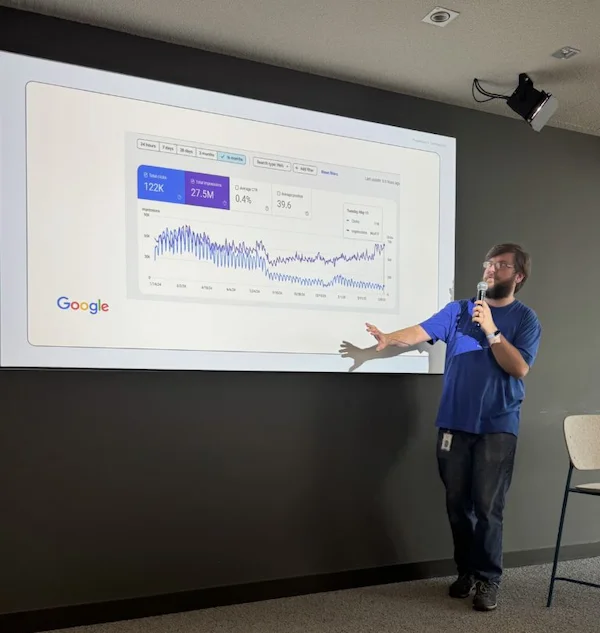
Source
This was followed by Google removing &num=100 (more on this later in the article), which led to speculation that maybe there was no real decoupling after all.
Nevertheless, many sites experienced a significant decline in traffic to top-funnel terms due to the rise of AIOs.
On the other hand, some sites’ search results fell into that “60+%” of search queries (based on the BrightEdge data) that remained unimpacted by AIOs.
And, to throw another wrench in the works, late in 2025, Google did start experimenting with more and differently displayed links in AIOs:
Seeing more and more links in Google’s AI Overviews! – This one has 7 in-content links directly to the source material!!
This is amazing.
Big shoutout and thanks to @sundarpichai credit where it is due, this could keep the open web thriving for decades to come.
If @sama… pic.twitter.com/lcMh6E0nzg
— Joe Youngblood – SEO, Futurology, AI, Marketing (@YoungbloodJoe) November 25, 2025
What does all of this mean for your business or site?
A few key takeaways:
- Identify the business-driving queries that your prospects are searching for that don’t have AIOs, and attack those.
- For queries that do have AIOs: use schema markup, make your answers succinct and consistent with the format being cited in AIOs, and monitor the types of content Google is citing prominently in AIOs to capture as much of that traffic as possible.
- Look at best practices for being featured in search or generative engines outside of Google, particularly as those tools gain share versus Google.
🔎 Get updated tips for your SEO strategy with our free guide >> How to Do SEO Right—Right Now!
2. AI Mode rolled out
Right now, AI Overviews are significantly more impactful in terms of actual traffic and business results than AI Mode in Google search.
AI Overviews are the AI-generated answers currently being layered into a standard Google search:
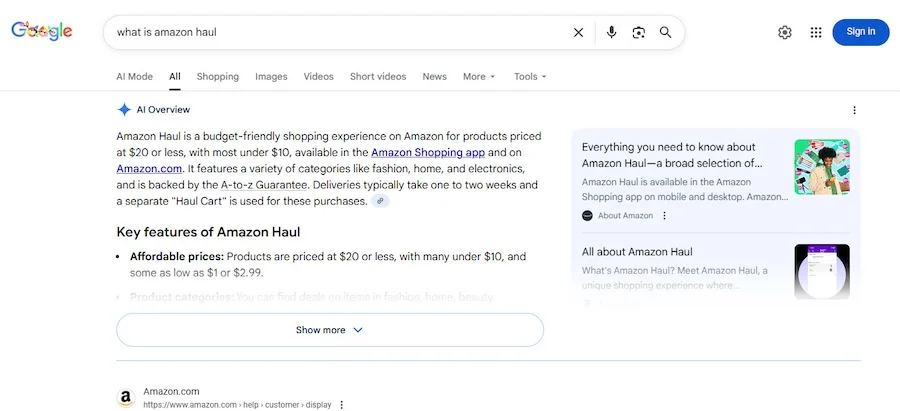
While “AI Mode” is still something a user needs to toggle over to in order to experience:
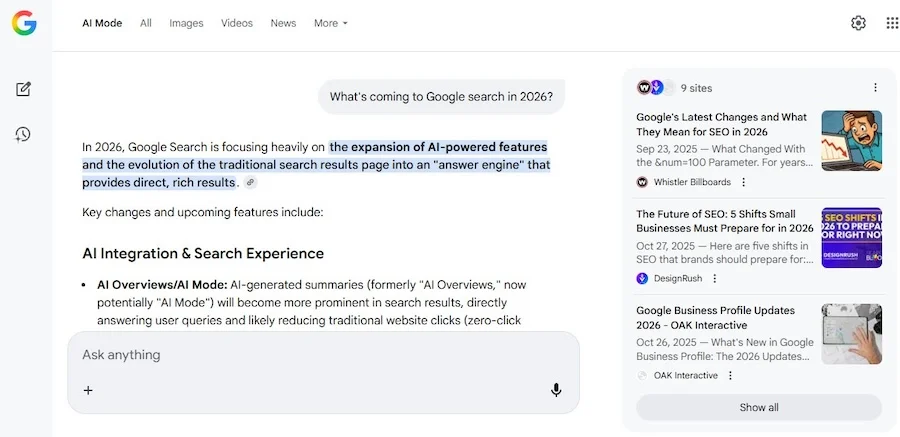
As you can see, AI Mode is more like a generative engine experience you’d have using tools like ChatGPT or Perplexity, versus AI Overviews, which feel more like AI answers layered on top of a standard Google search.
AI Mode has been introduced in different ways throughout 2025:
- As part of Search Labs in March
- Available to non-labs users (as a tab in Google search) in May
- Available in 180 countries in August
In a Q2 investor call, Google CEO Sundar Pichai revealed that AI Mode had 100 million users. While that’s an impressive number, AI Overviews at the time was being used across 2 billion searches a month.
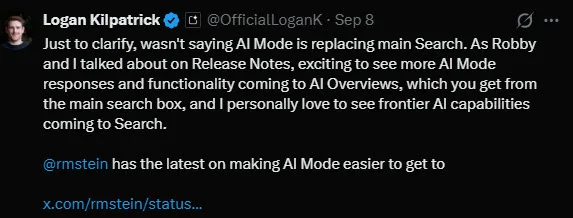
All of that said, Google’s Lead product for Google AI Studio & Gemini API seemed to indicate AI Mode may become the default search experience on Google.com:
soon : )
— Logan Kilpatrick (@OfficialLoganK) September 5, 2025
He then clarified that he meant that more AI Mode features would be implemented into AI Overviews and Google search:
While Google’s Chief Scientist, Google DeepMind & Google Research, Jeff Dean, demonstrated in November how Gemini 3 in AI Mode could change your UI experience based on your query:
As an example of how we are building on top of Gemini 3, AI Mode in Search now uses Gemini 3 to enable new generative UI experiences, all generated completely on the fly based on your query. Here’s how you might use this to learn a complex topic like how RNA polymerase works. pic.twitter.com/5NwQ3pNrmC
— Jeff Dean (@JeffDean) November 18, 2025
Why is this so important? Because it’s a signal that Google search is likely to undergo substantial changes in the coming months and years.
Knowing that Gemini will be powering things like the overall UI of search results, AI answers, and more means it’s important for search marketers and business owners not just to understand how AIOs work, but also how AI Mode returns results, answers questions, and determines the best UI for specific tasks or queries.
3. Algorithm updates produced winners (and losers)
While major algorithm updates were fewer and further between, you wouldn’t feel like they were diminished if your site was negatively or positively impacted by them.
As usual, with each core update, Google referenced existing documentation with vague advice about creating great content. While much of the time Google doesn’t follow their own guidelines and just “assessing your own content” won’t be good enough, their core update documentation does actually have some good advice for troubleshooting traffic drops:
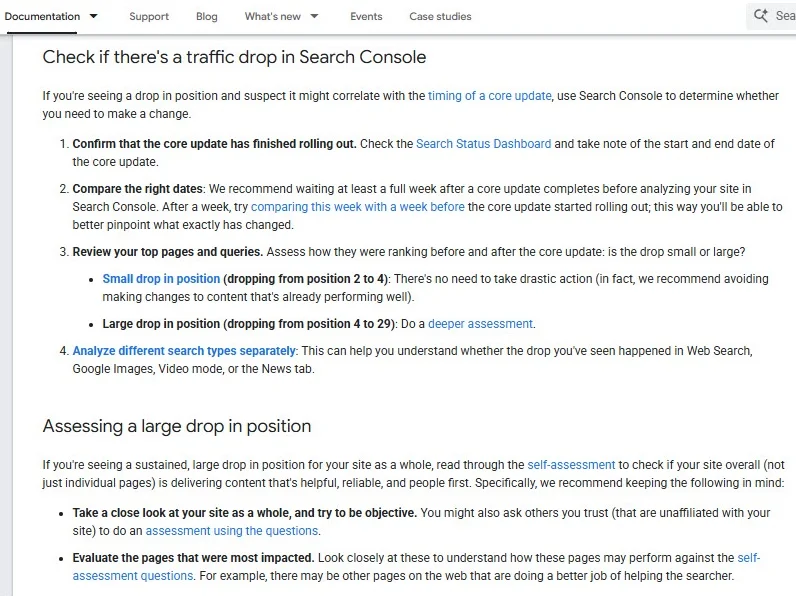
The June core update led to a series of reported recoveries, particularly from sites that had been impacted by the Helpful Content Update.
The August spam update received a similar treatment, with vague documentation telling impacted sites to review Google’s spam policies.
In addition to the spam update and broad core updates, there were several smaller updates over the course of the year.
So what can businesses and site owners take away from the 2025 algorithm updates?
- Thin, lower-value, unrelated top-funnel content with poor engagement metrics is continuing to get hit in algorithm updates.
- Google continues to be biased towards ranking your site in areas it believes you have topical expertise around.
- Having a high ratio of lower-quality links with aggressive anchor text (particularly on a lower authority site) can get you into trouble with spam updates.
The inverse of this is basically what you can do for your site to try to stay out in front of future core algorithm updates:
- Stick to the core topic areas Google ranks you for.
- Build out deep topic clusters around new topics you want to target.
- Eliminate pages on your site that are off-topic and/or have poor engagement metrics (low visitors, low click-through rates, high bounce rates).
🕵️ We surveyed over 300 SMBs about their SEO and website challenges. Find out what they said and what you need to know for your strategy in our 2026 Website Trends Report >>
4. AI SEO and GEO drove competition
In August of 2024, ChatGPT reported it had 200 million weekly users.
As of October 2025, the number was 800 million.
These numbers–the growth trajectory, particularly–are impressive, but it is worth noting that as far back as 2024, Google already boasted “six products with more than 2 billion monthly users, including 3 billion Android devices. 15 products have half a billion users. And we operate across 100-plus countries.”
That said, innovation around AI products was fast and furious in 2025, with the introduction of many developments that could impact Google search share, like:
- AI-centric browsers from ChatGPT and Perplexity
- New players like Deep Seek
- The rise of tools like N8N and ChatGPT’s AgentKit
Some of these innovations will impact Google directly (some share will go to people who will search for answers to questions on ChatGPT or Perplexity), and some will have a more indirect impact. For instance, a task someone was trying to complete, which may have caused them to run multiple searches, may be something an agent (or a series of agents) can complete end-to-end, eliminating a whole string of searches.
For business owners, the key takeaway here is to stay on top of how your customers are collecting information and executing tasks.
You may need to show up in more places than just Google–but you may still be getting the lion’s share of your traffic from Google.com. It’ll likely be very niche-dependent again, particularly in the short term.
🤖 Want to use AI the right way? Free download >> The Complete Guide to AI for Marketing
5. We saw the end of &num=100
Before September 2025, users were able to append &num=100 to the end of Google search results to have 100 results returned at a time.
In September of 2025, Google removed this functionality.
This was a tactic that third-party tools like Ahrefs or Semrush were using to determine how sites ranked beyond the first page of results.
For an average small business owner or site owner, this change didn’t mean anything at all. It didn’t change the actual traffic sent to sites, and many users wouldn’t have noticed it in reporting. But for tool companies and a lot of SEO practitioners, it had a major impact.
For anyone monitoring search query data: sites reported 87.7% drops in impressions and 77.6% fewer queries.
Many have suggested that the previously mentioned “great decoupling” wasn’t actually more impressions from AIOs, but rather inflated impressions from third-party tools tracking placement in search results (and in AIOs).
Why does this matter for business and site owners?
What data you get from where is going to change quickly:
- Tools like ChatGPT may share different data in different ways as their incentives change (e.g., if they roll out ad products and/or more robust shopping products).
- What Google shares and how will change based on how it competes with OpenAI and other products.
- How third-party tools position data and what they deem as important for your business will shift and change in the coming months.
Make sure you understand the core KPIs for your business and stay on top of the best ways to make sure you’re accurately attributing those KPIs to the right channels.
6. Sponsored results looked different
Google changed how it displays sponsored results, making ads look much more like organic listings. Here are ads:
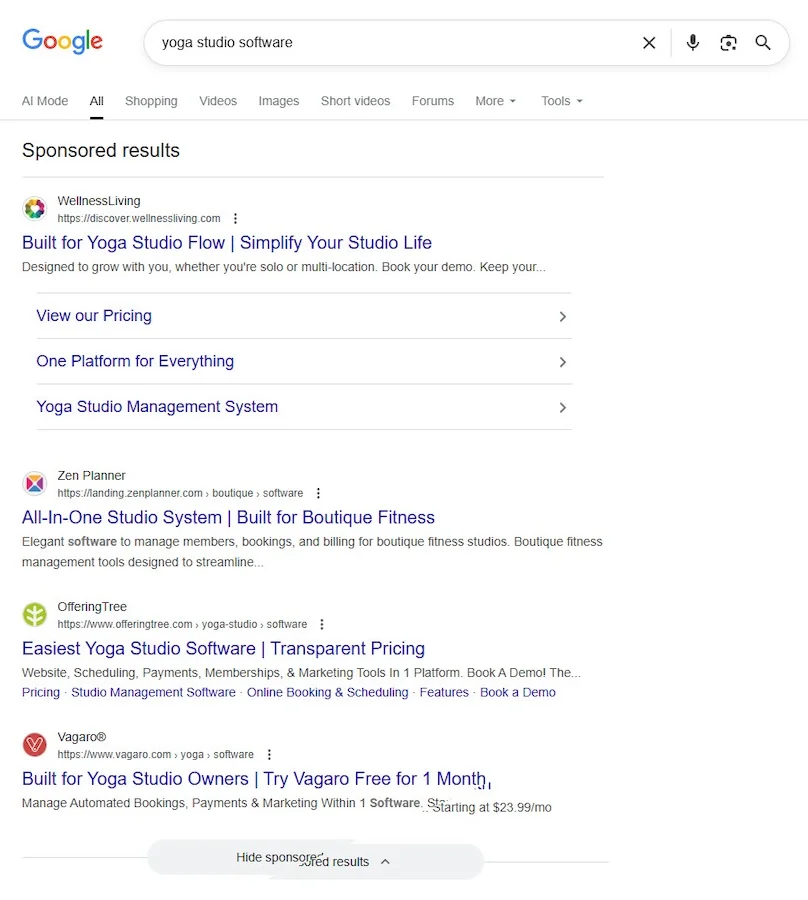
And here are organic listings:
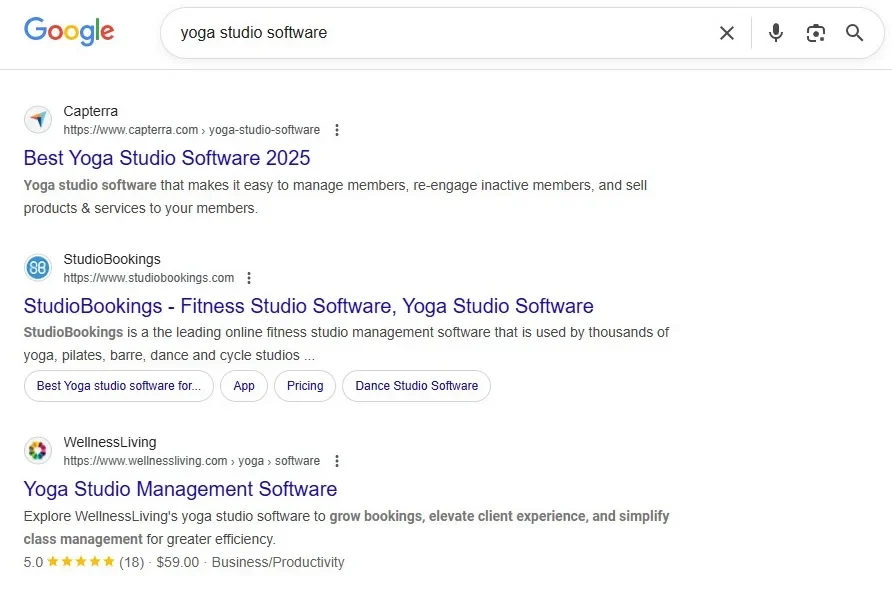
Watching how Google structures things in your search results will be crucial for businesses in 2026. You may need to consider:
- Buying ads in SERPs you didn’t previously.
- Adjusting the terms you’re targeting and the content you’re creating.
- Thinking about how your brand and your content can be integrated into multiple layers of search results.
🛑 Want to learn more about successful search engine marketing on Google? Get the free guide >> PPC 101: Complete Guide to Google Ads
7. Reddit continued growing in search results
While there was some back and forth on how much Reddit was featured in OpenAI results, their Google search traffic continued to climb in 2025:
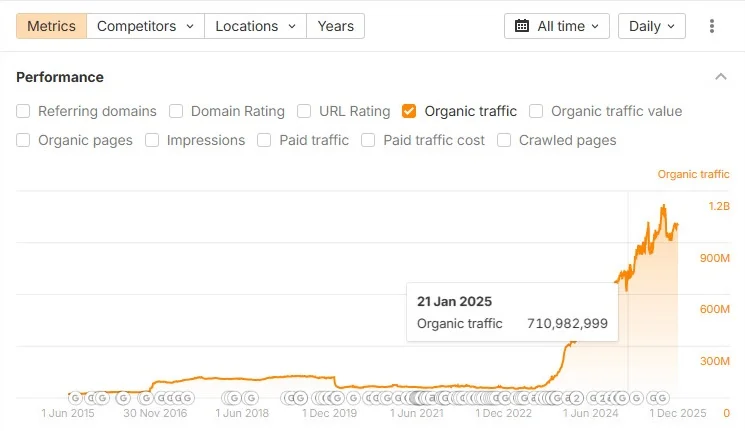
And generally, many forum and tool-focused sites continued to see traction in 2025. What does this mean for your brand coming into 2026?
Commenting, moderating, and monitoring your brand on Reddit may be an opportunity. Forum content and tool content that’s a fit for your brand may also perform well.
You can also use Reddit for things like tool ideas, content ideas, or keyword research, as it’s such a major powerhouse in Google search results.
8. AI-generated content and parasite SEO increased
While there are varying data points about how much of the web’s content is now AI-generated, it’s clear that the number has exploded in recent years. Some studies:
- ~30–40% of active web text is estimated to be AI-generated.
- 74.2% of new webpages in April 2025 contained some AI-generated content.
- ≈ 50.3% of newly published English-language articles in late 2024 were primarily AI-generated.
In conjunction with this, Google continues to reward sites with a lot of authority, and SEOs continue to build content on those sites designed to rank quickly and for competitive phrases (increasingly, using AI-generated content).
This has a few implications for businesses in 2026:
- You likely need to think about and work on leveraging AI tools to create content, without getting your site into trouble.
- You need to think about showing up on third-party sites (like Reddit, but across other parasite SEO opportunities as well) for reasons beyond just protecting your brand.
- You need to monitor how Google reacts to these realities–if the quality of AI content gets to be perceived as too low, or parasite SEO becomes too prevalent, we may see major reactions in the form of algorithmic updates.
9. Google changes impacted local businesses
Google also rolled out some changes that impacted traffic for locally focused businesses:
- A diversity update, which made it more difficult to rank for both map pack and organic listings.
- More AI Overviews in some locally focused search results (although again, this can be very niche-dependent).
- Some chatter that generally ranking in organic search results (rather than the map pack) has become even less valuable in terms of traffic and leads in 2025.
What this means for locally focused businesses is that while not much changes:
- Optimizing your Google Business Profile should be even more of a focus coming into 2026 (get reviews, keep your profile updated, and be sure your information is filled out and accurate).
- Growing your brand locally so that you’re synonymous with the service and area you serve is even more important (nailing citations, building links, local PR), so that you’re well-positioned to show up in AI Overviews and Gemini responses as they’re more and more prevalent in Google search
What does this ALL mean for 2026?
The good news is that while things are changing fast in recent months and years, many of the fundamentals that will help your site drive traffic, leads, sales, and revenue are the same:
- Becoming a popular brand that’s closely aligned with a specific product or service (PR, word of mouth, general authority).
- Creating content that specifically answers questions (though the types and volume of this content have and will continue to change).
- Monitoring Google (and now other generative engines like ChatGPT and Perplexity) for updates and to understand what works and what doesn’t for getting visibility.
And in addition to a lot of the fundamentals continuing to work to grow your brand in 2026, all of the changes will open up new avenues for growth (for companies that are paying attention) as well.