When you think of Motorola, what comes to mind? It is easy for pieces that marked an era to appear, from the StarTAC to the Razr V3, or even that attempt to recover the premium experience with the foldable Razr of 2019. That legacy lives on, although it has not always been accompanied by a perception aligned with the brands that dominate the highest range. In recent years, Motorola has worked to translate that heritage into a contemporary premium identity, supported by design, materials and its own style.
This duality between what Motorola represents today and what it aspires to be opens a natural question: how does the company interpret this moment? To answer it we spoke with Fabio Capocchivice president and general manager of Motorola for Europe, the Middle East and Africa within the Mobile Business Group, the unit that concentrates the brand’s smartphone strategy in the region. He assumed the position in 2022 with the aim of accelerating its growth in an increasingly competitive market. He lives in Spain and has an extensive career in the technology sector, with stints at EPSON, ASUS and the Lenovo group.
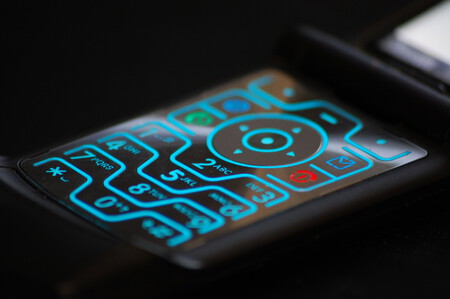

The Motorola Razr V3, the icon that defined the brand’s most premium era
Before entering into its vision, it is worth stopping for a moment at the point where Motorola is beyond what we have expressed in the first lines of this text. The company reaches this stage with real growth, a more defined identity and a catalog that expresses better than ever who it wants to be. It is not the gigantic Motorola of the 2000s, but nor is it a brand that has lost focus.
In 2024, the company’s shipments grew 24% year-on-year, according to Counterpoint Research, reaching its highest historical figure for smartphones. Even so, it remains far from the global podium, dominated by Apple, Samsung and Xiaomi, and moves in single-digit shares.
The contrast with his past is evident. In the mid-2000s, in the era of the Razr, Motorola became the second largest mobile phone manufacturer in the world.with shares greater than 20% and only behind Nokia. Since 2014 it has been part of Lenovo, which bought it from Google for $2.91 billion. Today it is no longer that giant, but a firm in the reinvention phase: smaller in share, but with sustained growth, a strong commitment to narrative lifestyle tech.
Motorola is transforming, and the Edge 70 plays a key role in that process
At the beginning of the interview, Fabio reviews the moment in which Motorola redefined its approach for Europe and for other territories where the brand wanted to advance. He explains that they detected that “something was missing” in the market: a proposal with its own identity, with recognizable values and a defined DNA. From there, the intention was not to add to the usual dynamics of the sector, but to strengthen a clearer brand personality.
That idea is condensed in a phrase that stands out in the conversation: “The challenge has been not to be a ‘copy paste’ of the competitionnot making a race on the technical specification.” From there, he explains that the priority has been “to try to talk about the end user, with a unique, very striking DNA”, with devices that are not defined only by numbers, but by the feeling of using something with its own character.

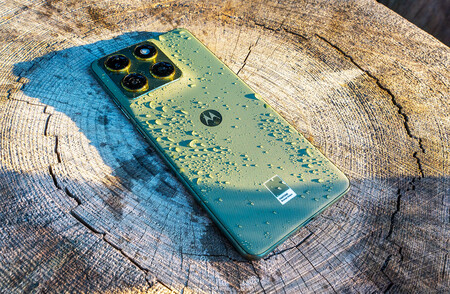

The new Motorola Edge 70 | Photo: WorldOfSoftware
For Fabio, design is not an accessory element, but rather an aspect that has guided Motorola’s recent evolution. It speaks of a commitment to materials that generate different sensations, such as vegan leather, and of a chromatic work that they develop together with Pantone to identify colors that connect better with users. This effort seeks to express a more defined and coherent identity with what the brand wants to project today.
“We have created a premium product and to be premium you have to have a premium aesthetic, it has to be in some way a little disruptive. In this sense we have created an incredibly light, thin product without any compromise. So with this product we want to put within a single product, and we want to see that every time we create a product, all our experience and all our DNA that we developed over the years, which is why it can be clearly identified as a Motorola DNA product, with an absolutely incredible technical sheet.”
Fabio gives us to understand that the Motorola Edge 70 should function as the meeting point between design and functionality. He explains that the brand was looking for a very light and very thin device that, even so, offered more battery than other reference models. The Edge 70, which we have been able to analyze in WorldOfSoftware, integrates a 4,800 mAh battery, one of the most notable aspects of this ultra-thin mobile. That balance, he assures, is what allows the product to faithfully represent the direction that Motorola wants to consolidate at the top of its catalog.

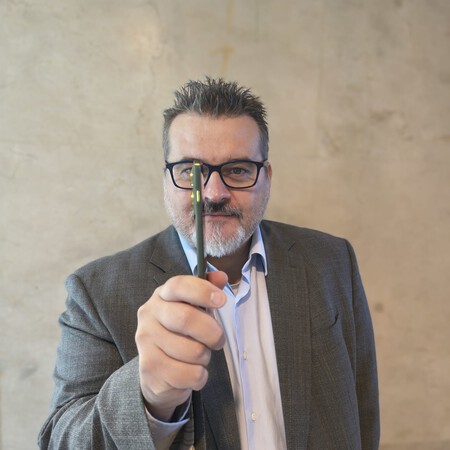

Fabio Capocchi, general director of Motorola for EMEA, with the new Edge 70 | Photo: Motorola
Throughout the interview, Fabio insists that this launch is not born from an isolated decision, but from an accumulated process of design, engineering and brand vision. Describes the Edge 70 as the synthesis of those years of work and the involvement of the team. And when we ask him for a definition in a few words, he answers:
“I believe that the Edge 70 for us represents our maximum effort to summarize within a product the last three years of development, which range from the design part, the technological part, but also the part of people’s passion (…) for such a fine design, but with a product that is cool to see (…) we have done miracles to change the design of the motherboard and, finally, which for me is the most important thing, is the passion that people are putting.”

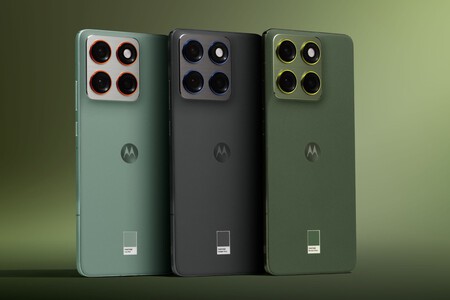

The Edge 70 represents Motorola’s most premium bet to date | Photo: Motorola
Spain appears in the conversation as a mirror in which Fabio recognizes elements that, according to him, also define Motorola: history, vitality and a very marked identity palette. That parallel sums up the way he interprets the evolution of the brand and the emphasis on design, color and style that sustains his lifestyle tech vision.
“Europe is a source of global inspiration. In Spain, for its part, you find everything, and it is a super-active, super-cheerful, very solar country and at the same time has a lot of history. And if I am going to make a parallel with Motorola, it seems to me that we are hand in hand, because Motorola invented what the mobile phone is. Now, returning to this parallel with Spain, I like it because Spain is very full of important history and has this second youth, but full of life, which coincides with us.”


Motorola reaches this stage with a legacy that weighs and with an ambition that aims higher than in previous years. From the icons of the past to the recent foldables and now to the Edge 70, the company is trying to reinforce its own identity at the top of its catalog, with a clear ambition in the premium field. From the outside, the challenge does not seem to be maintaining the pace of growth, but rather make your way in aspirational terrain which, for many users looking for a mobile phone with presence, continues to be dominated by Apple and Samsung. If this change in perception takes hold, we will see it over time.
Images | Motorola | WorldOfSoftware | Lemsipmatt (CC BY-SA 2.0)
In WorldOfSoftware | The POCO F8 Pro and F8 Ultra are a great change of direction for the brand. We spoke with POCO to find out what awaits us now