




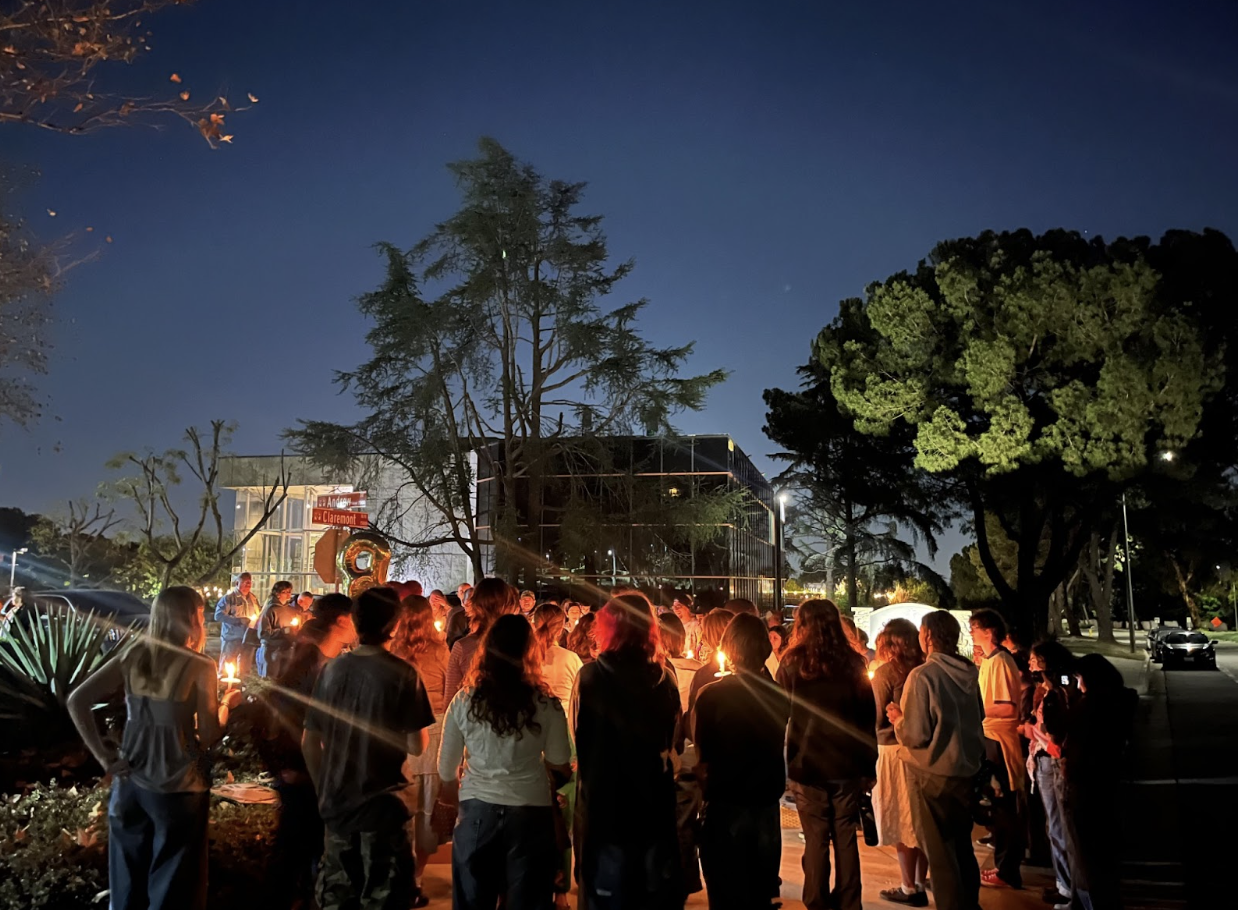
On November 28, within moments of each other, two people called 911. Caller A told it simply: a man on drugs was getting into his car. “A DUI,” the dispatcher decided. Caller B told a different story. He described a man “rolling around on the asphalt screaming and getting in and out of his car.”
Ten minutes later, Diego Alfonso Rios, age 30, was dead.
The following day, the Claremont Police Department published their account of what occurred. In a press release titled “Fatal Incident Following Traffic Stop,” Chief of Police Mike Ciszek stated that the Police Department “received two reports of a male acting erratically and possibly under the influence of narcotics.”
“As officers arrived in the area, they observed the subject driving and conducted a traffic enforcement stop.” The reason, Ciszek wrote, was “based on the subject’s behavior,” which led to the belief that “he was operating a motor vehicle while under the influence.” The officers “asked the subject to step out of the vehicle, at which point a use-of-force incident occurred.” “During the encounter,” Ciszek wrote, “the subject became unresponsive.”
On January 20, 53 days after Rios’ death, the city of Claremont released all investigatory material, including the body and surveillance footage, related to the incident. The city released these items seven days before the statutory deadline established by SB1421, a California law that broadly requires public disclosure of officer-involved use-of-force records and related investigatory materials. In an exemplary display of transparency and accessibility, the city of Claremont published this information on the city government’s website titled “Use of Force Incidents.”
The video footage tells a story.
Responding to the DUI alert from dispatch, officer Joshua Orona arrived at the scene first. He pulled Rios’ boxy blue Scion over at the intersection of Claremont Boulevard and Andrews Drive. While remaining in his police vehicle, Orona directed Rios on the speaker to park and turn off his car numerous times.
Rios did not comply.
Orona then exited his police vehicle and approached Rios’ driver-side window. His commands for Rios to lower the window were not met. Rios was shirtless, panting and pointing towards the backseat, seemingly confused.
Rios eventually rolled his window down. “There’s someone behind me,” he said, slurring. He continued to grab his head, pant, and look into his driver-side mirror.
“I’m a police officer, I’m here to help,” Orona said. He repeated this phrase again and directed Rios to remove his keys from the ignition and give them to him. Rios, dazed, complied and repeated “there’s someone behind me.”
Officer Benjamin Alba arrived two minutes later. He did not join Orona at the driver-side window but instead approached Rios’ passenger-side window. He walked from behind the vehicle with one hand in his pocket and the other rested on his holstered firearm. He peered inside Rios’ Scion. Orona directed Alba to come around to his side to “get him out.”
“There’s someone in the backseat bro, I know it, I see them, I see them.” Rios continued. “There’s literally someone in the backseat, please, please.”
Orona repeatedly asked Rios to relax and for his name. Alba opened the driver-side door. As Rios exited the vehicle, Alba grabbed his arms and forced them behind his back.
Rios said, “I will cooperate.”
“You’re going to,” Alba responded. “You have no option.”
The two officers then attempted to handcuff Rios. They secured one cuff on his left arm and Rios hollered in pain. He then lunged towards the still ajar driver-side door, screaming repeatedly “I’m cooperating.”
Alba grabbed Rios by the neck, buckled his knees, secured a headlock, and tackled him without losing a grip on his neck.
Rios lay face down on the asphalt, slurring incomprehensibly as Alba continued the neck hold for about ten seconds.
“Stop,” Orona said. It is unclear whether this was directed at Alba or Rios. Alba released his headlock on Rios’s neck and placed his right arm behind his back. At this point, Rios’s left arm was pinned under his own weight, head below his back bumper.
Alba began to press his right knee on Rios’ right shoulder blade. Alba, for the next minute and twenty seconds, would continue to press his weight on Rios’ right shoulder blade.
“Give us your other arm,” Orona said. With his arm still pinned underneath him though, Rios was unable to comply with the officers’ demands.
Rios pleaded with them to stop.
“I’m going to fucking tase you, bro,” Alba responded, and pulled out his taser. “Give us your other arm,” Orona said.
“Keep it up bro,” Alba said as he put his taser in contact mode and triggered a stun-warning, which is an action that causes voltage to become visible and audible.
Rios squirmed and screamed.
“I’m going to fucking tase you, you got it?” Alba said. Orona said “Relax” and Alba holstered his taser. Orona said, “We got time.” Orona continued to attempt de-escalation with phrases such as “Relax, Diego” and repeatedly asked for his left arm. Rios was able to release his left arm from under him. Alba used his handcuffs to secure both wrists.
After one minute and twenty seconds, Alba removed his weight from Rios’ right shoulder blade. Orona said, “Diego… Diego, what’s going on?” Rios was unresponsive. Alba rotated him on his side.
“He’s overdosing,” Orona said.
Orona ran to his police vehicle and said into his radio that the “subject appears to be overdosing.” He grabbed the vehicle’s medical kit and placed the EKG pads onto Rios. In the meantime, Alba began chest compressions.
Once relieved by Orona, Alba retrieved two nasal Narcan sprays from his vehicle and deployed them in Rios’s nostrils.
Rios remained unresponsive.
Lieutenant Matthew Hammil, author of the police incident report, arrived at the location and directed lifesaving measures. Two more nasal Narcan sprays were deployed, called in by Alba. Rios remained unresponsive.
This “incident” has shocked the Claremont community. With 36,000 residents, of whom approximately 23% are students, word carries quickly. At the first City Council meeting after Rios’ death, public comment became a space for the Rios family to ask, “what happened?” At each City Council meeting since then, public comment has overflowed into two 30-minute segments. In the pews, students and local community members wore t-shirts that read “Justice for Diego.”
The Claremont community expects transparency from its government. For the past 35 years, the city of Claremont has been awarded the highest recognition for governmental financial reporting and transparency. The city in its most recent annual financial report counted 25,965 trees living on its 13.4 square miles. “The city of trees and PhDs” does not take its audits lightly.
This commitment to transparency is exemplary. Since Rios’ death, the city has been clear about disclosure and access to information. I was able to meet with Chief Ciszek along with Anthony Noriega of the League of United Latin American Citizens in the wake of Rios’ death. Accountability, however, does not have a foothold in the city. Questions about disciplining officers, policy reviews, and the absence of a mental health crisis team deployment were answered with opaque responses about “process.”
In response to calls for a robust investigation, the city has responded that the investigators are “outside and independent.” Claremont is one of 33 cities in Los Angeles County that responds in this fashion when a fatal use of force occurs. The City’s Attorney, Alisha Patterson, in an exchange with Councilmember Corey Calaycay during the December 9 City Council meeting went as far as to say that “it would be problematic if we were able to choose who gets to investigate these incidents.” Calaycay agreed, responding “that’s just as bad as anything else if we were to have our hands in it,” in reference to the city.
The “outside investigators” are the Los Angeles Sheriff’s Department’s Homicide Bureau and the Justice System Integrity Division (JSID) of the Los Angeles County District Attorney’s Office. These investigations determine criminal liability, but data provided by the Police Records Access Project shows that they have concluded that every shooting use-of-force investigation from 2019 to 2023 was “lawful,” “having insufficient evidence,” and “accidental,” carrying no criminal culpability. The Los Angeles Sheriff’s Department, one of the supposedly “outside and independent” investigative bodies, was investigated itself by JSID 76 times out of these 218 cases.
Patterson and Calaycay’s anxieties are valid — it would not make sense for the city to investigate itself. Yet, that is the current policy. The Claremont Police Department, a city agency, investigates itself in use-of-force cases. The department’s policy manual directs the Chief of Police or Operations Division Captain to create an ad-hoc Use of Force Review Board “as soon as practicable” and “limit its findings to whether the actions of the involved employees were within Department policies.” It also states that “this process may be in addition to any other review or investigation that may be conducted by any outside or other agency.” The policy manual does not discriminate between non-fatal and fatal use-of-force incidents.
After the creation of the Use of Force Review Board, they must deliver a report to the Operations Division Captain within thirty days. The Operations Division Captain then has the sole responsibility to determine disciplinary action within ten days. Regardless of the results, the Operations Division Captain will review findings of the incident “to ensure the consistent application of the use of force policy and identify training needs to reinforce that consistent application.”
What if the actions that led to Rios’ death cannot be pinned on the involved officers, but rather the policy and associated training? How could we even arrive at that question? What if the Operations Division Captain has an interpersonal relationship with one of the officers under review? In a department with only 60 people, this is not an unrealistic possibility. Does there even exist a space for the department to say, “we made a mistake and we want to fix it”?
The city of Claremont has directed the community to attend the city’s Police Commission, created in 1999 after the fatal officer-involved shooting of Irvin Landrum. This Commission “reviews and comments on police department policies, procedures, and practices, and assists in setting goals for the department that reflect community values.”
This past year, the Commission has failed to review a fatal police-involved shooting in July 2025 and the allegations of sexual assault by a former Claremont police officer which the city settled for $3 million. The Police Commission cancelled their regularly scheduled meeting on February 5, 2026, for “lack of business.” It remains unclear what their role is.
Residents questioned why Tri-City Mental Health Authority’s crisis unit was not deployed on the night of Rios’ death, particularly given that City Councilmember Jed Leano had attended the first anniversary of the newly launched Mobile Crisis Care (MCC) team just months earlier, in June 2025. The city initially blamed budget constraints, claiming the crisis unit had sunset in 2022. Yet according to Tri-City Mental Health’s Executive Director Ontson Placide, the MCC team had received nine police referrals between July 2025 and February 2026. The unit exists; clarity surrounding the policy governing its deployment on November 28 does not.
The City and community advocates both agree that an independent, outside investigation is necessary. In healthcare, unexpected events that cause a patient’s death or severe bodily harm, called sentinel events, are rigorously investigated to prevent future occurrences and improve patient safety. These investigations begin from the perspective that the healthcare system failed a patient and it is the hospital’s responsibility to understand how and what needs to be done to avoid those failures in the future. What if public safety was investigated in this way? How would this investigation change if respective institutions held the perspective that our police department failed our community, and that it is our collective responsibility to find out how and why, and seek to fix it?
On February 17, Rios’ family filed a civil liability claim against the City of Claremont, alleging that Alba’s sustained neck hold and subsequent knee pressure violated Rios’ Fourth Amendment Constitutional rights and California Government Code Sections 7286.5 (a)(1) and (a)(2), which prohibit police from authorizing carotid restraints or choke holds, and techniques or transport methods that create “a substantial risk of positional asphyxia.” The family of Diego Rios continue to await the findings from county investigators and host rallies at Claremont City Hall every Sunday at 1:00 PM.


