The State Meteorological Agency (AEMET) has not waited for the solstice to begin winter. A season that, meteorologically speaking, extends from December 1 to February 28. Three months of cold await us (although less and less), rain, snow and various inclement weather. This year, it is inevitable to wonder if the cold can affect the DGT’s V16 beacons. The answer is a resounding yes.
Resistance up to -10ºC. All approved V16 beacons must meet a series of requirements. And one of them talks precisely about resistance. There are two things to keep in mind here: the IP rating and what temperature range they can operate in.
New connected beacons must have at least IP54 certification. That is, resistance to dust and splashes of water. But they must also offer adequate operation within a wide range of temperatures. Specifically, between -10ºC and 50ºC. It is enough even if we leave the car in full sun in summer, but in winter it gets a little more complicated.
BUT. Theoretically, Spain is not a very cold country. But although it is not at the level of the Nordic countries, in certain places or times the thermometer can fall below -10ºC. If we are going skiing, if we are driving on a mountain road on a particularly cold day or if we are considering a getaway to one of the “refrigerators of Spain”, things get complicated. For example, Molina de Aragón (Guadalajara) is considered the coldest town in Spain and has the milestone of having reached -28.2 degrees.
In these types of places and situations, the resistance to -10ºC of the beacons is insufficient, so their connectivity may stop working, thus losing virtual visibility, or even fail to turn on.
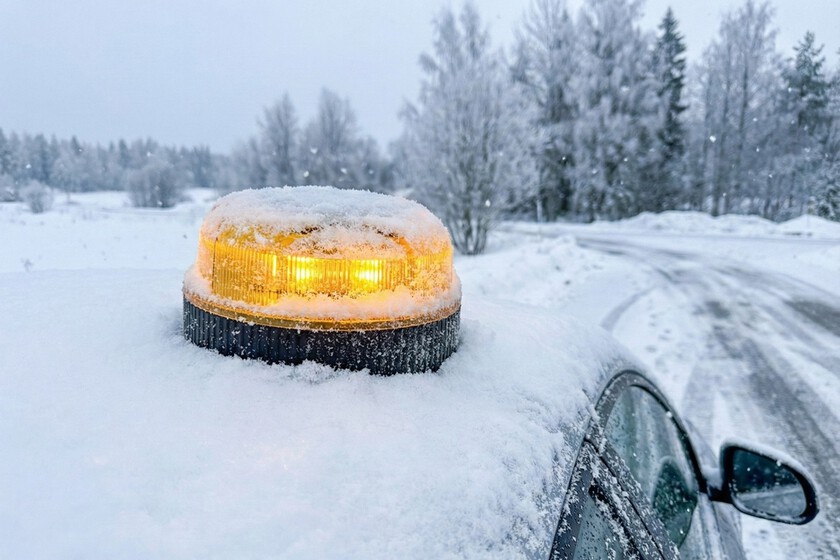
Another problem: snow. Beyond the problems caused by extreme temperatures, there is another phenomenon that in the winter season can interfere with the beacons. Much has been said about the visibility problems of these devices in broad daylight, in fog or on very tight curves, but snow can also become another obstacle.
Beacons should be placed on the highest part of the vehicle where possible, usually the roof. If the snow settles, it can cover it and thus kill the physical visibility it provides us.
The alternative. The V16 beacons aim to improve safety on the roads, warning other drivers of the obstacle posed by a car stopped on them. In the event that the beacon does not work due to problems with temperatures or snow, the option left is to contact the emergency services via mobile phone.
The V16 beacons, which will be mandatory from January 1, 2026, are not without controversy. From the scams surrounding them to the accusations by Civil Guard groups, the DGT has had to recognize its errors and has already explained that it will be flexible with fines.
Cover image | Generated with Gemini
In WorldOfSoftware | FACUA believes that a lot of V16 beacons “approved by the DGT” are not legal. And there’s a way to sum it up: fraud.
In WorldOfSoftware | Living 1,300 kilometers from the North Pole: a Catalan tells of his experience in the northernmost city in the world