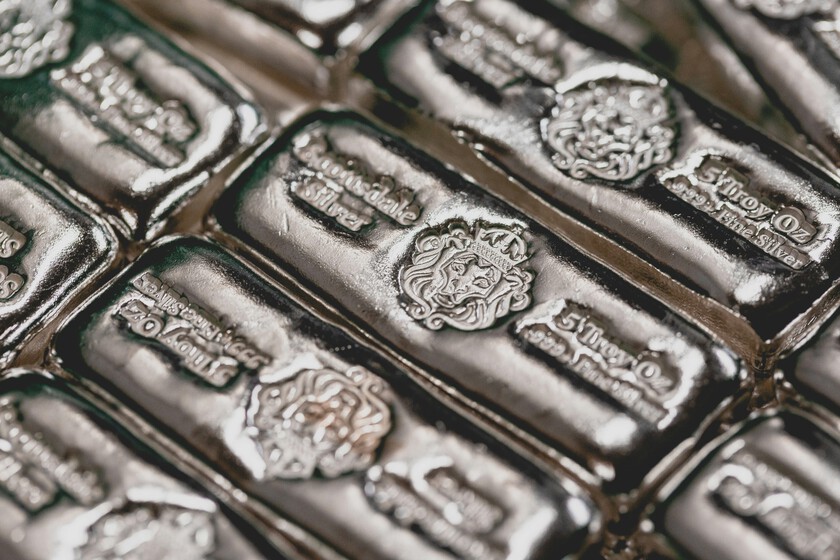
Silver just hit $51 per ounce, a level it hasn’t seen since 1980. The metal is up 75% so far this year, even outpacing gold’s spectacular rise. This increase corresponds to the growing industrial demand for said metal, especially in a context in which mining production stagnates and forms an imbalance that puts a Price on the shortage.
Structural deficit for the fifth consecutive year. The silver market has been in supply deficit for years. Mining production is not growing at the rate that the industry needs, and this gap is reaching historic levels. Metals Focus projects the 2025 shortfall will be 187.6 million ounces, one of the largest figures ever recorded. Therefore, less and less silver is extracted than the world consumes.
The technology what devours silver. Industrial demand already represents 59% of total silver consumption, according to the Silver Institute. Solar panels are behind much of that pressure. And it is expected that they will absorb 195.7 million ounces this year. But it is not the only thing: the semiconductors that shape artificial intelligence, electric vehicles and consumer electronics also pull strongly on this metal.
A refuge at a lower cost than gold. Silver is also benefiting from the drag effect of gold, which has just surpassed $4,000 per ounce for the first time in its history. Many investors who see the gold market as overly saturated are looking to silver as a more affordable alternative to protect themselves from economic uncertainty, geopolitical instability and the weakening of the dollar. Flows into silver-backed ETFs have already reached the highest levels since 2020 in 2025.
The psychological barrier of $50. Silver has never managed to sustainably stay above $50. Each time it has approached that level (in 1980 and in 2011) it has been followed by deep corrections that have scared away investors. “Psychologically, silver has never exceeded $50 and has really stayed there,” David Morgan, editor of the Morgan Report, explained to the specialized media Investing News Network. Morgan calls it “crossing the Rubicon,” a defining moment that could open up uncharted territory for the metal’s price.


India strongly joins the demand. Since its regulator approved silver exchange-traded funds in 2021, India has become a key source of new demand. Silver-backed products accounted for 40% of the country’s total retail investment in 2024, and Indian imports are at all-time highs. China, for its part, is increasing industrial consumption for technological installations and solar panels. Two Asian giants pushing demand at the same time.
And now what. Morgan does not expect silver to shoot up to $70 in the short term, but he does expect it to consolidate above $50 if it manages to break through that barrier solidly. HSBC projects that the price could reach $55 in 2026 before retreating in the second half of the year. What seems clear is that, as long as the technology industry continues to need more silver than it can be mined, the pressure on the price is not going to disappear.
Cover image | Scottsdale Mint
In WorldOfSoftware | OpenAI is the King Midas of the stock market: everything it touches skyrockets