




Gasoline skyrockets. It is the consequence of the attacks on Iran and the country’s responses to the United States and Israel. In an enclave very exposed to any type of crisis, the Strait of Hormuz, oil transit is suffering harsh consequences. China already warns that it will not export its fuel.
And, meanwhile, gasoline is rising at a dizzying pace.
20 cents. Tomorrow, Saturday, March 7, marks one week since the United States and Israel attacked Iran. Since then, hostilities in the Middle East have continued, with a response from Iran in which its neighboring countries and even the European Union have been involved.
It was February 28 and gasoline was moving below 1.50 euros/liter on average. When we write these lines, March 6, the portal dieselgasolina.com which monitors the Price of Spanish service stations offers a very different image:
So far this month, prices have skyrocketed:
- Gasoline 95: from 1,495 euros/liter to 1,608 euros/liter. +11 cents/liter
- Gasoline 98: from 1,687 euros/liter to 1,766 euros/liter. +8 cents/liter
- Diesel A: from 1,447 euros/liter to 1,643 euros/liter. +20 cents/liter
- Diesel A+: from 1,549 euros/liter to 1,734 euros/liter. +19 cents/liter
A week. Barely a week has been enough for the price of gasoline and diesel to skyrocket and, above all… there is no prospect of their ceiling. And the oil companies and service stations are already beginning to notify the Government that they are not willing to support a new gasoline subsidy, as would happen in 2022.
This means that the prospects are not at all promising and the truth is that if we look at the progress of the conflict, everything indicates that we can expect the worst. Right now:

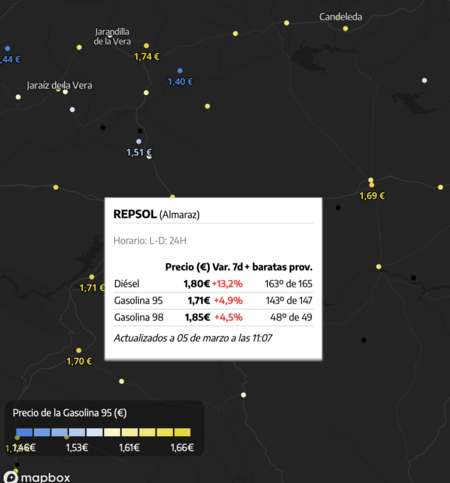

Sign of the increase in price in a few days
like a rocket. What we are witnessing, again, is the theory of the rocket and the pen. When the supply chain falters, the price of gasoline skyrockets. However, its descent lasts for weeks or months, reproducing the effect of a feather.
And, as soon as the last war in the Middle East began, gas stations already began to raise prices. It doesn’t matter that the impact of a rise in the barrel of Brent is not immediate on the prices at which they Buy oil, the truth is that there are gas stations where prices have increased by more than 10% in the first days of the conflict, as you can see in the image above.
The diesel. Although the price of gasoline is rising, without a doubt the biggest loser is the diesel customer. Spain continues to be a country whose vehicle fleet is made up mostly of this type of fuel and seeing an increase of 20 cents/liter, on average, in just one week is hard.
Its price is already higher than gasoline. What was once a historical rarity, today has become a certain normality. As we already observed during the Russian invasion of Ukraine and the war in this territory, diesel became more expensive because Russia was a large exporter of it and European refineries had been reduced. That is to say, we had less fuel available on the market and for what there was we had two options: buy it at a high price or wait for the European funnel to ease.

And the room for maneuver is small. But, in addition, since the War in Ukraine the State has been applying some measures that reduce the room for maneuver to try to patch the situation. Public transport is now much cheaper than then and gas and oil stations have already raised the hatchet against possible subsidies.
A tax cut seems complicated. The State would be shooting itself in the foot, reducing revenue that also increases when the price of fuel rises. And the European Union has been pushing for years to eliminate diesel bonuses and, therefore, equalize taxes with gasoline.
Photo | Hamza Şamil Yavuz
In WorldOfSoftware | Europe has been demanding that Spain increase diesel prices for five years. And Spain is playing at being Spain


