




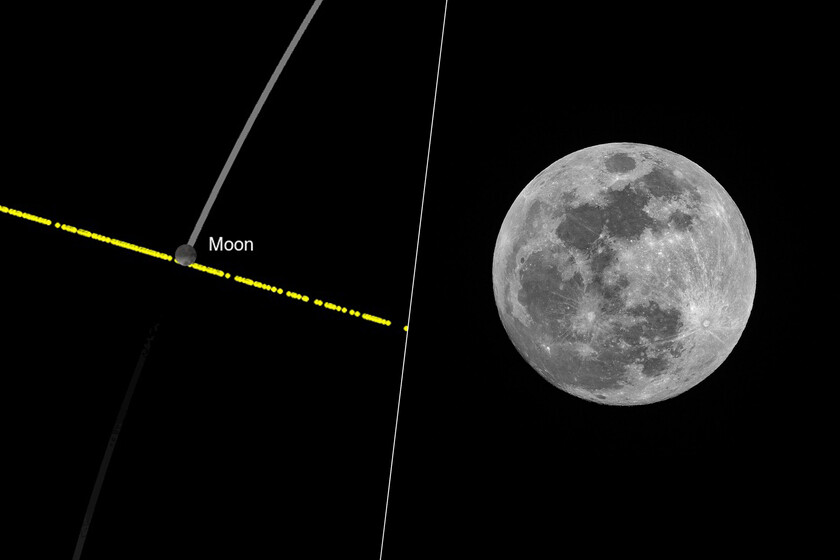
There are asteroids that go almost unnoticed and others that force us to look at them much more carefully. 2024 YR4 belongs to that second group. When it was discovered at the end of 2024, the first calculations of its trajectory still had enough margin of error to contemplate a very small possibility of impact with Earth. That scenario was soon ruled out, but, as ESA explains, the case remained under follow-up for a different reason: a doubt about the Moon was left open that was not resolved until new observations arrived.
Impact risk. With data available since spring 2025, trajectory models indicated that the asteroid had about a 4% chance of hitting the Moon on December 22, 2032, an estimate that NASA placed at 4.3% in its previous calculations. It was not a high percentage, but it was significant enough for the teams dedicated to monitoring near-Earth objects to follow it with special attention. Furthermore, we are talking about an object of about 60 meters.
How Webb came into play. To clear up that doubt, something more than the usual telescopes was needed. An international team of astronomers identified two very specific windows in February 2026 in which the James Webb Space Telescope could try to detect the asteroid, which at that time was just an extremely faint point millions of kilometers away. It involved using one of the most complex scientific instruments built to date to locate an almost invisible object and measure its position with the necessary precision to project its orbit almost seven years into the future.
Key piece. The observations were made on February 18 and 26, 2026 with the NIRCam camera on the James Webb Telescope. From these images, astronomers compared the position of the asteroid with that of the background stars, whose coordinates are known with great precision thanks to ESA’s Gaia mission. ESA adds a relevant detail to understand why this went ahead: the planning and analysis was coordinated with ESA’s Near-Earth Object Coordination Center, NASA’s Center for Near-Earth Object Studies and the Webb mission team. With this new data package, the orbital models were adjusted enough to close the mystery.
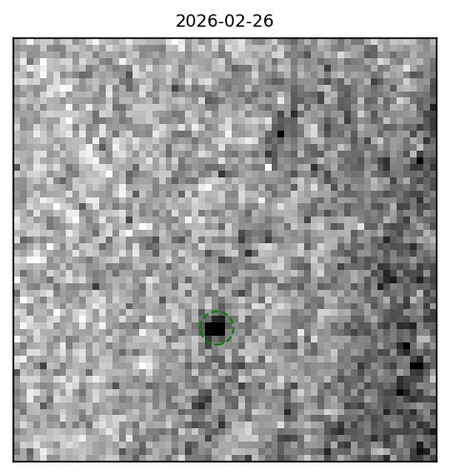

James Webb analyzed the position of the asteroid in relation to the background stars
The flyby distance. With the new calculations, monitoring teams can now estimate quite accurately what the asteroid’s passage through the lunar environment will be like. According to NASA, it will pass on December 22, 2032 about 21,000 kilometers from the surface of the Moon. That range is enough to eliminate the impact scenario that had been on the table for months. In other words, the object will continue on its way through the solar system without hitting either the Moon or Earth.

Surveillance doesn’t stop. Programs such as ESA’s Space Security or NASA’s tracking systems continue to detect and analyze near-Earth objects to anticipate any possible future threats. The logic is simple: the sooner a potentially dangerous object is identified, the more room there will be to study its trajectory and assess the real risk. In this case, the result has been reassuring, but it also illustrates, as ESA insists, what planetary defense means in practice when a doubt is resolved with more data and better measurements.
Images | THAT
In WorldOfSoftware | We have been burning space junk for years to get rid of the problem. It turned out to be a bad idea


