The Vernadsky Research Base is a Ukrainian scientific station where penguin colonies have been sighted. It happens that it is in Antarctica, not in Ukraine, an enclave where these creatures that live almost exclusively in the southern hemisphere and, in any case, rarely and naturally in the northern hemisphere do not exist.
However, in Ukraine they do not stop being sighted.
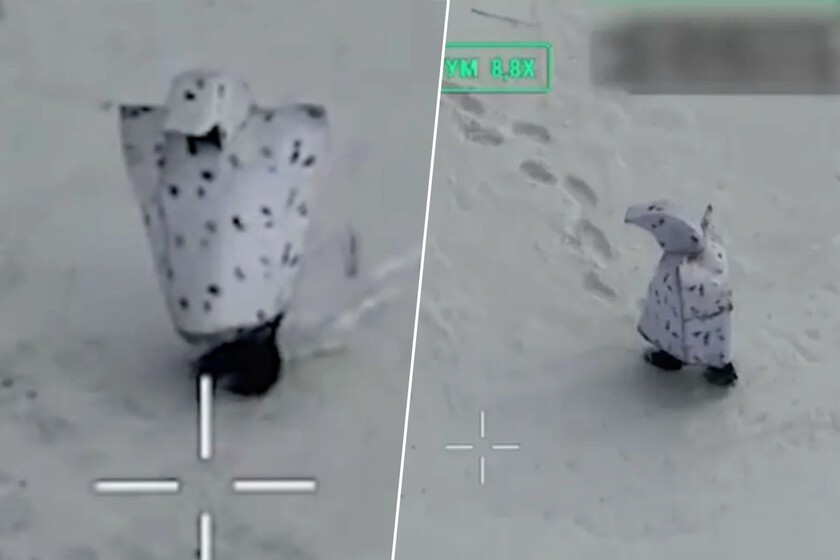
Penguins on the battlefield. Yes, on the Ukrainian front one of the most disconcerting images of this highly technological war has emerged: Russian soldiers advancing alone through snowy fields covered in white thermal ponchos that, seen with the naked eye, clearly make them look like giant penguins.
The logic behind this tactic is simple and desperate at the same time, since these ponchos (can be found for about $75), made with fabrics capable of retaining almost all body heat, seek to erase the thermal silhouette of the soldier in front of drones equipped with infrared cameras.
The “but”. In theory, the human body should blend in with the cold of the environment, disappearing for thermal sensors. In practice and as the Ukrainian forces have been responsible for publicizing, camouflage only works under very specific conditions and at night, and its repeated use in broad daylight has turned these “penguins” into targets that are easily identifiable by optical drones, which detect them without difficulty before attacking them.

Camouflage as a mistake. The videos released by Ukrainian operators show that the problem is not so much the garment as its tactical use. Ponchos can hide the heat of the torso, but leave parts such as the feet exposed or create artificially cold silhouettes that stand out against slightly warmer backgrounds, making target acquisition easier.
Additionally, a lack of training exacerbates the problem, as many soldiers appear to be unaware of how and when to use this type of camouflage. The result is paradoxical: what was supposed to reduce visibility ends up generating black and perfectly delimited figures on the thermal screens of the drones, making the carriers even more detectable. Even so, Russian units insist on repeating the tactic, sending isolated men over and over again to cross open terrain, with almost always lethal results against explosive-laden FPVs.
The battle of deception and decoys. We have told it before. This extreme resource is not an isolated case, but part of an increasingly sophisticated war of deception on both sides. While some soldiers literally try to disguise themselves to survive aerial surveillance, Ukraine has perfected the use of large-scale decoys, such as inflatable F-16 fighters deployed at airfields.
These full-size models have come to attract Russian satellite-guided loitering munitions, forcing the adversary to expend expensive and technically advanced drones against targets of no military value. Even from the Russian side it has been implicitly recognized that some of their supposed big blows have ended up destroying simple mock-ups, an assumed cost that, however, reveals the limits of intelligence and target identification in an environment saturated with sensors.


A drone war. If you will, all this exchange of costumes, thermal ponchos and plastic airplanes underlines a deeper and more repeated reality: the battlefield has been transformed into a permanent duel between detection and concealment, in which drones are responsible for the majority of casualties and set the pace of operations.
Improvised human camouflage tactics and elaborate industrial decoys are part of the same phenomenon, a war in which fooling the sensor is almost as important as destroying the enemy. In this context, the somewhat surreal image of a “penguin” advancing through the snow is not so much an anecdote, but rather the extreme symptom of a conflict in which survival increasingly depends on outwitting a camera that never blinks.
Image | Telegram
In WorldOfSoftware | Three Russians surrender on camera: what was previously a “normal” scene in the war in Ukraine is science fiction
In WorldOfSoftware | “They are under our feet”: Ukraine has entered an inexplicable phase, that of its drones attacking Russians at absurd distances