In a battle where drones no longer need humans to coordinate and attack, and where these combat devices have taken technological warfare to a new crazy phase where they are shooting themselves down, sooner or later it had to happen. Drones and Ukrainian airspace are increasingly similar, for better and worse, to cars and roads around the planet.
The congested sky. The Ukrainian front has become an airspace so saturated with drones that its operators must negotiate among themselves to avoid collisions and, above all, interference from their own electronic warfare systems.
In an environment where thousands of aircraft fly simultaneously, pilots establish temporary “flight corridors”, agreed by group messages or by radio, to cross areas under friendly control without being shot down by their own army’s signal jammers. This exchange, at times chaotic and spontaneous, reflects how modern warfare is fought both in the air and on the electromagnetic spectrum, where waves, rather than bullets, determine who sees, who shoots, and who survives.
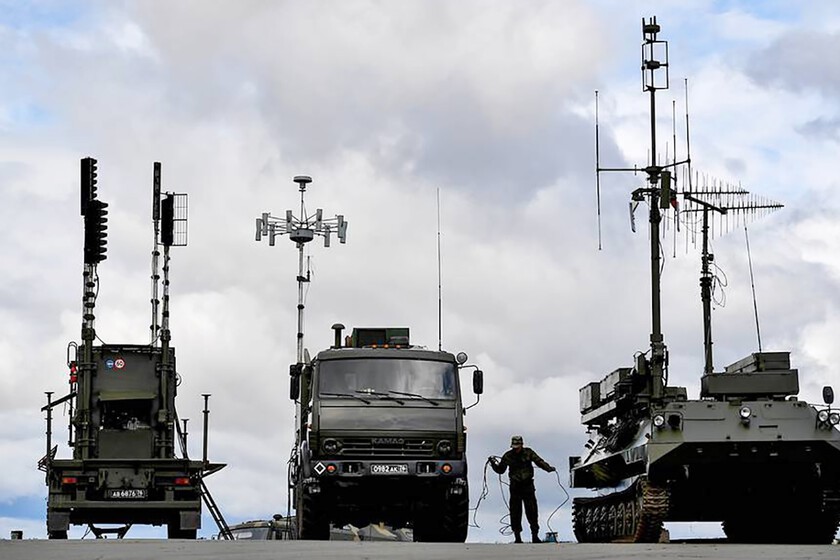
The invisible war. We have told it before. The battle for control of the electromagnetic spectrum is already one of the most decisive of the conflict. Each side tries to saturate or protect the other’s frequencies through jamming systems that can nullify drones, missiles or radars, but also blind their own. Pilots like Dimko Zhluktenko, from the Ukrainian Unmanned Systems Forces, explain in Insiere that their work includes identifying Russian electronic warfare systems to destroy them before they block the signal of their drones.
Other operators, however, must coordinate with several units simultaneously, seeking a balance between protecting their troops and the need to keep flight routes open. In many cases, the commanders who control the jamming systems are at higher hierarchical levels, so units on the ground can barely request changes, with no real ability to turn them off or adjust them according to their missions.
The chaos of the sky. The density of devices in the air has created an environment that is almost impossible to manage. Modified commercial drones, explosive FPV devices, reconnaissance drones, interceptors and electronic warfare systems compete for space and signal, in a landscape where distinguishing between friend and enemy is increasingly difficult. Many soldiers fire or activate their jammers at any approaching drone, unable to accurately identify it.
The similarity between the Russian and Ukrainian models aggravates the confusion, and sometimes the Ukrainians themselves shoot down allied devices out of fear or uncertainty. In this scenario, the war resembles a gigantic air traffic jam where each operator must warn, coordinate and wait their turn to cross the front without being blocked or destroyed by their own side.
Non-stop race. In the background, Ukraine and Russia compete to develop technologies capable of resisting electromagnetic blocking. The new models include drones without dependence on GPS, controlled by fiber optic cable, equipped with artificial intelligence or capable of changing frequencies to escape enemy “noise.”
However, these innovations slowly reach the front lines, where they coexist with outdated equipment that requires improvisation and constant communication. Thus, each flight is a negotiation between units, each mission a bet against the chaos of the spectrum, and each Russian advance forces an immediate Ukrainian response.


The new frontier. Ultimately, the conflict in Ukraine has turned heaven into a laboratory where 21st century war is redefined. It is no longer just about tanks or missiles, but about waves, signals and microprocessors. The coordination between drones and interference systems reveals both the maturity and fragility of an army that has made ingenuity its main weapon.
And it also shows a limit: the more saturated the spectrum, the more likely it will be that the technology will turn against those who use it. In that invisible space, where every interference can decide the fate of a drone or a life, Ukraine fights a war as modern as it is paradoxical: a war in which communication is the only way to prevent the defense from becoming its own enemy.
Imagen | TASS
In WorldOfSoftware | If the question is how to end the war in Ukraine, the US has a disturbing solution: threaten Russia with a missile
In WorldOfSoftware | Russia’s technological superiority over Ukraine is growing every day. And all thanks to a friend: China