




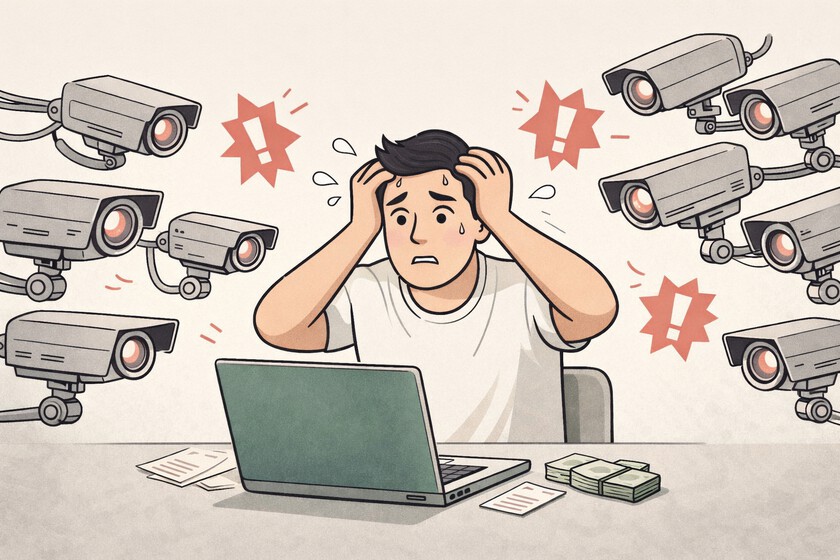
Betting houses sell a dream in their advertisements: anyone can win. The reality is just the opposite. They are designed to identify those who know what they are doing and neutralize them before they become a problem.
A data journalist from The Economist He discovered it the hard way. After building models to detect miscalculated odds, Ladbrokes allowed him to bet exactly five pounds on the NBA MVP award. All other British houses closed their doors to him soon after. Not to make a lot of money, but to show that he knew what he was doing.
The algorithm ranks you before your first bet
Platforms don’t wait to see if you win or lose to evaluate you. They start much earlier. Do you enter from a computer or from your mobile? Do you deposit with a debit card or electronic wallets? Are you a woman in a sector where 90% are men?
Each technical decision feeds a risk profile. An industry consultant explained it this way to The Economist: When you make your first bet, the houses already know with 80-90% certainty how much money they are going to win or lose with you.
The initial play confirms or denies suspicions.
- A normal bettor bet on the Premier League or the NFL half an hour before the game, choosing the winner without comparing the odds too much. And he likes the combined ones: five, six, twelve crossed bets that are much more profitable (and therefore much more complicated to get right).
- a professional does the opposite. Bet on minor leagues as soon as the odds are published, when they still contain calculation errors. Look for derivative markets, such as how many points will be scored in the second quarter or whether a secondary player will beat a certain statistic, because that’s where the algorithms are least accurate. He never makes combinations.
If your first bet captures a clearly mismatched market share, the restriction comes immediately. If not, the system needs less than ten moves to confirm it through the closing-line value: If you consistently bet better than the final odds, the algorithm already knows that you are a problem.
Anthony Kaminskas runs ak Bets, a small house with 50,000 accounts. He perfectly remembers that British journalist’s first bet: 25 pounds on a basketball result that would take five months to resolve. Among hundreds of customers betting on the day’s football, that was too loud. He restricted it to 30% of the standard limit on the spot, adding a note: “This user has found a Price where he has an advantage.”
Whaling is more profitable than expelling ready whales
But the system is not designed just to kick out the good guys. Its true function is to distinguish between three types of winners:
- Those who know.
- Those who are lucky.
- And those who are about to lose everything.
They are treated depending on which group they belong to:
- “Those who know” are expelled.
- They keep the lucky ones close, waiting for their luck to change.
- And the “whales” (players with a lot of money who bet poorly) are pampered with VIP treatment: trips, five-star hotels, front-row tickets… Everything so that they feel entertained and continue betting happily, even if they tend to lose.
In 2023, DraftKings identified Felix Baum as a whale. They paid for a trip on the Indiana Pacers plane and a night at the Four Seasons. He turned out to be a camouflaged professional. But the cost of that mistake is pocket change: a year later, PointsBet raised its market share in New Jersey from 11% to 24% after catching a single real whale.
The problem is that some professionals specialize in imitating whales:
- They purposely lose large sums on “silly” bets, such as accumulators on a very popular sport, so that the system raises the limits.
- When the house lets its guard down, they recover their losses and disappear with a net profit.
The best ones even log on at three in the morning when there are games in other time zones, imitating the compulsive behavior of an addict.


When all the doors close to you, the black market remains
If all platforms restrict you, the options are a little murky:
- Houses in tax havens accept cryptocurrencies without asking questions, but then cancel winning bets citing “suspicious patterns.”
- Physical stores accept cash, but only in small amounts, and you have to constantly change hats and sunglasses to avoid facial recognition.
The alternative is resort to front men. Family and friends who bet following your instructions. With the right precautions, such as never using the same WiFi or keeping each account on different devices, it is often almost impossible to detect.
An attendee at BetBash, a professional betting conference in Las Vegas, explained that he has twenty different iPads and drives around his state so that each bet comes from different locations. Another recruits mules at his church.
When the circle of trust is exhausted, there are professional intermediaries who sell access to networks of front men. They keep between 10% and 50% of the profits depending on the volume they move. Meta-fraud is included in the price: they estimate that between 3% and 5% of the mules will disappear with the money.
Professionals do not want the system to change
Several governments have attempted to ban these types of restrictions.
The surprising thing is that professionals do not support these changes. If the houses could not limit accounts, they would worsen the odds for everyone or stop offering exploitable markets. “The restrictions are the best thing that ever happened to me,” says industry veteran Chris Dierkes. “They keep the competition away and make me money”.
The entire system works because it benefits everyone who knows how to play: the houses maximize their profits by concentrating on the losers, and the professionals keep the market inefficient. And the casual bettor, convinced by advertising that he can win, keeps turning the crank.
In WorldOfSoftware | “Betting is the heroine of the 21st century”: this is how online betting has conquered Spain
Featured image | WorldOfSoftware


