




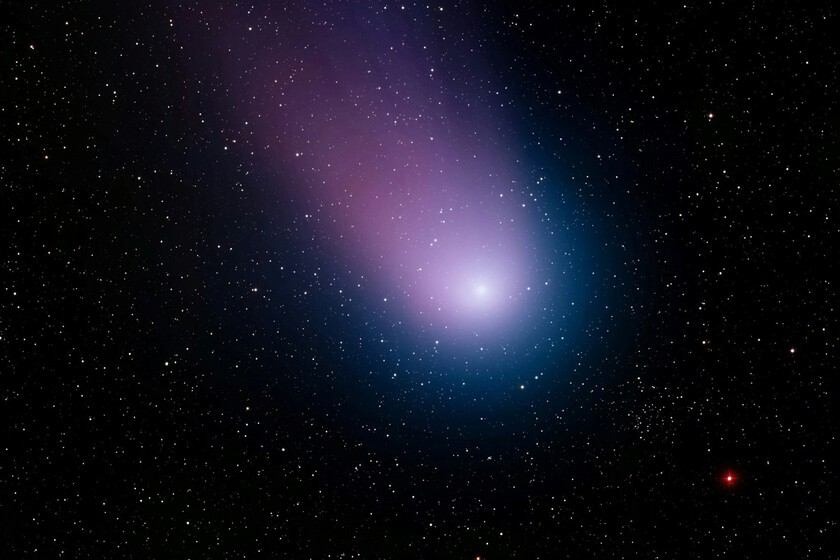
We have just started 2026 and astronomy has already given us the first surprise of the year, since while most were looking towards the usual objectives, a team of astronomers in the Atacama Desert has detected an object. It is comet C/2026 A1, and there are possibilities that we can see it from Earth itself.
Its relevance. We are not looking at just any comet, since its orbit and size suggest that we are looking at a “sungrazer”, which translated into Spanish would be something like “sungrazer”. This means that it is a type of suicidal object that, if it manages to survive its passage through perihelion, could become a visual phenomenon comparable to the legendary comet Ikeya-Seki of 1965.
The discovery. The story of this discovery begins on January 13 at the AMACS1 observatory, located in the privileged geography of San Pedro de Atacama in Chile, with a team of French astronomers who detected an unusual movement.
The discovery was made as part of the MAPS search program, which has been active since 2020 and already has the discovery of 8 comets and more than 300 near-Earth asteroids to its credit. In this way, the different organisms initially confirmed this finding as a diffuse spot.
It had already been seen. Weeks before this discovery, researchers saw that ‘precoveries’ already existed in the databases. This means that other teams had uploaded previous images where the comet appeared, but it had not been identified since the brightness was even dimmer. But this team has finally not missed it.
Your family. What makes the C/2026 A1 special is not only its discovery, but its lineage. Data from the JPL Small-Body Database and expert Seiichi Yoshida confirm that it belongs to the Kreutz family, specifically the Pe subgroup.
In order to understand all these words, we must put ourselves in context to know that Kreutz comets are fragments of a giant comet that broke up centuries ago. Now this new visitor appears to be directly related to the Great Comet of 1106, a monster that broke into pieces giving rise to some of the brightest comets in history.
Your trip. When analyzing the journey you are having, the truth is that the figures can be dizzying. Specifically, it has been seen that it has a speed of 3.2 million kilometers per hour and, based on this information, it has been seen when it will pass close to the Sun.
Specifically, it will be on April 4, 2026 when it will pass just 0.00547 Astronomical Units from the Sun. In “Christian”, that means that it will pass about 800,000 kilometers from our star, which for an object made of ice and rock, that is basically grazing the solar surface.
The April scenario. This is where the scientific community is divided between caution and excitement, as it all depends on one very specific question: ‘Will he survive?’ Right now on the table there are two possible scenarios that can be summarized in the following points:
- The first is for the comet to disintegrate, which would be a boring ending. What basically happens here is that the immense gravity and solar heat vaporize the comet before it leaves perihelion, being the fate of many sungrazers small.
- The second scenario is that it survives, and it is not nonsense since current estimates place the comet’s nucleus at about 2.4 kilometers in diameter. This figure is good news because it is large enough to have a chance of survival.
If he survives. If it withstands the gravitational and thermal pull, the C/2026 A1 could reach an absurd brightness. Some optimistic projections suggest that it could be brighter than the full Moon or even visible to the naked eye during the day, near the solar disk, something we haven’t seen since Comet Ikeya-Seki in the 1960s.

Calendar to view. The calendar that is currently on the table begins at the end of March 2026, when astronomy fans will be able to begin to see them with telescopes. From here we will have to wait until April 4 to see if it survives and increases its brightness greatly to later deploy a massive tail visible to the naked eye in our skies.
As always with comets, they are like cats: they have tails and do exactly what they want. But with a core of 2.4 km and a direct trajectory from the Kreutz clan, C/2026 A1 is, without a doubt, one of those events that we must keep in mind in order to make history.
Images | NASA Hubble Space Telescope
In WorldOfSoftware | China has created the largest kite in the world with a very clear objective: to make its energy extremely cheaper.


