The issue of potential security guarantees for Ukraine has dominated US-led peace talks in recent months, but current proposals lack credibility. While everyone agrees that security guarantees are essential, is anybody actually prepared to risk war with Russia in order to enforce them? Based on the excessive caution displayed by Western leaders over the past four years, it is easy to see why many observers remain unconvinced.
With Ukraine’s Western partners unlikely to defend the country against a new Russian invasion, the most realistic option is to build up Kyiv’s own military capabilities. This process is already well underway. Since 2022, the Ukrainian army has expanded dramatically to become by far the largest fighting force in Europe and a world leader in drone warfare. Ukraine’s transformation into a major European military power has been supported by the country’s allies, who have provided large quantities of weapons and equipment along with the financial support needed to power the rapid expansion of the Ukrainian defense industry.
The growing strength of the Ukrainian military has been instrumental in stemming the tide of Russia’s invasion. Despite holding the battlefield initiative throughout 2025, Putin’s army was able to seize less than one percent of Ukrainian territory while suffering heavy losses. The priority now is to freeze the front lines further and reach a point where even minor Russian advances become increasingly unfeasible. However, effective defenses alone will not be enough to end the war or prevent a new Russian invasion. In order to deter Putin, Ukraine must also be able to strike back effectively at targets across Russia.
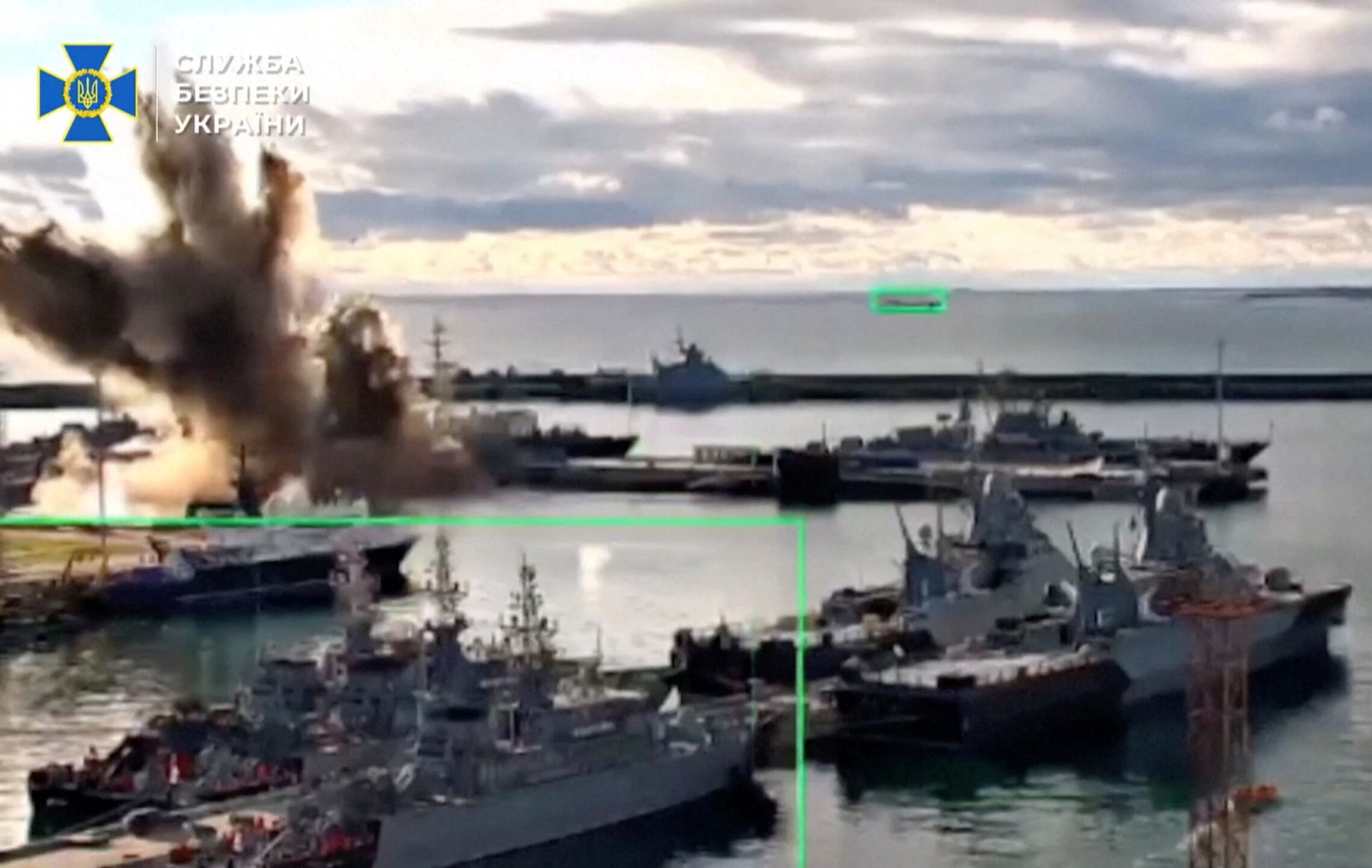
Ukraine’s arsenal of long-range weapons has evolved significantly since 2022. Over the past four years, the country has managed to develop a variety of strike drones with the capacity to reach targets located well over a thousand kilometers from the Ukrainian border. Ukraine also now boasts an expanding selection of domestically produced cruise missiles. This enhanced long-range firepower has made it possible for Ukraine to conduct an escalating bombing campaign inside Russia that has already changed the geography of the war.
Since summer 2025, long-range Ukrainian attacks on Russian territory have reached record highs. Ukraine has struck dozens of military facilities and defense industry enterprises, while also paying special attention to the oil and gas infrastructure that fuels the Russian war economy. Ukraine has hit refineries, pipelines, oil rigs, ports, and a number of tankers belonging to the Kremlin’s so-called shadow fleet. These strikes have complicated the logistics of the invasion while contributing to a significant decline in Russia’s energy export revenues.
In addition to hampering the Kremlin war machine and causing economic damage, Ukraine’s mounting campaign of long-range strikes has also had a major psychological impact that is helping to bring home the reality of the war to the Russian public. Since the start of the full-scale invasion, the Kremlin has worked hard to shield ordinary Russians and contain the conflict within the borders of Ukraine. However, with air raid sirens becoming an increasingly routine feature of daily life in Russian towns and cities, the Putin regime is no longer able to control the narrative.
A recent survey conducted by Russia’s only remaining independent pollster, the Levada Center, has highlighted the impact Ukrainian strikes are having on Russian public sentiment. Asked to name the most notable event of the past year, 28 percent of respondents cited Ukrainian drone attacks on Russian cities and industrial facilities, making this the third most popular answer. Clearly, Ukraine’s long-range bombing campaign has succeeded in breaking through the Kremlin propaganda bubble and has made a strong impression on the Russian population.
Eurasia Center events


For Ukraine’s partners, the objective now should be to boost Ukraine’s long-range capabilities to the maximum in order to equip the country with the kind of strike power that can deter Russia. Numerous Western leaders have shied away from providing Kyiv with long-range missiles from their own arsenals due to escalation fears. The solution is simple: Western partners should focus their efforts on helping Ukraine produce sufficient quantities of drones and missiles domestically.
Ukrainian officials are well aware that the ability to hit targets across the Russian Federation may be their country’s most effective security guarantee against further Kremlin aggression. They are now appealing to Kyiv’s international partners for increased support as they seek to exploit the country’s considerable spare defense industry production capacity and crank up output.
“The modern arms race is not about nukes. It is about millions of cheap drones. Those who can scale up production quicker will secure peace,” commented Ukrainian Foreign Minister Andrii Sybiha in late 2025. “This requires quick and sufficient funding for Ukraine’s defense industry, which is now the greatest source of defense innovation in the world. We can produce up to twenty million drones next year if we get sufficient funding.”
Throughout the past year of faltering US-led peace efforts, Vladimir Putin has repeatedly demonstrated that he has no intention of ending the invasion. As long as the war is being fought predominantly inside Ukraine, he is unlikely to change his position, regardless of Russian combat losses. However, if Ukrainian drone and missile strikes inside Russia continue to expand during 2026, the economic and social impact may become too serious to ignore. This could force Putin to abandon his stalling tactics and finally enter into genuine negotiations. It would also oblige him to think carefully before restarting his invasion in the years ahead.
Serhii Kuzan is chairman of the Ukrainian Security and Cooperation Center (USCC). He formerly served as an adviser to the Ukrainian Ministry of Defense (2022-2023) and as an advisor to the Secretary of Ukraine’s National Security and Defense Council (2014).
The views expressed in UkraineAlert are solely those of the authors and do not necessarily reflect the views of the , its staff, or its supporters.


The Eurasia Center’s mission is to enhance transatlantic cooperation in promoting stability, democratic values, and prosperity in Eurasia, from Eastern Europe and Turkey in the West to the Caucasus, Russia, and Central Asia in the East.
Image: Footage released by the Security Service of Ukraine shows what it says is a strike on a Russian submarine at a port facility, in Novorossiysk, Krasnodar Region, Russia, in this screengrab from video released on December 15, 2025. (Security Service Of Ukraine/Handout via REUTERS)