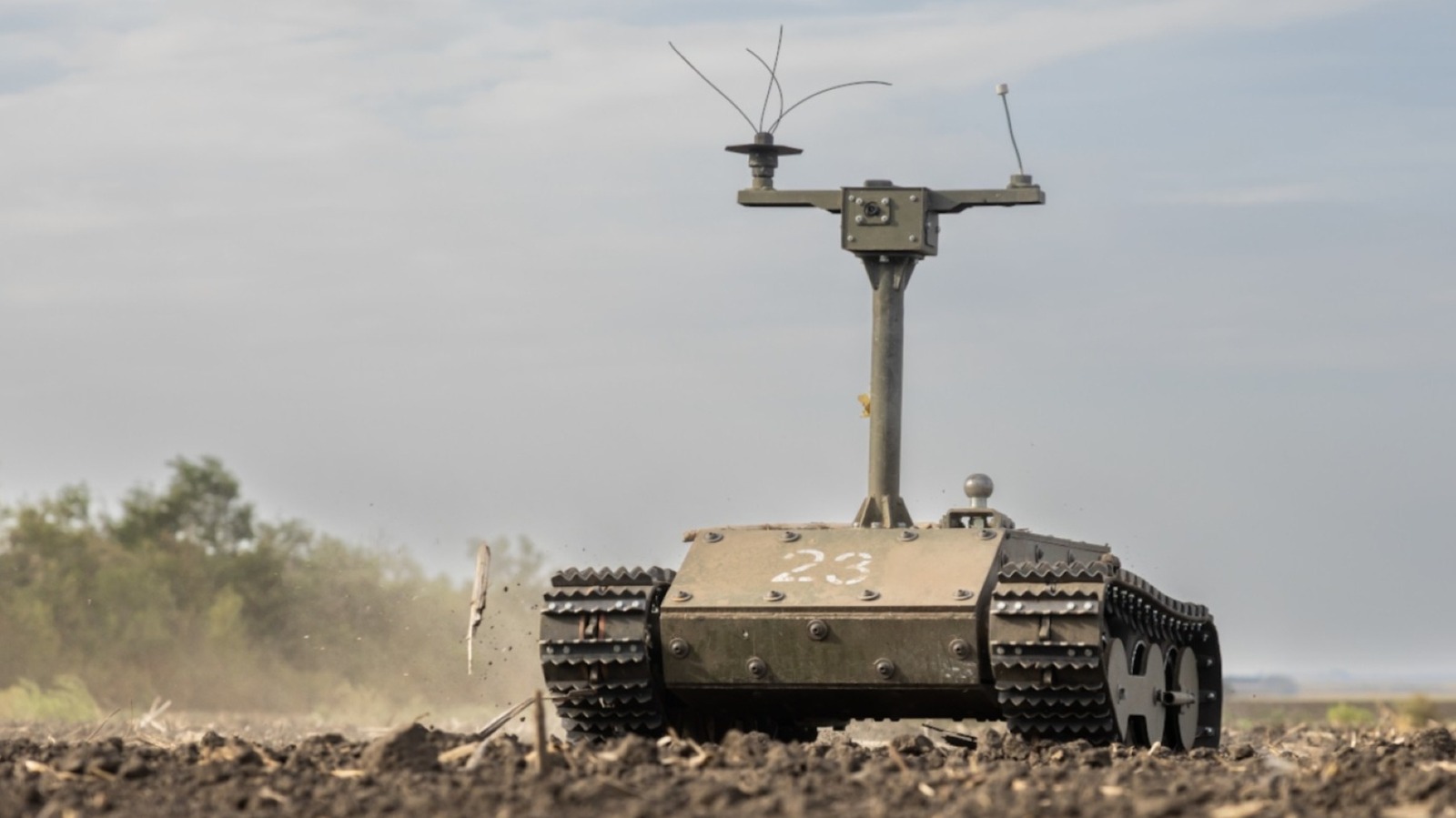
Since the Russia-Ukraine war began in 2022, military leaders around the world have drawn lessons from it about an ever-evolving technological landscape. Both sides continue to deploy and counteract groundbreaking weapon systems in realtime, ranging from sea drones to high-energy lasers. One such technology is Ukraine’s recent use of unmanned ground robots. Equipped with grenade launchers to machine guns, these unmanned ground vehicles (UGVs) have changed the way Ukraine conducts its reconnaissance, assault, and resupply missions.
The multipurpose capabilities of UGVs have made them a popular choice for Ukrainian leaders looking to disrupt Russian operations while reducing casualties. However, these drones have experienced varying degrees of success and have yet to be deployed to the same level as their aerial counterparts. This doesn’t mean that they haven’t worked on the battlefield, as Ukrainian forces have posted videos showcasing UGVs gunning down Russian armored vehicles (via Defense Express). Even with this in mind, however, unmanned ground vehicles may prove more useful as logistics tools, a key area where Ukraine has a distinct disadvantage. According to Jack Watling, a senior research fellow at the Royal United Services Institute, “UGVs are disproportionately used for resupply in Ukraine.”
On balance, both Ukraine’s and Russia’s use of drones has revealed several points of exposure in the gear and equipment of global military powers. As such, military leaders have begun to develop unmanned technologies with earnest, perhaps best exemplified by Russia’s development of aerial drones immune to electromagnetic warfare, and Indonesia’s autonomous submarines. These advances have specialists believing that unmanned technologies will revolutionize the battlefield for years to come.
Ukraine’s robot army
Ukraine’s arsenal of unmanned ground vehicles has steadily increased through a mix of foreign military aid, state-sponsored development, and grassroots funding(via Kyiv Post). Since the war’s onset in 2022, the Ukrainians have used Estonian THeMIS platforms to perform resupply and casualty evacuation missions. According to Milrem Robotics, THeMIS’ manufacturer, the Netherlands funded an order of 150 additional units in October 2025. Domestically, companies like DevDroid, which specialize in robotic combat systems, have developed drones capable of orchestrating complex ground operations remotely.
In addition to these models, Ukrainian soldiers have met increasing demand by rebuilding, modifying, and deploying UGVs. In a behind-the-scenes look at Ukraine’s 3rd Assault Brigade by the Kyiv Post, UGVs costing roughly $22,000 were reportedly purchased through a combination of state funding and civilian donations. According to the report, the 3rd Brigade’s store of UGVs has grown from only a few units in 2023 to now being capable of supplying an entire army brigade through these unconventional systems, delivering up to 370 tons of military equipment in a single month.
Increasingly, UGVs are being deployed as attack drones. Equipped with a variety of weapons, including .50 caliber machine guns and grenade launchers, UGVs have been used to clear the way for Ukrainian ground troops in uncertain or contested environments (via Kyiv Post). With use cases ranging from clearing out barbed wire to detonating enemy mines and infrastructure, Ukraine’s UGVs can act as a primary attack and reconnaissance force. Lighter and equipped with better traction than other vehicles, UGVs are ideal for entering conflict zones with variable terrain. Furthermore, their smaller build and quiet electrical engines have made ground robots incredibly effective at retrieving the wounded using stretchers.
An unmanned future
Although Ukraine pioneered the deployment of UGVs at scale, militaries around the world are quickly adopting this technology. Russia, for instance, has deployed robots to carry supplies and soldiers to the front lines (via Militarnyi). Another prominent example is China, whose People’s Liberation Army began testing AI-enabled UGVs that can carry cargo and key supplies to troops in uncertain terrain. NATO, for its part, is developing its fleet of battle robots, largely basing potential designs on the experience of its Ukrainian allies(via Defense One). Already, several NATO member nations have begun to adopt such technologies. Estonia, for example, has invested in the technology since 2015, and its THeMIS hybrid has garnered a role in 19 global militaries, including 8 NATO partners (via Milrem Robotics). The U.K., meanwhile, expects to deploy its own version of the THeMIS shortly (via Breaking Defense). In the U.S., both the Marines and the Army are looking to develop UGVs, even partnering with the Republic of Korea to test its UGV program (via Marine Corps Systems Command). Similar changes will likely occur on the aquatic battlefield as well, as surface and underwater drones continue to proliferate, potentially changing the future of naval warfare.
More broadly, UGVs have the potential to change how militaries view the scale and scope of conflicts. In the wake of the Russia-Ukraine war, in which unmanned vehicles have changed logistics, reconnaissance, and attack strategies, military leaders are rethinking how logistics and defense systems fit into modern conflicts. For one thing, the growth of drones will likely force militaries to reevaluate everything, from equipment and vehicle types to combat team compositions, to meet the changing scope of battlefields. As such, how countries adjust to unmanned technologies could revolutionize warfare for years to come.