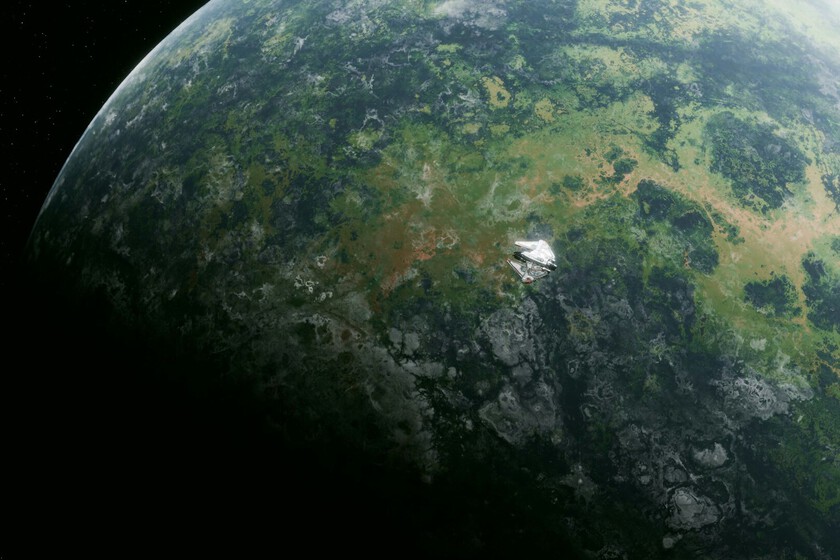
If we look at the Earth from space, in addition to distinguishing the shapes of the continents, great landmarks of nature and the occasional human construction such as the greenhouses of Almería, we can also observe how time and the seasons pass: the terrestrial vegetation follows a seasonal pattern, a kind of green wave that runs across the surface of the planet from north to south. Thus, in the boreal summer, the maximum of greenery moves towards the north. In the southern summer, towards the south.
From space we can also observe climate change and its effects. Without going any further, the peninsula it cracked after the torrent of rains at the beginning of the year and that green belt is also moving. Specifically, 14 kilometers a year, as determined by a research team from the University of Leipzig, the German Center for Integrative Biodiversity Research and the University of Valencia.
The discovery. The green wave is moving northwest and moving faster and faster. The southern hemisphere takes the cake: between 2010 and 2020, displacement accelerated to 14 kilometers per year.
Furthermore, it does so in a way that the scientific community did not expect: the center of global vegetation is moving north in both hemispheres. That it would do so in the northern hemisphere was expected, but that it would do so in the south was not (based on the patterns, one would expect it to move south). But it is also moving towards the east, breaking all schemes.
Why is it important. It is the first global metric of biological cycles expressed in kilometers, a magnitude as clear and intuitive as sea level or temperature and that works as if it were a compass. What this indicator says is that the north and south amplitude of the green wave is reducing: if you put a point on the map representing where the center of gravity of all the vegetation on the planet is, it would be moving towards the northwest.
The planet “greens” in an increasingly asymmetrical way. They explain that in a high emissions scenario, the eastern shift will end up dominating over the north at the end of the century. This involves a profound reconfiguration of where and when the Earth’s biosphere functions, which will affect carbon cycles, migrations and ecosystems.
Context. Global warming leads to global greening, a widespread increase in vegetation documented since the 1980s and concentrated especially in the northern hemisphere. The reason is global warming (as winters are shorter, plants have more time to grow), carbon dioxide that acts as fertilizer and that countries like China and India have intensified their agriculture. In fact, they are the drivers of change.
Why east? It is a direct consequence of the above: in short, because East Asia, India, Europe are “pulling” the center of gravity of global greenery towards the east. And South America does just the opposite: the vegetation there is losing strength, due to causes such as deforestation, droughts or changes in land use. Not only has East Asia become greener in recent decades, we know it now drags the center of gravity of the entire Earth’s biosphere.
How have they done it. To arrive at this metric and its effects, they have taken satellite data from 1982 to 2020 and have validated the results with six Earth system models from the CMIP6 project, which coordinates the simulations of the most advanced climate models.
From here, the research team has calculated the center of mass of all terrestrial vegetation in 3D Cartesian coordinates (called a centroid), weighted by greenness indices. They have called the moment of maximum hemispheric greenness viridistice, like the solstice. The resulting trajectory summarizes the dynamics of biological cycles in a single curve.
In WorldOfSoftware | Spain today has 12 more days of “extreme risk” of fires per year: the cause is neither arsonists nor ranchers
In WorldOfSoftware | A plant from the Red Sea has appeared in the bay of Palma. It is a bad omen for the future of the Mediterranean
Portada | Harsh Kumar