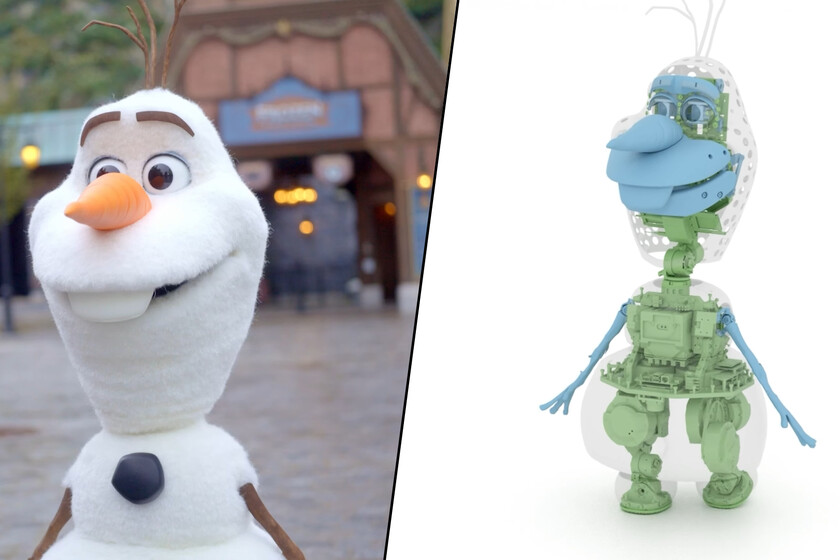
For decades, Disney has been a pioneer in bringing its characters to life through animatronics, an already classic part of its theme parks that gives them that ‘magic’ that dazzles children and not so children. However, for some time now they have been working on going further with the help of the latest advances in robotics and AI so that the experience ends up being even more authentic. For this reason, they recently announced that Olaf, the little snowman from the Frozen franchise, would arrive at their parks as the first completely autonomous robotic character.
As the company announced, Olaf will debut in the parks of Hong Kong and Paris during 2026. The interesting thing is that here we are not talking about a simple automaton, but rather its engineers have applied reinforcement learning and used the latest advances in robotics to accurately replicate the character’s movements.
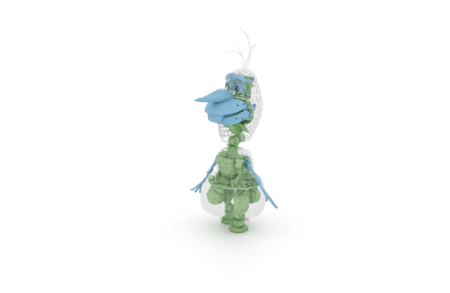

Olaf’s internal parts
A controlled scenario. The robotics that coexist with us beyond experimentation have traditionally been anchored to functional and specific objectives, from industrial robots to quadrupeds that traverse complex terrain. Disney knows that there is a niche where they can take advantage of the capabilities of this technology to ‘give life’ to their characters and, how could it be otherwise, continue selling tickets to their parks.
In this sense, theme parks become perfect settings for experimentation and development of advanced robotics, since they are controlled environments where robots can interact with thousands of people every day, learn from those interactions and perfect their behaviors, always with supervision.
The technical challenge that Olaf poses. According to the paper published by Disney Research Hub (and the interesting video published on their channel), creating Olaf posed certain problems. The character has a huge head supported by a tiny neck, small feet with no visible legs, and a walking style that does not respect real physical laws. To solve this, the engineers designed a system of asymmetrical legs (one inverted with respect to the other) hidden under a polyurethane foam “skirt” that simulates its snow body. This skirt not only conceals the internal mechanics, but absorbs impacts and allows for recovery steps without breaking the visual illusion.

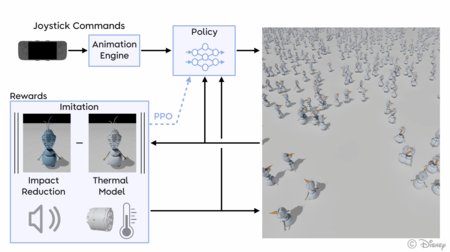

Reinforcement learning scheme that applies policies to modify your behavior
As the engineers responsible for its development explain, each facial joint, from the eyes to the jaw, is controlled by spherical and flat mechanical links that allow total expressiveness while keeping tiny actuators hidden under the costume.
The key: thereinforcement learning. Instead of manually programming each move, the team trained Olaf using reinforcement learning guided by reference animations created by artists. As Kyle Laughlin, senior vice president of Walt Disney Imagineering, explained to Variety, “a process that used to take years can now be done in days and weeks.”
Laughlin says that the system generates millions of simulations where the robot learns to walk, maintain balance and emulate gestures exactly as a child learning to move would do. But it’s not just about walking, since the AI must also capture that spark of personality that makes the character recognizable. And for this, those responsible explain that specific rewards were used that rewarded the precise imitation of the original animated cycle.

Noise and temperature. Two technical obstacles that threatened to ruin the robot’s credibility. On the one hand, the sound, since the robotic steps were too mechanical and noisy. According to those responsible, they introduced an additional reward during training that penalized sudden changes in the vertical speed of the foot when touching the ground. In this way they managed to reduce the average noise of each footfall from almost 82 dB to just 64 dB, all without significantly compromising their gait.
The second problem was overheating. And its thin neck houses small actuators that must support the weight of its large head, also covered by an insulating suit. The solution involved feeding real-time temperature data to the AI system using a thermal model integrated into the simulation. Thus, when the actuators approach the 80°C limit, the system subtly adjusts the posture to reduce engine torque before any damage is done.
A collaborative ecosystem accelerated by Newton. Behind the technological leap is Newton, a physics engine jointly developed by NVIDIA, Google DeepMind and Disney Research announced during GTC 2025 last March. “This is how we are going to train robots in the future,” said Jensen Huang himself, CEO of NVIDIA, at the last GTC conference showing the technology.
Newton allows you to accurately simulate how robots interact with deformable objects such as fabric or food, something crucial for costumed characters like Olaf, and is designed to integrate with MuJoCo, the physics engine already used by Google DeepMind to simulate complex joint movements.
From BDX to Olaf. The Star Wars-inspired bipedal BDX droids, which debuted in Galaxy’s Edge in fall 2023 and have since appeared at events like SXSW or even filming scenes for the upcoming “Mandalorian and Grogu” movie, were Disney’s initial step toward this technology. According to Laughlin, the company has “a solid roadmap” to deploy more autonomous characters with greater expressiveness and interactivity in theme parks and cruise ships. This idea is planned in the plan announced by Disney to invest $60 billion over the next decade in new attractions.
Valuable data. The arrival of this type of technology to its parks also provides them with reusable infrastructure. And the techniques used in Olaf, such as the compact asymmetric design, its thermal systems or its control based on acoustic reduction, can also be applied to future characters with equally strange morphologies.
In addition, it must be taken into account that the robots would operate daily under the public eye at all times, something that becomes an advantage, since each interaction generates valuable data on how to improve their behavior. Given what seems to be an imminent arrival of new humanoid robots powered by AI, Disney may end up being a very profitable client in this new era of robotics and also a powerful ally for robotics startups to convince us that we need one.
Images | Disney Research Hub
In WorldOfSoftware | I have asked for water from the first humanoid robot working in Beijing. It’s a weird vending machine.