
For more than a decade, programming and Stack Overflow were almost synonymous. When faced with an error, a question, or a line of code that didn’t work, the gesture was automatic: open the browser, search for the exact question and trust that someone, somewhere in the world, had already gone through the same thing. Today that reflection begins to fail. Not because the problems have disappeared, but because the conversation seems to have shifted. The data suggests that the place where millions of developers asked new questions in public is becoming increasingly silent.
Therefore, the value of Stack Overflow was not just in accumulating answers, but in how it constructed them. Each question was left open, debated and refined until the community agreed on which solution deserved to be highlighted. This process turned the platform into a technical thermometer: it allowed us to detect which languages were growing, which frameworks generated the most friction, and where the real problems of modern development were. Over time, that dynamic led many to assume that the software ecosystem as we know it would be difficult to understand without this collective repository.
The data that set off the alarms To understand what is happening, perceptions are not enough. The graph comes from the Stack Exchange Data Explorer (SEDE), a public tool that allows you to run SQL queries on historical data from the Stack Exchange network. In this case, the number of new questions published on Stack Overflow month by month has been measured. It is an imperfect metric, but very revealing when its evolution over time is analyzed.
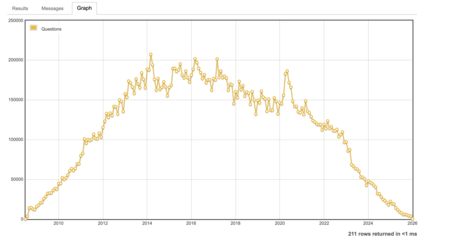

The fall of Stack Overflow reflected in a Stack Exchange chart
The data allows the recent history of Stack Overflow to be divided into fairly clear stages. Between 2008 and 2014, the platform experienced a phase of accelerated expansion, coinciding with its adoption as a global reference to resolve programming doubts. Starting in 2015 and until 2021, it enters a long stage of maturity, with high and relatively stable volumes of new questions. The turning point comes in 2022, when the trend reverses and the number of queries begins to fall steadily, a moment that coincides in time with the public emergence of tools like ChatGPT, a change of context that helps interpret the chronology, although it does not explain it on its own.
A historic low: The fall not only continues, but accelerates in the last section. Data from that series shows a decline from around 17,000 questions per month at the beginning of 2025 to approximately 3,800 in January 2026, the lowest level reflected in the graph in its final stretch. This fall marks a before and after, because it no longer speaks of progressive wear and tear, but rather of an abrupt change in the use of the platform.
The need for help does not disappear, but it changes location. Compared to Stack Overflow’s open model, AI offers immediate responses adapted to the context that the user provides, with results that may vary in quality and precision. You don’t have to formulate the question well for a broad audience or expose yourself to public corrections. Just ask for it. That comfort does not in itself prove a direct causal relationship, but it fits with the moment when public participation begins to fade.



AI enters the workflow: The internal X-ray reinforces what the graph suggests. According to Stack Overflow’s 2025 Developer Survey, conducted among more than 49,000 developers around the world, the use of AI tools now reaches 84% of respondents, up from 76% the previous year. GPT models lead that adoption, followed by Claude Sonnet and Gemini Flash. It is not a marginal technology, but rather a layer integrated into everyday life, which helps contextualize why fewer and fewer doubts are raised in public.
OverflowAI and the product pivot: Far from ignoring the change, Stack Overflow has begun to integrate artificial intelligence into its own proposal. OverflowAI is a suite designed to enable semantic searches and AI-generated responses that summarize knowledge already validated by the community. The idea is not to replace human responses, but to reorganize and make more accessible the enormous archive accumulated over years. In a context of falling new questions, the platform tries to remain useful as a point of consultation, although the interaction no longer takes the traditional form of the forum.
Integrate into the AI ecosystem: In parallel with the collapse of new questions, Stack Overflow has closed agreements with OpenAI and Google Cloud reached between 2024 and 2025 that place its content within the flow of development and improvement of language models. These agreements allow the platform’s technical file to be used as a reference to increase the accuracy of the responses. In practice, references to Stack Overflow may appear in some technical responses generated by AI assistants, although this does not in itself imply a stable return on direct participation by developers.


With this panorama, the question is no longer whether Stack Overflow has lost centrality, but what it means today to “continue to exist” for a platform like this. Data shows that public questions have dropped to historic lows, while accumulated knowledge continues to have value on and off site. Stack Overflow may stop being the place where you ask questions and become, above all, a silent layer that feeds other systems. What remains up in the air is whether this transformation is compatible with the open spirit that made it essential.
Images | WorldOfSoftware with Gemini 3 Pro
In WorldOfSoftware | As Google enters the AI race, Samsung has opted for a more intriguing move