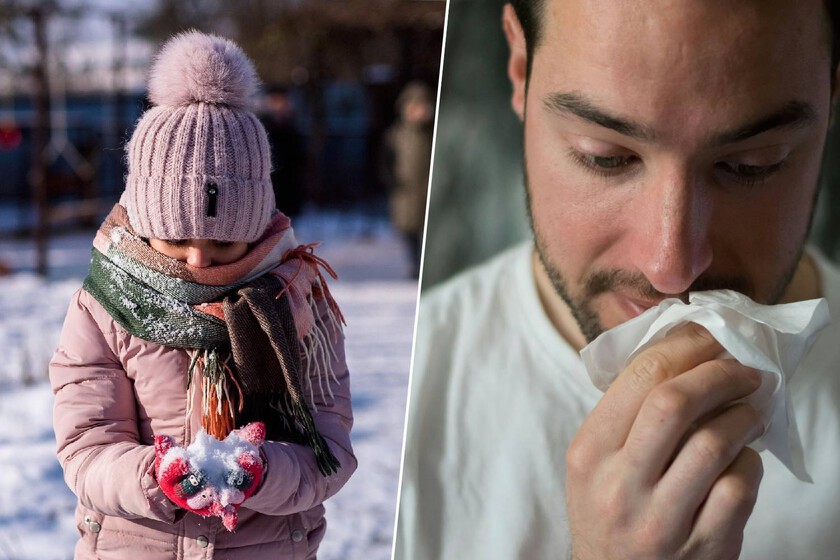
“Don’t go out with wet hair or you’ll catch pneumonia” or “put on your coat because you’re going to catch a cold” are very grandmotherly phrases that almost all of us have been told in our childhood and that have been burned into our brains. But the question we can ask ourselves: is this true? The reality is that not directly.
The culprit. Whether we have a cold or the flu does not exactly depend on the cold. The culprit in this case are infectious agents such as viruses, the most common being rhinoviruses. The fact that this microscopic germ accesses our body and overcomes our defense barriers causes it to begin to replicate and generate its effect, which in the long run is really annoying as it is accompanied by fever, cough and a host of other symptoms.
In this way, the equation is quite simple: if there is no exposure to the virus, the external temperature is irrelevant. To understand it, if we put ourselves in the situation of going out to Antarctica with our hair soaked and naked, we would surely die of hypothermia, but we wouldn’t catch a cold unless a penguin sneezed rhinovirus on us. The same thing happens if we are in an environment completely isolated from viruses and at a very low temperature: no infection would occur.
The experts. As Mayo Clinic experts and disseminating pharmacists explain, cold alone does not have the capacity to spontaneously generate a pathogen. Cold is a physical condition, not a biological agent.
And science has been trying to explain this for decades. One of the most cited and relevant studies is the one carried out by the University of Rochester where they separated volunteers into two groups. One of them was exposed to low temperature and cold conditions; the other was kept in a warm and comfortable environment. They were subsequently exposed to the rhinovirus that causes colds.
The result. In this way, it was seen that between the two groups there was no significant difference in the contagion of the virus or in the symptoms they presented. The group subjected to the cold did not have a harsher cold, so the factor in getting sick was solely and exclusively the virus.
Getting sick in winter. It is a reality that when winter arrives the rates of people with colds or the flu increase greatly, as we are seeing in Spain these days. This makes us think that the relationship really exists, whatever science says.
And this is where we give a little point to ‘grandmother’s advice’. Science suggests that rhinoviruses replicate best at the temperatures we usually have in the nose, which ranges from 33 to 35 °C. But in addition, the cold temperature also causes our defenses to lower, so it is much easier for the virus to access our body and begin to spread in a much simpler way. And that’s why winter is where we see a higher rate of colds.
Other factors. But he is not the only one. The social factor is also a big culprit, because when it is cold the truth is that it is better to be locked up at home with Netflix. But in these cases we would be in an interior space with little ventilation (because it is cold) and very close to other people. In this way, if a person has the virus, the probability of contagion increases in a closed, heated place much more than in an open-air park at 5°C.
Another point is the dry environment that exists at this time due to the cold outside and the indoor heating. This causes the nasal mucous membranes to dry out, which is a serious problem for the mucus, which is our first line of defense at the entrance to viruses and bacteria. If the mucosa is dry, its effectiveness decreases and facilitates the entry of pathogens.


Wet hair. A special distinction must be made for this myth since today there is no evidence to justify a relationship between wet hair and an increase in viral infections.
Going out with wet hair causes a great loss of body heat (since the head has a lot of vascularized surface), which generates notable thermal discomfort. This translates into a feeling of very cold, feeling cold and perhaps accompanied by a headache due to muscle tension derived from the cold, but the humidity on the scalp does not attract germs or facilitate infection.
Images | Dmitriy Kievskiy Brittany Colette
In WorldOfSoftware | H5N1 bird flu unleashes a massacre in Antarctica: half of the female seals have already disappeared