




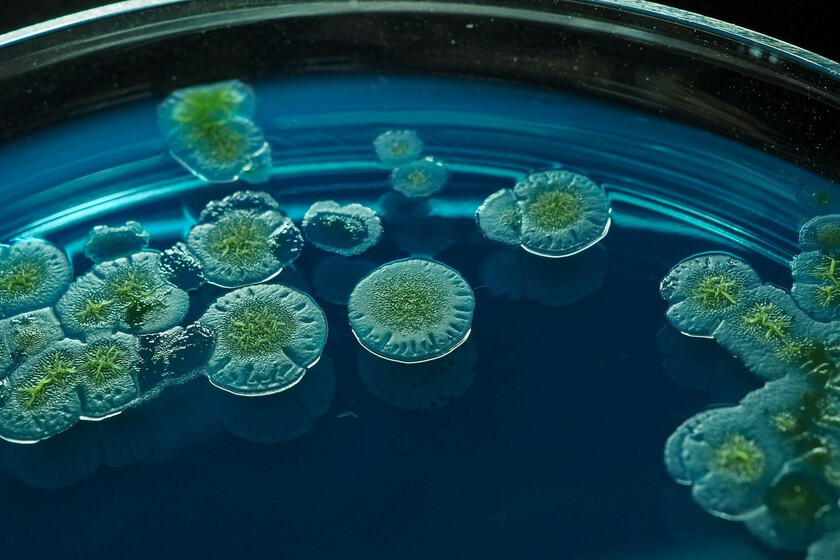
In the hospital environment there is a fungus that is undoubtedly a real nightmare for modern healthcare systems, since it can put an entire hospital floor in check. We talk about the fungus Candida auris, which was first identified in 2009 and which is undoubtedly a “superfungus” resistant to most common drugs and which can spread quickly and be a silent epidemic that kills more and more human beings.
Your weak point. Due to its aggressiveness, science has a clear objective: to find its weak point in order to develop a drug that allows us to destroy it. Now a group of researchers has published research in Communications Biology that changes the rules of the game: they have identified the exact genetic process that the fungus uses to survive inside the human body. And knowing its insides gives us options to destroy it.
The iron problem. Like almost any living organism, this fungus needs iron to grow, replicate and cause damage. In the human body, iron is not “free” precisely as a defense system to prevent pathogens from using it against ourselves.
Now science has seen that the fungus Candida auris It has a strategy to avoid this defense barrier that our body has. And the secret is in its genetics, specifically in specific genes called XTC, which literally act as ‘suction pumps’ that allow the fungus to capture iron even in the most hostile conditions.
And this is the key. If iron is what feeds them, and we already know how they get the mineral from our own body… we already have the key to preventing them from consuming our own reserves.
An unexpected ally. One of the biggest challenges in studying this fungus is that it has the ability to reproduce at high temperatures such as 37ºC. This makes it difficult to use traditional models to carry out studies, which until now were zebrafish, which want cold waters.
To overcome this drawback, the research team used a rather innovative model: the killifish. A small fish that is able to live in desert environments and tolerate temperatures of up to 37 °C, making it a perfect “living laboratory” to observe how the fungus behaves in real time within a vertebrate organism.
Its importance. It must be taken into account that we are dealing with a pathogen that the WHO classifies as a “critical priority”, and that is why this research gives rise to the creation of drugs that attack the ‘suction’ system of fungi in order to defeat them. Plus, we already have something in our drug repository that we could use: iron chelators. An option that can ‘starve’ mushrooms, but has yet to be tried.
In addition to this, the pathogens will be able to be identified much better, since there are strains of fungi that are much more aggressive because they capture a much greater amount of iron inside.

The future. Although we have the focus on superbacteria that can doom humanity, research must also focus on fungi that are developing resistance to specific treatments. In this way, finding a path that the fungus “cannot avoid” gives us, for the first time, a strategic advantage that we should not hesitate to use.
Images | masakazu sasaki
In WorldOfSoftware | A viral video has “shown” all the bacteria in a drinks can. It’s more complex than it seems


