




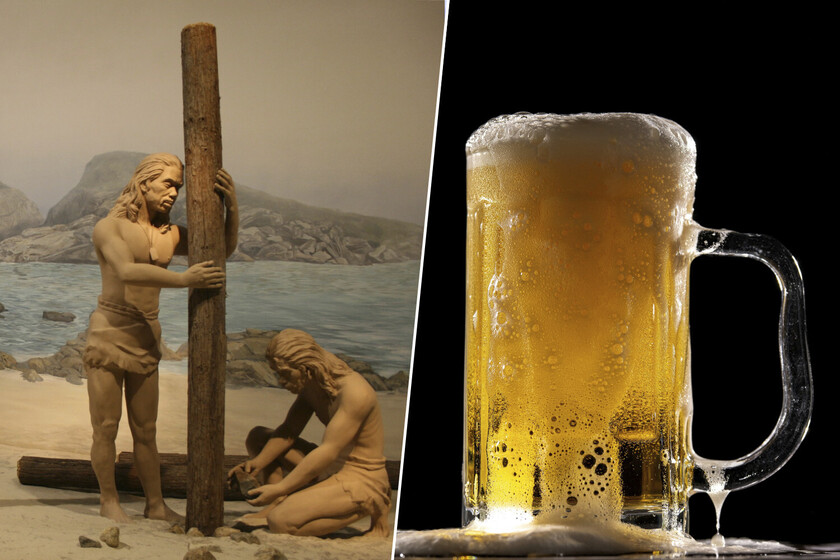
The big question is not whether it was the chicken or the egg first, but rather what our ancestors began to make first: bread or beer? About 12,000 years ago, humans promoted one of the most important chapters in our history in the Middle East, the Neolithic Revolution. From being nomads who lived by hunting and gathering, we became sedentary creatures who cultivated the fields. The change was so momentous that anthropologists have long wondered what caused it. It would be reasonable to think that the search for something as simple as bread, but there are those who believe that the answer is something else: beer.
What if the great catalyst that led us to plow and harvest the fields was not the search for bread but our ancestral love of raising our elbows?
Cereals, what do I want you for? Scientists have spent the last few decades unraveling the mysteries of our most remote past, but there is one (fundamental) one that they have not yet agreed on: What the hell led humanity to change hunting and gathering for a sedentary life based on agriculture and livestock? What was the catalyst for the Neolithic Revolution, one of the most momentous periods of all time?
Since since humans have been human, they need to eat, the answer seems simple: if those men and women settled to plant wheat and barley, it had to be to make bread, right? That is, they began to spend hours and hours tending their fields to obtain grain with which to nourish themselves. In the 1950s, however, a question began to creep into the anthropological debate: What if what really interested them in grain was not bread or porridge but beer?


But… And why is that? The debate is not new. It has been on the table for some time and is heated from time to time with new discoveries, such as the one announced in 2018 by a group of Stanford researchers who found “the oldest record of alcohol”, clues that tell us about the making of beer 13,000 years ago.
The last one to raise the discussion was Michael Marshall, a scientific journalist and columnist for New Scientist. In December he published an extensive chronicle in which he reviews the latest findings on the subject and (most importantly) exposes how much it is costing anthropologists to reach a conclusion.
The benefits of beer. To understand the discussion, we must first clarify a key point: neither the bread nor the beer of the Stone Age were like the bread and beer that we know today. The latter in fact has little or nothing to do with the refreshing amber liquid that they serve us in bars. It was more like a puree, a “sweet, slightly fermented porridge,” says Professor Jiajing Wang of Dartmouth College in New Hampshire. “They germinated the grains, cooked them and then used wild yeast.”
The result was a nutritious, caloric, protein-rich concoction that could even be safer than drinking water from rivers and wells. After all, it was the result of fermentation. Added to that was its alcohol content, a “social lubricant” that we still use in the 21st century to relax and socialize. Archaeologist Brin Hayden highlights, for example, its use in events that helped structure communities. There is research that suggests that (at least some communities) used it in rituals and for veneration of the deceased.


Much more than suspicions. If the debate has been on the table since the 1950s, it is basically because it has been nourished by archaeological findings. Researchers have found vestiges that tell us about beer brewing at least 5,000 years ago in southern Egypt and northern China or how 10,000 years ago the Shangshan culture was already brewing rice beer.
One of the most important revelations in recent years was, however, achieved in a cave in Israel in 2018 by a team led by Professor Li Liu, from Stanford University. There they found evidence of beer brewing before the first cereals cultivated in the Middle East. The discovery is related to the Natufians, a people dedicated to gathering and hunting, although they also tended to stay for long periods in the same place.
“The oldest”. After analyzing residues located in 13,000-year-old mortars located in a cave in Raqefet, a Natufian cemetery near Haifa, Liu and his colleagues discovered remains of beer. A milestone, as she herself highlights: “It is the oldest record of alcohol made by man.” “This discovery indicates that alcohol production was not necessarily a result of agricultural surplus production, but was developed for ritual and spiritual purposes, at least to some extent, before agriculture.”
Issue settled? At all. To understand the complexity of the issue, it helps to review the discovery announced in 2018. At least at that time, the oldest known remains of bread, extracted from a Natufian site located in eastern Jordan, were between 11,600 and 14,600 years old. The traces of beer discovered by Liu’s team move in a similar range: a priori, they could be dated between 11,700 and 13,700 years ago. One of the keys to the problem, Marshall explains in his article, is that basically the making of bread and beer leaves very similar traces, basically starch residues.
“We still don’t have conclusive evidence to answer that question,” Liu acknowledges on the question of whether we turned to beer or bread first. The reality is more complex: because we don’t know, we don’t even know if some of those foods were the great catalyst that led our ancestors to change their lifestyle. “I wouldn’t be surprised if both were the motivations.”
At the end of the day, the ‘beer first, bread first’ debate does not seek definitive conclusions so much as vindicating the weight of both foods. Both beer and bread, bread and beer, played a decisive role in diets and rituals.
Images | Gary Todd (Flickr), Enhin Akyurt (Unsplash) and Gerrie van der Walt (Unsplash)
In WorldOfSoftware | The Wari dominated pre-Columbian Peru before the Incas. They did it thanks to drugs and psychedelia


