
During these three years of coexistence with ChatGPT, there has been a certain feeling that the usual search engine is no longer essential. The chatbot responds in natural language, allows for questioning and, in many cases, saves time compared to a list of links. But that comfort does not necessarily imply that it is doing the same job as Google. Searching is not always about getting a closed answer: it is also about exploring sources, comparing and deciding for yourself what information to give credit to.
To understand what is really changing, it is worth looking at how each tool is used and not just how they are talked about. Before moving on to the study, we can ask a specific question: when we open ChatGPT, are we searching for information in the classic sense or are we doing something else? The nuance matters because “searching,” as we have said, mixes very different actions.
What studies say about the true relationship between ChatGPT and Google
A paper from the National Bureau of Economic Research prepared with data provided by OpenAI is the starting point to address this topic. It is built from messages sent to ChatGPT automatically classified to detect patterns without anyone reading the content. The objective is not to evaluate the quality of the responses, but to measure why we use the chat in practice and how that use changes over time.
The first photo offered by the paper is clear and should be given with temporal precision. In June 2025, 73% of messages were considered non-work related, compared to 27% linked to work tasks. This distribution also changes with respect to previous stages that the study itself compares, and suggests that personal use is gaining weight over time. The data matters because it questions a widespread idea: that chat is above all a professional tool.
When the analysis goes down to detail, the activity is concentrated in three large categories.
- Practical guidance: when we want to understand something, clarify concepts or see options more clearly.
- Information search: investigate specific facts, topics or questions (this is the section that is closest to the traditional web search pattern).
- Writing: includes everything from writing to structuring ideas and planning tasks.
This translates to very recognizable gestures that do not depend on a list of results. We sometimes use ChatGPT to clarify ideas or ask for guidance. Other times we delegate work, from polishing an email to organizing a document or preparing a plan. And, to a lesser extent, it is also used as a space to think out loud and organize concerns. In all of those cases, the value is not in reaching a page, but in receiving a response tailored to the immediate context and in the form of usable output.
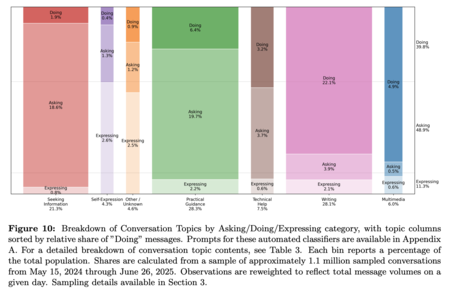

That’s where the comparison with Google becomes more accurate. The search engine is designed to show a map of linksallowing us to explore sources and decide which ones to enter, with the cost of reading, comparing and synthesizing information scattered on the web. ChatGPT, on the other hand, concentrates some of that work on an answer and adjusts it to what we have asked, which shifts the effort from navigation to interpretation.
This coexistence fits well with what Nielsen Norman Group describes in one of its studies. Their main conclusion is that search habits are surprisingly persistent and that we tend to start with what is familiar, even when we have already incorporated AI tools into other daily tasks.



We often use it as a mental and practical shortcut to reach destinations we already know. Instead of typing “youtube.com” directly, we type “YouTube” into Google and from there we access the site. Under this scheme, the search engine continues to operate as a great gateway to the web ecosystem, rather than as a pure discovery engine.
The result is neither a clean replacement nor an immediate replacement, but rather a more fragmented and functionally distributed ecosystem. We alternate between traditional search engines and chatbots depending on the moment and the taskand that redistributes the effort between finding information, understanding it, making decisions and producing content. Even so, it is advisable to handle these data with caution. The ecosystem is still moving and habits are still adjusting, so we should not read these results as definitive.


On the other hand, Google has been incorporating layers of generative AI, from AI summaries to the so-called AI Mode. However, for now the link-based model continues to set the pace of the experience. And the service continues to be a dominant source of traffic for the website, although its own AI integration is already starting to reduce the need to click in many cases.
Imagenes | Berke Citak | Firmbee.com | sarah b
In WorldOfSoftware | Microsoft has reduced its ambition with AI. It has been realized that almost no one uses Copilot, they say in The Information