




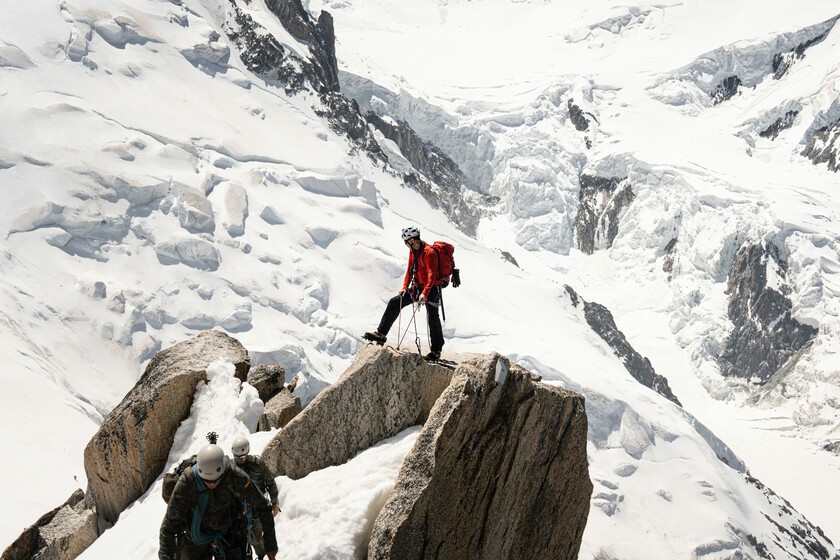
Not all adventures have to be successfully resolved to become epic. It happened with what is known as the Imperial Transantarctic, the expedition that left England in August 1914 under the orders of explorer Ernest Shackleton with an enormous purpose and not for the faint of heart: to cross Antarctica, from Vahsel, in the Weddell Sea, to Ross Island, at the other end.
Due to the harsh conditions of the South Pole, the ship Endurance ended up trapped in the ice and Shackleton saw how his plans became complicated until they dragged him into a real feat that took his endurance and that of his colleagues to a limit level only achievable between icebergs, glacial temperatures and extreme exhaustion.
The explorer’s feat also served something that he probably did not even suspect: coining the expression “third man factor or syndrome.” Well known by mountaineers and which is, even today, a fascinating phenomenon.
“Who is the third person walking beside you?”


Ernest Shackleton (left) with Robert Falcon Scott and Edward Wilson in Antarctica, 1902.
The phenomenon was described by Shackleton when he recalled the very hard two and a half days during which he advanced—along with Frank Worseley and Tom Cream—towards a whaling station located on the northern coast of South Georgia. The group walked 36 long hours between terrible conditions, with hardly any material and avoiding death. On their shoulders they also carried the responsibility of having to help the rest of their companions from the ill-fated Imperial Transantarctic.
Only the three of them, Ernest, Frank and Tom, wandered through the desolate Antarctica, although if someone had asked them how many people made up that desperate entourage, they would probably have answered something different: that with them was another person, a fourth member, nameless, faceless… but undeniable.
“I know that during that long and stormy march over nameless mountains and glaciers, it often seemed to me that there were four of us, not three,” the explorer wrote. That common sensation, precise The Guardianoverwhelmed the three men who undertook the journey: the presence of a “fourth” that accompanied them.
Such an expression must have surprised the poet TS Eliot, who some time later, in 1922, after reading Shackleton’s story, picked up the idea to capture it in his popular poem The Waste Land: “Who is the third one who always walks by your side? When I count, there is only you and me together, but when I look ahead on the white road there is always another walking at your side.”


Eliot’s license, which changed Shackleton’s “fourth” man for a “third” was successful and since then we often speak of the “third man syndrome” to refer to that: the feeling of a ghostly companion, a presence that in some way comforts people facing a borderline sensation.
Shackleton was not the only one to describe it. Several years after his death, in 1933, Frank Smythe, a British explorer like him, recounted a similar experience while trying to reach the summit of Mount Everest. “The whole time I was climbing alone I had the strong feeling that I was accompanied by a second person. It was so strong that completely eliminated all the loneliness I might otherwise have felt,” the explorer wrote in his diary.
The sensation was so vivid that, Smythe explains, at one point during the ascent he searched in his pocket, took out a piece of Kendal Mint Cake, broke it and turned to offer one of the halves to that companion who felt so close.
He didn’t see anyone, of course.


You don’t have to go back that far in time. Not that far. The Madrid mountaineer Fernando Garrido wrote in his notebook the sensation that overwhelmed him when, at the beginning of 1986, he spent more than two months on the solitary summit of Aconcagua, at almost 7,000 meters, to achieve the record of survival at altitude.
“Today, like other times, I woke up with the feeling that there was someone outsidenext to the store. Have you spent the night there? Why didn’t he call me to let him in? (…) —said the mountaineer in statements collected by the The Confidential—He’s my brother, my brother Javier! Javi, wake up, come on, wake up! I turn it towards me. “He is dead, his head is a skull.”
“A solid science”
A good handful of articles and references have been written about the phenomenon, some in media within the reach of The Guardian or NPR, and in 2008 the writer John Geiger even dedicated a monographic book to him, ‘The Third Man Factor: Surviving the Impossible’ after spending five years tracking down similar stories.
It is more complicated than collecting experiences, however, to give them a plausible explanation. Years ago, during a talk with NPR journalist Guy Raz, Geiger related that there are those who turn to spirituality, although he insists that the syndrome can be explained by “a solid science”. “Many skeptics and non-believers have had this experience and attribute it to other causes,” claims the author, who in his volume even includes the case of a 9/11 survivor.
In 2009 Geiger pointed out explanations such as biochemical reactions or simply failures in brain activity. “If we understand that the third man factor is part of us, like adrenaline is… then we can access it more easily. It is not a hallucination in the sense that hallucinations are disordered. This is a very useful and orderly guide,” he reflected.

Years ago, researchers Ben Alderson-Day and David Smailes commented on the phenomenon and explained that “strong feelings of presence” do not occur only in dramatic circumstances. Cases have been recorded after bereavement, during sleep paralysis or in cases of neurological disorders, such as Parkinson’s disease or brain damage. “The different contexts in which they occur give us some clues about what could be happening,” they say.
“Understanding more about how and why felt presences occur has the potential to tell us many things about ourselves: how we react under intense mental or physical stress, how we deal with danger and threat, and how we recognize the shape and position of our own body.”
“One thing it can also do is shed light on other unusual experiences that are difficult to understand,” the experts conclude in their 2015 article: “The Third Man doesn’t just tell us about our minds or bodies; he offers us a way to help and understand others, as he did with Shackleton.”
The passage of time has not made the phenomenon more fascinating, nor has it diminished its interest for experts, who work for example for know better dangers that lie in wait for mountaineers beyond glaciers, blizzards or chasms, threats that are in their own heads, such as isolated altitude psychosis.
Images | Thibault Lam Tran, Mountainarious (Unsplash), Wikipedia, the free encyclopedia
In WorldOfSoftware | The Winter Olympics leave Italy with a debt of 7.8 million dollars. Not to organize them, to win them
In WorldOfSoftware | The wildest race on the Olympic tracks in Cortina was in 1981. A man launched himself dodging bullets and assassins on a motorcycle


