




The failure mode that shows up after everything feels aligned.
The Moment Everyone Relaxes
There’s a moment most senior teams recognize.
The decision is made. The memo lands. No one pushes back.
The room relaxes.
Meetings get shorter. Language tightens. Questions disappear.
It feels like progress.
It usually isn’t.
Because the most dangerous systems don’t fail under pressure.
They fail after stability sets in.
The Misunderstood Problem
Most senior teams think the risk is misalignment. It isn’t.
The real risk is assuming alignment exists because no one is objecting. Agreement becomes a proxy for understanding. Silence gets mistaken for clarity.
The team moves forward believing it shares a mental model,
when it’s really just sharing language.
Why Confidence Changes the System
Early teams ask too many questions.
They repeat themselves. They argue over definitions. They slow everything down.
It feels inefficient. n It’s also how shared understanding is built.
Senior teams behave differently.
They’ve seen these patterns before. n They trust experience. n They recognize shapes instead of interrogating assumptions.
So, interrogation gets replaced by recognition.
That swap feels harmless.. even smart.
But it changes how the system works.
Confidence doesn’t just speed decisions. n It quietly removes the need to explain them.
This Isn’t About Ego or Politics
When this pattern shows up, people reach for human explanations.
Groupthink. n Hierarchy. n Communication breakdowns.
Those explanations are comfortable.
They’re also incomplete.
What’s breaking isn’t behavior. n It’s structure.
Decision-making at senior levels is a system.
And systems fail in predictable ways.
The Stack Most Teams Don’t Notice
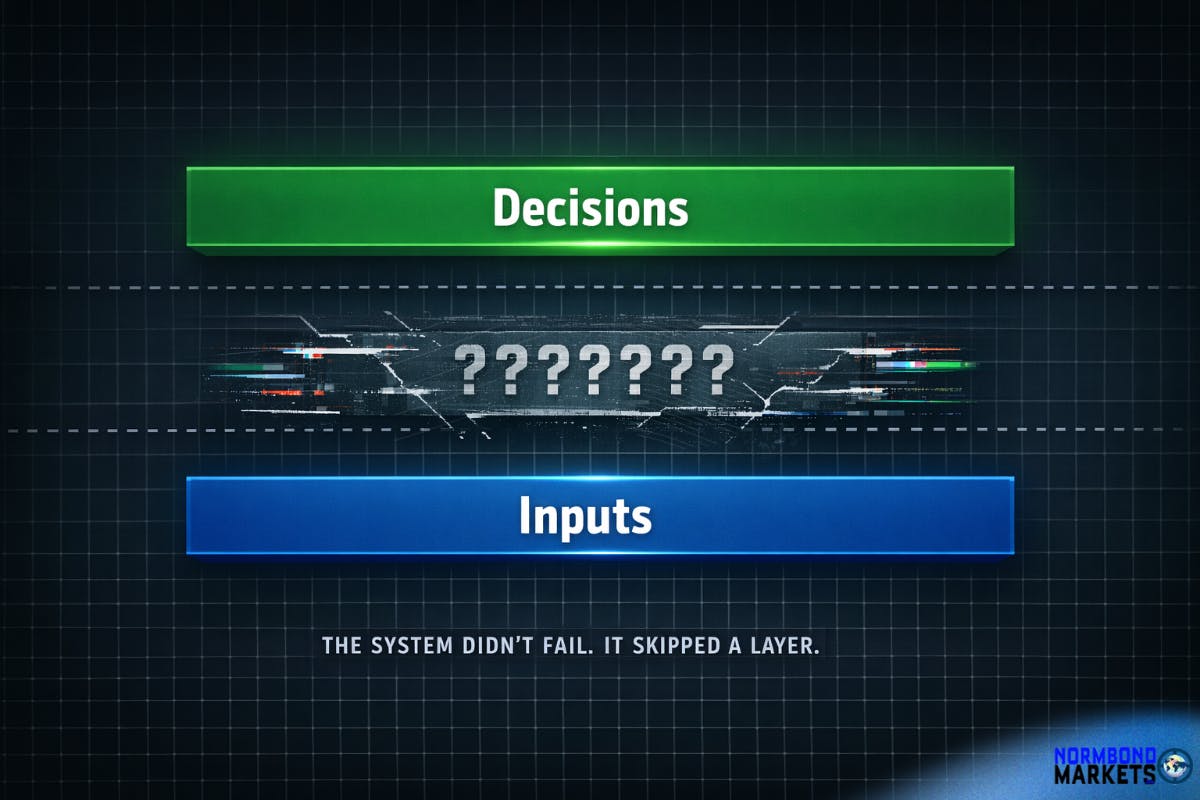
Most leadership decisions run on a simple stack:
Inputs: Metrics. Market signals. Customer data.
Interpretation: What those signals mean.
Which assumptions are in play? n Which model is being applied?
Decisions: What gets prioritized. n What gets funded. n What gets dropped.
Early teams spend time in the middle layer.
Senior teams compress the stack.
Inputs jump straight to decisions.
Interpretation doesn’t disappear. n It goes private.
Experience becomes the compiler. n The reasoning just stops being visible.
What Interpretive Drift Looks Like in Practice
You don’t see this failure as a blow-up.
You see it as a series of reasonable outcomes.
- A roadmap everyone “agreed” on ships. But no one can explain it the same way.
- A post-mortem finds no execution errors, only vague external causes.
- A strategy handoff creates weeks of clarification. Not because teams are confused, n but because intent was never fully externalized.
In each case, nothing went wrong in the room.
No disagreement. n No confusion. n No visible risk.
The failure shows up later, downstream, n where decisions finally meet reality.
Why Data Doesn’t Solve This
Teams often respond by adding more data.
Better dashboards. n Cleaner metrics. n More reports.
But data doesn’t interpret itself.
Two leaders can look at the same metric n and apply different mental models n without realizing it.
The problem isn’t information scarcity. n It’s interpretive invisibility.
And interpretation is the first thing confidence removes.
The Pattern Has a Name
This isn’t misalignment. n It isn’t confusion.
It’s drift.
Interpretive drift.
It follows a familiar loop:
- Success builds trust in intuition
- Language compresses
- Assumptions go unspoken
- Agreement accelerates
- Internal models diverge
Execution continues.
Understanding doesn’t.
Why Senior Teams Are Especially Exposed
Experience earns speed. n Speed reduces friction.
Friction is where assumptions get tested.
So the more capable the team, n the easier it becomes to stop making thinking visible.
Not because people are careless. n Because the systemrewards confidence.
That’s the paradox.
The teams best equipped to reason deeply n are the ones most likely to stop showing their reasoning.
The Recognition Point
Every senior team remembers a decision that felt obvious.
The real question isn’t whether it was right.
It’s whether it felt obvious n for the same reason n to everyone in the room.
Systems don’t fail when people disagree.
They fail when confidence convinces the system n that disagreement is no longer necessary.
When decisions feel obvious, n that’s not the end of thinking.
That’s the moment the system most needs to be inspected.


