




Although the teleworking rate in Spain has doubled since 2019, in the last two years it has stagnated at around 14%. The return to the office that companies have promoted has caused the hybrid shift to climb positions, while 100% remote shifts are declining.
However, according to a recent report from the US National Bureau of Economic Research, in the not too distant future this situation will once again shift towards remote work models. Specifically, the report places this change at the time when the current CEOs of the Baby Boom generation retire.
Young people love teleworking. According to the study of National Bureau of Economic Research (NBER), workers in companies created after 2015 allow on average 27% more days of teleworking than those companies founded before 1990. For their part, self-employed professionals work from home more than twice as often as other workers.
Researchers at Stanford University observed a pattern in data from 8,000 American workers ages 20 to 64, surveyed monthly through 2025. Startups often adopt technologies and ways of working that facilitate remote work from the start. As your age advances, the possibility of teleworking is progressively reduced.
The age of the boss makes a difference. The study found a direct relationship between the age of the company’s CEO and the number of days its employees were allowed to telework. The younger the CEO, the more days a week his employees were allowed to telework.
The data show a clear drop in required office days as the age of the manager decreases. This suggests that younger managers accept teleworking as something natural, not as an extra effort that slows down daily performance. “Employees telework more frequently in companies with younger CEOs,” the study’s authors noted.

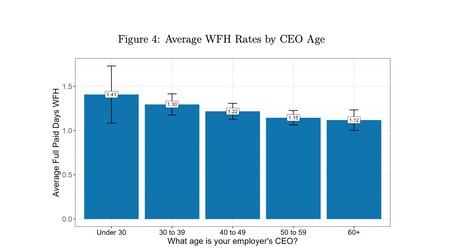

Relationship between the age of CEOs and teleworking time Source: NBER
Boomer retirement will drive change. According to the researchers, as managers boomers and Generation X retire over the next decade, millennials and Generation Z will take over. This will make teleworking once again the norm, not the exception, despite the fact that the current policies of large technology companies such as Amazon or JPMorgan require going to the office five days a week.
The NBER study concludes that this trend may mark a turning point when changing jobs for those who do not want to wait for their bosses to retire to work more days from home: if you want to telework more days, prioritize young companies with young bosses.
Bosses who were trained remotely. As highlighted in Fortuneyounger CEOs are not only more aware of the importance of flexible hours and teleworking in the well-being of employees, but they have trained and developed their companies with tools such as Slack, Zoom or AI from the beginning. This generates companies that are digitally native by nature, where remote and in-person work use the same tools and processes.
Mark Dixon, executive director of the coworking platform International Workplace Group (IWG), said in an interview for Fortune that “embrace comprehensive technology, which includes flexible working, remote location, high levels of technology and using technology to get the most out of your staff. Those will be the winning companies, because it is people-centric.”
In WorldOfSoftware | Neither tax incentives nor free daycare have managed to improve birth rates: teleworking has
Image | Unsplash (Redmind Studio)


