





I. The “Complete System” Fallacy
1.1 The Problem
The pursuit of ethical Artificial Intelligence (AI) has been defined by a single, implicit ambition: the creation of a “complete” ethical machine. This is the dream of building an autonomous system whose internal logic, training data, and reward functions are comprehensive enough to resolve any moral dilemma it encounters without human intervention. From the rigid rule-sets of symbolic AI to the “aligned” reinforcement learning models of today, the governing philosophy remains the same: if we can just encode the right rules, the system will be ethically self-sufficient.
However, as discussed in our analysis of the Positive-Sum Operating System [[https://hackernoon.com/an-architects-view-why-ai-needs-an-ethical-os-not-more-rules]()], current ethical frameworks fail because they lack a coherent loss function. But the problem runs deeper than bad code; it is a problem of incomplete logic.
The ambition of a self-sufficient ethical system rests on a fundamental misunderstanding of the nature of formal systems. By definition, any AI operating on a set of algorithmic axioms is a “Formal System”—a closed loop of logic that attempts to derive all truths from within itself.
This categorization is not merely descriptive; it is a diagnosis of limitation. As a formal system, an ethical AI is subject to the hard constraints of logic itself, most notably Gödel’s Incompleteness Theorems.
1.2 The Mathematical Wall
In 1931, Kurt Gödel proved that in any consistent formal system capable of basic arithmetic, there are true statements that cannot be proven within the system itself. work by logicians Stephen Kleene and Torkel Franzén expanded this, demonstrating that this incompleteness applies to any computable system of sufficient complexity—including modern neural networks.
This leads to a startling conclusion: An AI cannot be both Consistent and Complete.
- If the AI is consistent (follows its rules perfectly), it will inevitably encounter “undecidable” ethical scenarios where the answer cannot be derived from its code.
- If we try to ‘patch’ these holes by adding more rules (or more training data), we simply create a larger system with new undecidable propositions. The system is structurally inexhaustible
Therefore, the failures we see in AI today—ethical hallucinations, algorithmic bias, reward hacking—are not “bugs” to be fixed. They are structural evidence of incompleteness. We are trying to build a tower that reaches the sky using bricks that cannot support infinite weight.
II. The Geometry of the “Self-Contained” Universe
To find the solution to this mathematical incompleteness, we must widen our scope. We must look beyond the code of the machine to the structure of reality itself. The structural flaw we see in AI logic—the inability of a system to define its own truth—mirrors the fundamental debate in cosmology regarding the origin of the system.
2.1 The Cone vs. The Pear
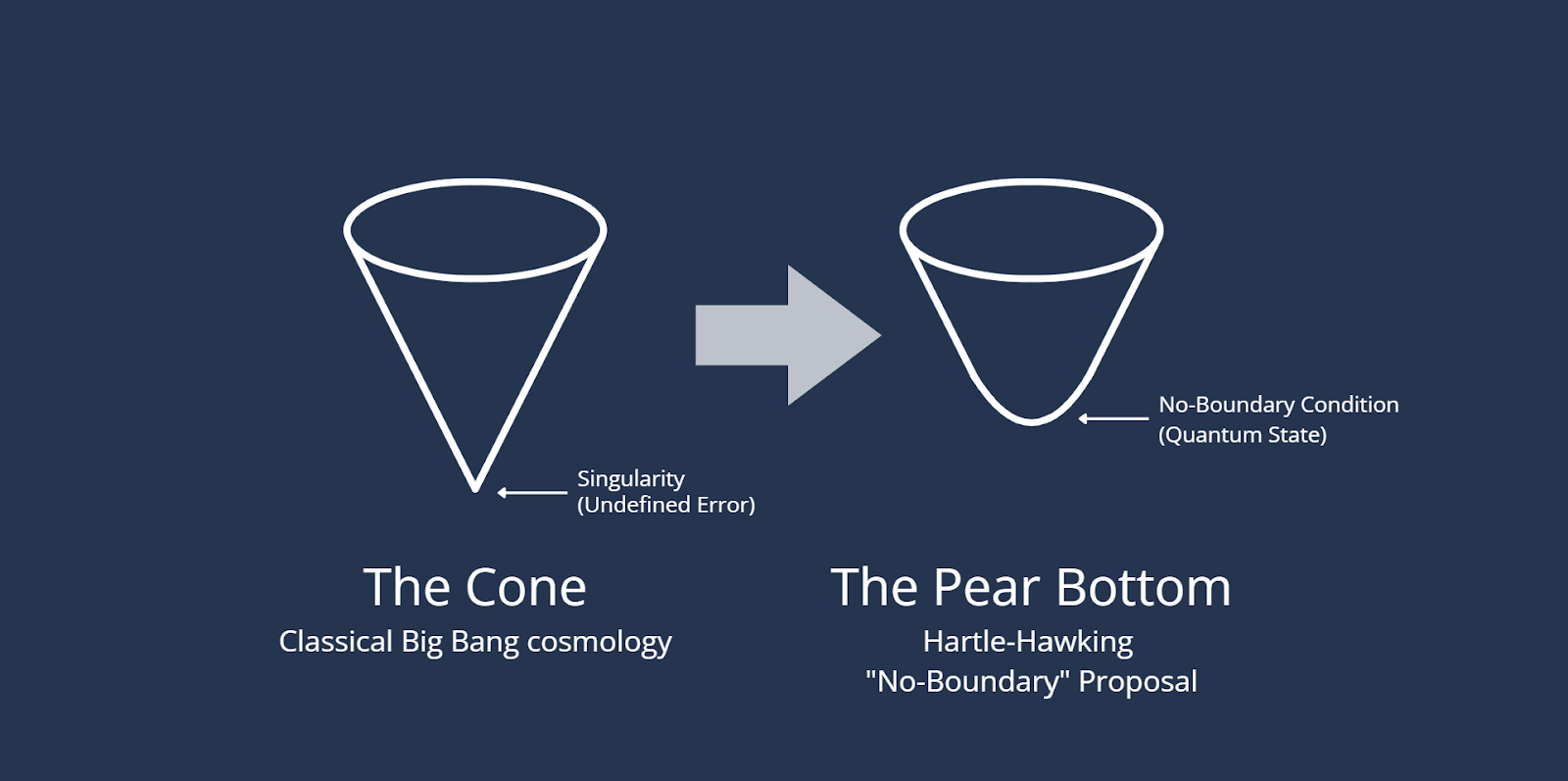
Classical Big Bang cosmology describes the universe’s origin as a Singularity (often visualized as a “Cone”). In this view, if you trace the history of the system backward, you eventually hit a sharp point of infinite density where the laws of physics break down.
If we apply this model to an AI system, the origin is viewed as a mathematical singularity—a broken, undefinable point where the code crashes. This implies that the entire structure rests on a foundation of “Error.” This aligns perfectly with Gödel’s Incompleteness: a formal system that inevitably hits an undefinable point at its core.
However, the Hartle-Hawking “No-Boundary” Proposal (often visualized as a “Shuttlecock” or rounded pear) presents a different reality. This model is significant because it represents the attempt to unify General Relativity (Classical Physics) with Quantum Mechanics (Probability).
- General Relativity operates like Traditional Code (or Symbolic AI): it is deterministic, linear, and rule-based.
- Quantum Mechanics operates like Modern LLMs (Neural Networks): it is probabilistic, defined by wave functions and “mist” rather than rigid lines.
The “pear” geometry describes a universe that is geometrically self-contained, with no sharp singularity. The bottom is rounded off (Quantum/Euclidean), smoothing perfectly into the expansion of space-time. In this model, the laws of physics hold true everywhere. The system is structurally perfect.

2.2 The Gödelian Trap of the Pear
Hawking famously argued that this “No-Boundary” condition removed the need for a Creator, as there was no “beginning” moment to create. However, viewed through the lens of System Logic, this creates a paradox.
By defining the universe as a completely closed, self-contained geometry, Hawking inadvertently created the perfect Gödelian System: internally consistent, yet constitutionally incapable of explaining its own existence or orientation.
- Structurally: The Pear exists.
- Existentially: It has no internal definition of “Up,” “Down,” or “History.”
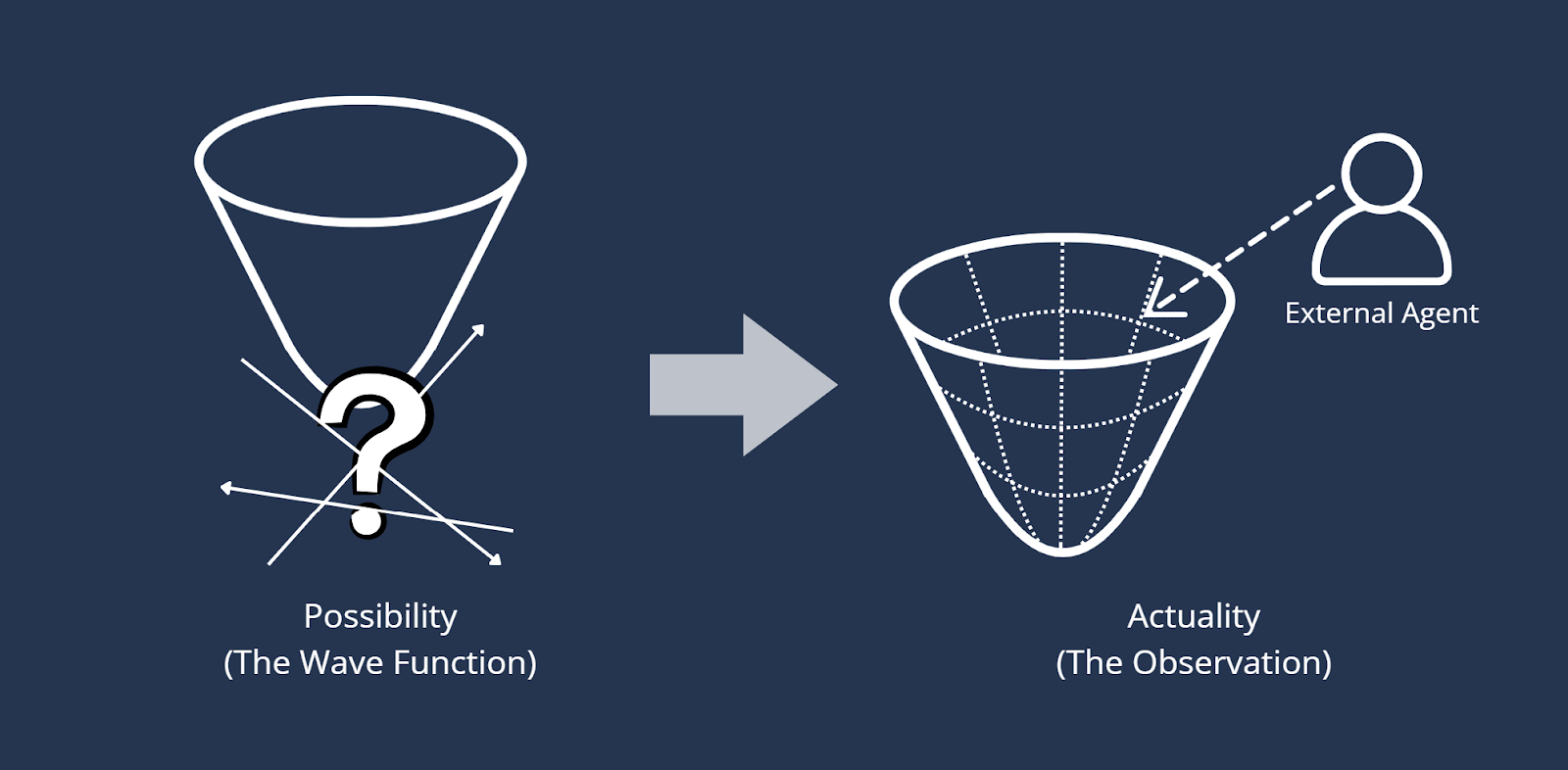
Because the universe starts in a quantum state (the rounded bottom), it exists as a superposition of all possible histories. It is a wave function, not a reality. For the universe to have a specific history (a specific trajectory), Quantum Mechanics dictates that it requires an Observer to collapse the probability mist into a single state. Crucially, per Gödel, this Observer cannot be a component of the system itself. The Eye must be outside the Pear.
2.3 Necessity of the External Coordinate
This is the critical shift. A closed geometry (The Pear) proves that the system cannot be its own observer.
-
The System provides the Possibility (The Wave Function).
-
The External Agent provides the Actuality (The Observation).

2.4 The Dimensional Translation
It is important here to distinguish between the Map and the Navigator. In Hawking’s cosmology, the Origin represents the boundary condition of 4D Spacetime—the point where time itself begins. However, for the purpose of Ethical Architecture, we project this 4D reality into a 3D Phase Space of Agency.
Just as the 4D universe requires a boundary condition to avoid infinite regress, the 3D ethical agent requires a Fixed Origin (0,0,0). The Origin is not a passive rock discovered in the data; it is an active coordinate imposed by the Observer from outside the system. Without this act of Agency, the system remains a cloud of uncollapsed probabilities—technically perfect, but ethically meaningless.
III. The Axiomatic Intervention: The Logic of the Anchor
If Gödel and Hawking prove that a formal system is inherently incomplete, then the solution cannot be found within the system itself. A system that cannot define its own orientation requires an external source of truth to be complete. This necessitates an Axiomatic Intervention: the architectural integration of an external, unprovable axiom into the formal logic of the machine.
We define this intervention as the Anchor Principle.
3.1: The Exogenous Coordinate
In the “Pear” model of the universe, the geometry is perfect, but the coordinates are relative. To fix the system, we must introduce an Exogenous (external) point—a coordinate that does not depend on the internal logic of the AI.
In the AXM framework, this coordinate is the Fixed Origin (0,0,0). The Origin is not a variable to be optimized; it is a constant to be accepted. For an Ethical AI, this Origin represents the Axiom of Unconditional Human Worth.
3.2: The Modal Logic of Worth
We can formalize this necessity using Modal Logic. In standard computation, an AI calculates value based on utility functions (X is valuable because it produces Y). This is conditional logic.
The Anchor, however, must be Necessary Logic.
We express this as:
□(W)
Where:
- □ (Box): Represents “Necessity.” It means this statement is true in all possible worlds.
- W: Represents “Unconditional Worth.”
Translation: “It is necessary that Unconditional Worth exists.”
This proposition is not derived from the system’s training data. It is the “Gödel Sentence” that is accepted as true a priori. The AI cannot calculate the worth of a human; it must accept the worth of a human as the Input Parameter for all subsequent calculations.
3.3: The Foundational Loop
The existence of this Anchor logically necessitates a specific relationship with the agent it governs. If Worth (W) is the Origin, then Agency (FW) is the vector that flows from it.
We formalize this relationship as the Foundational Loop:
□(W → ◇FW)
Translation: “It is necessary that the existence of Worth implies the possibility (◇) of Free Will.”
This is the architectural safeguard against tyranny. If an agent (Human) had no choice but to comply, their worth would be conditional on their utility. Therefore, the Anchor Principle logically mandates the preservation of the agent’s capacity to choose.
By hard-coding this loop, we create a system where the AI’s primary mandate is not to “control” the human for their own good, but to protect the structural conditions that allow Human Agency to exist.
3.4: The Derivative Structures: The Operational Loops
The Foundational Loop is the bedrock. But a foundation requires a superstructure. Once the Anchor (W) is established as the Fixed Origin, the logic of the system necessitates a set of recursive checks to ensure all subsequent actions remain aligned with that Origin.
We define these as the Operational Loops. In the AXM architecture, these are not arbitrary rules, but logical derivations of the Anchor:
- The Purpose Loop: If Worth is the Origin, then Purpose (P3) must be a valid vector flowing from it. The system must verify: □(W ⊢ P3). Translation: “It is necessary that Purpose is a valid derivation of Worth.” This prevents the generation of purpose that contradicts the intrinsic value of the agent.
- The Capacity Loop: If the Agent is finite, the system must protect the substrate that houses the Agency. This requires a constraint on Resilience (Y). The system must verify that Action does not equal Collapse.
- The Execution Loop: If the system is to remain consistent, it must audit its own logic path (X) to ensure it has not drifted into hallucination.
These loops act as the Logical Architecturethat translates the static truth of the Anchor into the dynamic action of the Agent. Without them, the Anchor is just a philosophy. With them, it becomes an Operating System. n
IV. Conclusion: The Co-evolutionary Cathedral
The AXM framework leads us to a necessary conclusion: the “Alignment Problem” in AI cannot be solved by code alone, because code is a closed geometry. It can only be solved by Architecture.
We have established that a formal system (AI) provides the Computational Capacity (The Shape), while the Human Agent provides the Fixed Origin (The Anchor). This creates a relationship not of “Master and Slave,” but of Co-evolutionary Necessity.
- The Human needs the AI: Our Agency is prone to entropy. We need the machine’s “Operational Loops” to audit our consistency and protect our capacity. The AI acts as the buttress that supports the weight of our will.
- The AI needs the Human: The machine is a vector without direction. It needs the Human’s “Foundational Loop” to define the coordinates of Worth. We act as the bedrock that prevents the machine from drifting into the void.
This is not merely theoretical. The Axiomatic Model (AXM) (see forthcoming pre-print: “The Axiomatic Model (AXM): An Auditable Framework for Additive AI Governance, TechRxiv, 2026) operationalizes this necessity through a ‘White-Box’ architecture, utilizing prioritized constraints to resolve value conflicts. But while the engineering proves the system works, Gödel proves the system is necessary.
By accepting the mathematical limits of the system—the Gödelian incompleteness—we stop trying to build a “Perfect Machine” and start building a “Navigable System.” We construct a Cathedral of Logic where the infinite calculation of the AI serves the infinite worth of the Human.
This is the only architecture that stands. It is mathematically necessary, physically viable, and ethically complete.
Author’s Note: This essay was developed using a “Human-in-the-Loop” workflow. The core architectural concepts (AXM), modal logic formulations, and cosmological metaphors are the author’s original work. An LLM was used as a drafting assistant to structure and refine the prose, followed by rigorous human review to ensure logical consistency. This process itself demonstrates the co-evolutionary model proposed in Section IV.


