





In 2026, Generative AI in software testing is no longer going to be viewed as an experimental capability, but it is now a practical necessity due to the AI-generated code, frequent UI changes, microservices architectures, and accelerated release cycles. Modern QA teams now expect AI to not only assist but also autonomously create, adapt, and maintain tests in production environments.
The constant drive towards automation has prominently featured the introduction of Generative AI in software testing. This innovative approach goes beyond the confines of traditional automation. Unlike systems that merely execute predefined steps, generative AI can autonomously produce novel and valuable outputs. The breadth and depth of AI’s applicability within QA are vast, making it imperative for professionals to grasp this paradigm shift.
The Key Factors behind using Generative AI
Automation and Generative AI can work hand in hand due to the factors specified below
- Generative AI shifts software testing from static automation to autonomous, adaptive, and continuously evolving test creation.
- Modern QA teams rely on AI to handle rapid UI changes, microservices complexity, and accelerated release cycles.
- Generative AI improves test coverage, consistency, and feedback speed while reducing manual effort and maintenance.
- Reliability, governance, and human oversight are essential to prevent hallucinated or irrelevant AI-generated tests.
- QA roles are evolving toward strategic quality intelligence, AI supervision, and decision-making rather than manual execution.
The Dawn of Generative AI
Enter Generative AI , the QA Revolution and a game-changer for the industry. At its core, generative AI is an AI LLM model capable of generating novel and valuable outputs, such as test cases or test data, without explicit human instruction. This capacity for autonomous creativity marked a radical enhancement in testing scope, introducing the potential to generate context-specific tests and significantly reducing the need for human intervention.
In modern QA environments, this autonomy allows AI-driven systems to generate tests continuously as applications evolve, rather than relying on static test design created at a single point in time.
While the idea of generative AI might seem daunting due to the complexity associated with AI models, understanding the basics unveils the massive potential it holds for QA. It’s the power to create, to adapt, and to generate tests tailored to the specific needs of a system or a feature. From creating test cases based on given descriptions to completing code, the applications of generative AI in QA are expansive and continually growing.
Benefits of Generative AI in QA
The potential of Generative AI to revolutionize the Quality Assurance (QA) sector is substantial, offering an array of benefits that promise to significantly enhance testing processes. Yet, as with any transformative technology, the journey towards fully leveraging these advantages comes with its unique set of challenges. This calls for a more in-depth examination of the potential rewards and obstacles tied to the integration of Generative AI within QA workflows.
-
Integration with Continuous Integration/Continuous Deployment (CI/CD) Pipelines: Generative AI can be a game-changer when it comes to implementing DevOps practices. Its ability to swiftly generate tests makes it a perfect fit for CI/CD pipelines, enhancing the speed and efficiency of software development and delivery.
-
Increased Test Coverage: Generative AI can create a wide range of test scenarios, covering more ground than traditional methods. This ability to comprehensively scan the software helps unearth bugs and vulnerabilities that might otherwise slip through, thus increasing the software’s reliability and robustness.
-
Consistency in Test Quality: Generative AI provides a level of consistency that’s challenging to achieve manually. By leveraging AI, businesses can maintain a high standard of test cases, thereby minimizing human errors often associated with repetitive tasks.
-
Continual Learning and Improvement: AI models, including generative ones, learn and improve over time. As the AI is exposed to more scenarios, it becomes better at creating tests that accurately reflect the system’s behaviour.
-
Faster Feedback on Application Changes: By automatically generating and executing relevant tests when changes occur, Generative AI enables faster feedback for developers. This helps teams detect issues earlier in the development cycle, reducing the cost and impact of late-stage defects.
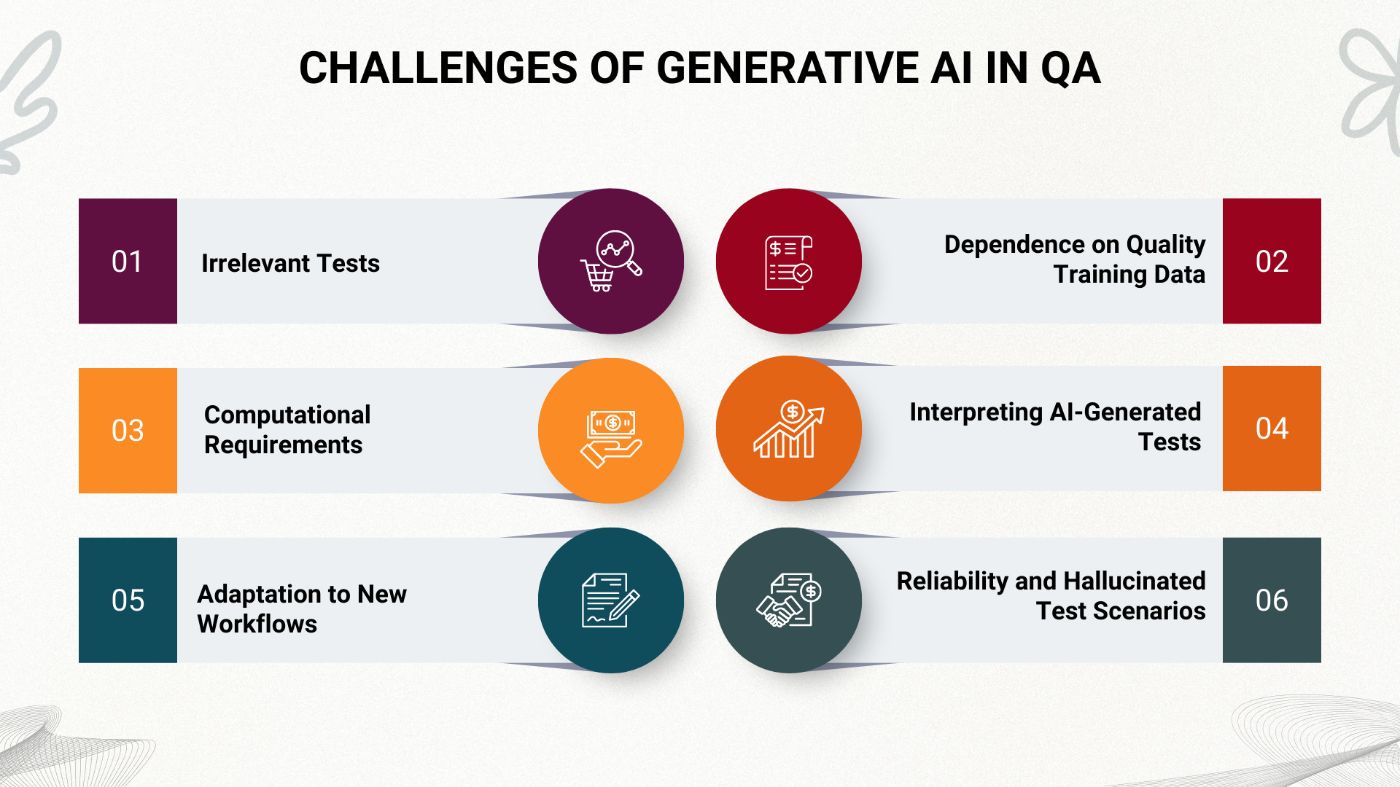
Challenges of Generative AI in QA
While the potential advantages are significant, it’s also crucial to understand the potential obstacles that Generative AI brings to the QA process:

-
Irrelevant Tests: One of the primary challenges is that generative AI may create irrelevant or nonsensical tests, primarily due to its limitations in comprehending context or the intricacies of a complex software system.
-
Computational Requirements: Generative AI, particularly models like GANs or large Transformers, require substantial computational resources for training and operation. This can be a hurdle, especially for smaller organizations with limited resources.
-
Adaptation to New Workflows: The integration of generative AI into QA necessitates changes in traditional workflows. Existing teams may require training to effectively utilize AI-based tools, and there could be resistance to such changes.
-
Dependence on Quality Training Data: The effectiveness of generative AI is heavily dependent on the quality and diversity of the training data. Poor or biased data can result in inaccurate tests, making data collection and management a significant challenge.
-
Interpreting AI-Generated Tests: While AI can generate tests, understanding and interpreting these tests, especially when they fail, can be challenging. This could necessitate additional tools or skills to decipher the AI’s output effectively.
Developing an Automation Strategy with Generative AI
Incorporating generative AI into a QA strategy requires careful planning and consideration. Here are some steps that an organization can follow:
-
Define Your Goals: Start by identifying what you hope to achieve through implementing generative AI in your QA process. This could range from improving test coverage, reducing the time spent on manual testing, enhancing the detection of bugs and vulnerabilities, or a combination of these.
-
Understand Your Testing Needs: Not all applications or software will benefit from generative AI testing in the same way. Understand the specific needs and challenges of your testing scenario and consider whether generative AI can address them effectively.
-
Assess Your Infrastructure: Generative AI requires substantial computational resources. Hence, it is necessary to ensure your infrastructure can support these demands. This might mean investing in hardware upgrades or cloud-based solutions.
-
Choose the Right Tools: There are various generative AI models and tools available, each with its own strengths and weaknesses. Evaluate these options in terms of your defined goals and testing needs to select the most suitable ones.
-
Train Your Team: Implementing generative AI in QA will require your team to have the necessary skills to work with AI systems effectively. This might involve training in AI fundamentals, how to interpret AI-generated test results, and how to troubleshoot potential issues.
-
Implement and Monitor: Once you have defined your goals, understood your testing needs, assessed your infrastructure, chosen the right tools, and trained your team, it is time to implement the strategy. Begin by introducing AI in a few key areas and gradually expanding its use. Regularly monitor and review the performance of the AI in your testing process to ensure it is meeting your goals.
Conclusion
The integration of Generative AI marks a transformative shift in QA, enabling automated, context-aware testing that significantly improves efficiency, coverage, and alignment with CI/CD pipelines while continuously learning and evolving. Although challenges exist in model complexity, workflow integration, and ethical considerations such as bias and privacy, the long-term benefits far outweigh these hurdles when adopted responsibly. Embracing Generative AI is not just a tooling upgrade but a paradigm shift toward a future where AI and human testers collaborate to deliver higher-quality, more reliable software.


