As sure as night turns to day, the networking industry is working on yet another wireless standard. While it’s still many years away, 6G mobile networks are already on the tip of tech tongues, with companies and governments rapidly investing and preparing the regulatory frameworks to make next-gen networks a reality. The global race for 6G is slowly getting underway.
But after 5G has so far failed to deliver on the truly next-gen experiences used to hype up its development cycle, the real question isn’t whether 6G can provide speeds in a lab — it’s whether it will meaningfully improve battery life, coverage, reliability, or monthly bills. On those fronts, the case for excitement is far less clear. Here’s everything that you need to know.
Are you already thinking about 6G networking?
42 votes
Checking the headline claims

David Imel / Android Authority
The 6G specification is still under active development, but some of its preliminary objectives have already been publicly disclosed. In practice, this means that many of 6G’s headline features are not entirely new ideas, but long-promised capabilities that were delayed or only partially realized during the 5G era. Ultra-low latency, massive IoT support, advanced positioning, and AI-assisted networking are all part of the modern 5G vision; 6G’s goal is to make these features native and interoperable from day one, rather than layering them on through years of revisions.
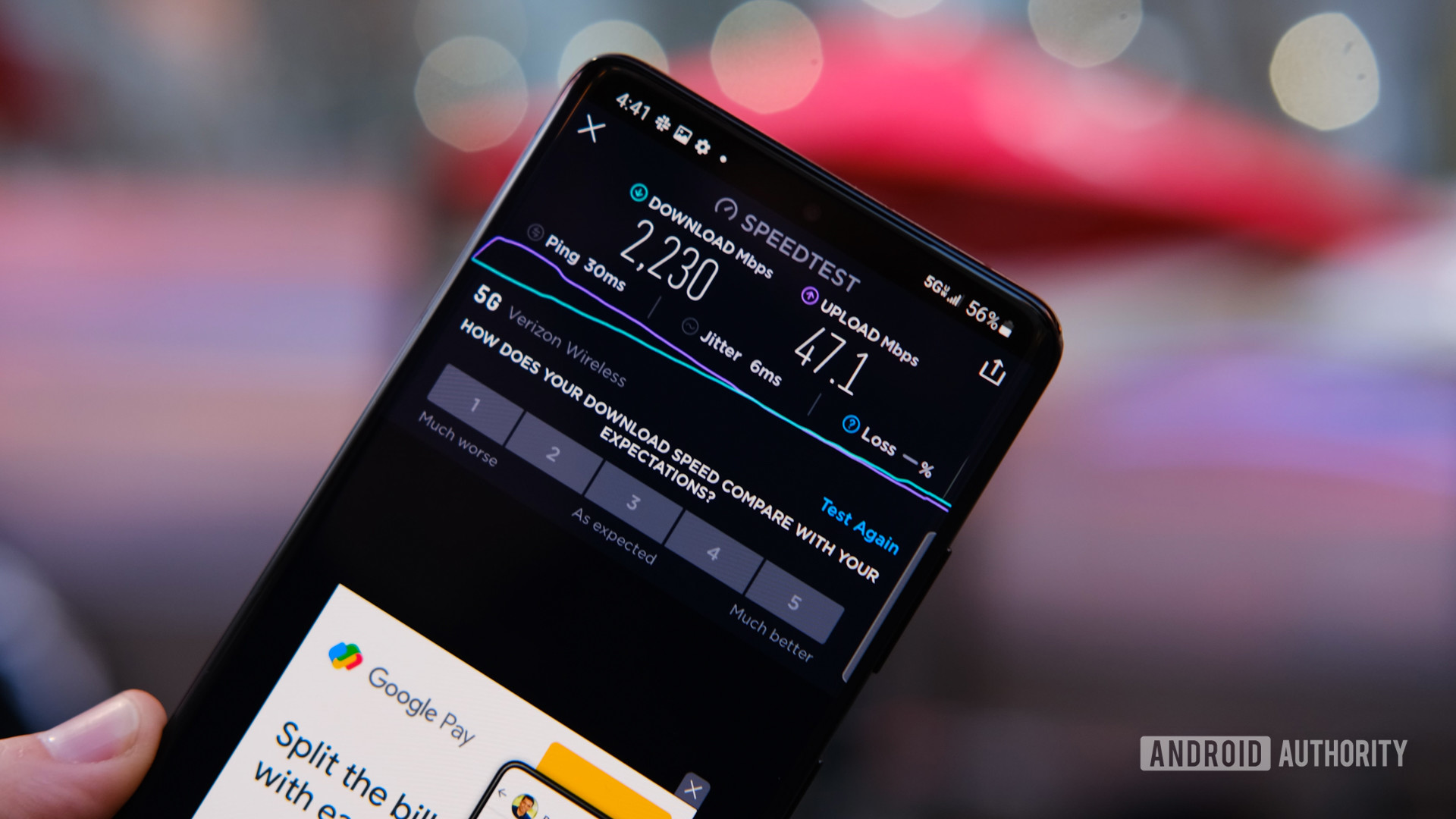
Still, the fledgling specification has some lofty plans for peak data capabilities, ranging up to hundreds of Gigabits per second and microsecond (<1ms) latency capabilities. Claims like these are worryingly familiar, and history suggests they will apply primarily to controlled demonstrations rather than everyday consumer connections. For instance, modern networking speeds are likely 3x to 5x faster than 4G/LTE, but we’re still a long way from the 10x or greater speed boosts we were promised with 5G. As such, I don’t expect consumer 6G to be anywhere near as fast as these early promises — at least not for consumer applications.
Faster, more efficient, and brand new use cases. Does 6G sound familiar?
Still, if there’s one thing that 6G has going for it, it’s that it will build upon networking technologies that have proven useful in recent years. Supporting data from low-Earth orbit satellites, for instance, will help provide superior coverage in rural and hard-to-reach areas, while fixed wireless access will cover homes and businesses without the need for fibre, all under the umbrella of a single specification.

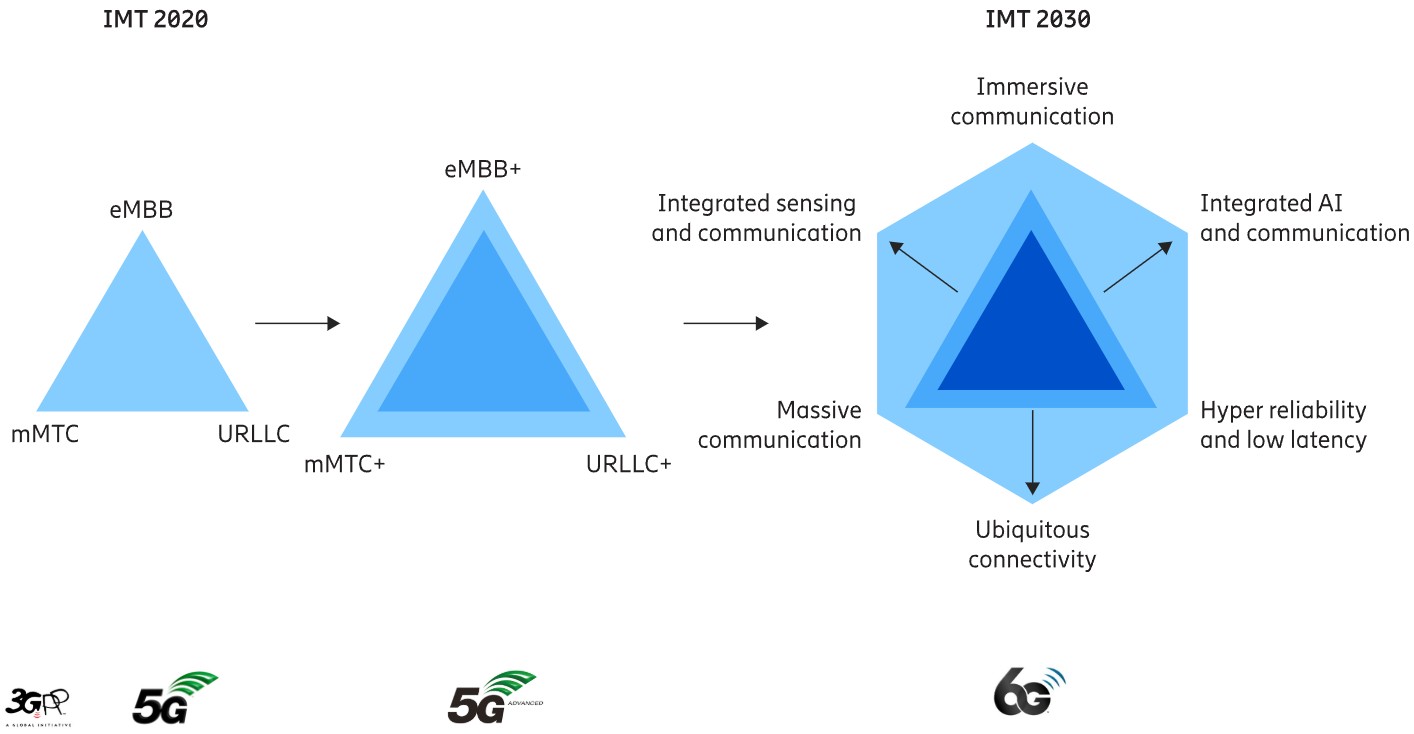
Much like the drive for 5G, 6G is aimed at boosting overall network capacity — allowing not just for higher bandwidth but also supporting far more devices online at any given time. Those claims about mass internet-of-things connectivity remain, with early 6G planning to accommodate narrow-band IoT, Reduced Capacity, and Ambient IoT under a single standard. The idea being that 6G networks can support a much wider range of devices without the bolt-ons and revisions that crept in under 4G and 5G.
An underrated target of the emerging 6G specification is networking efficiency, which involves delivering more data using less power per transmitted bit. If realized, this could translate into longer battery life for phones and wearables, more consistent performance under load, and lower operating costs for carriers — benefits that matter far more to everyday users than peak download speeds. 6G aims for dynamic spectrum sharing across licensed, unlicensed, and shared bands, as well as specific optimizations for non-phone devices.
More outlandish ideas include “zero-energy” IoT harvesting and AI power management at every networking layer, such as radios that dynamically adjust power to extreme precision mmWave beamforming. Sounds promising, but again, 5G made similar boasts, and yet early devices were less efficient than their 4G counterparts.
6G should be a natural progression from 5G, rather than the 4G/5G cliff edge.
Perhaps the best way to think about 6G is that it seems to be learning from the mistakes of 4G and 5G deployments, and should consolidate much of today’s complex web into a more unified standard. Many 6G features will follow directly from 5G Advanced (which will roll out between now and 2030), including ideas like sub-10 cm position accuracy both indoors and outdoors, a greater range of spectrum aggregation, and AI and ML technologies across the RAN core to help boost traffic efficiency.
As such, the arrival of 6G might feel more like a natural progression from 5G, rather than the cliff edge that was the transition from 4G to 5G.
Solving the spectrum problem

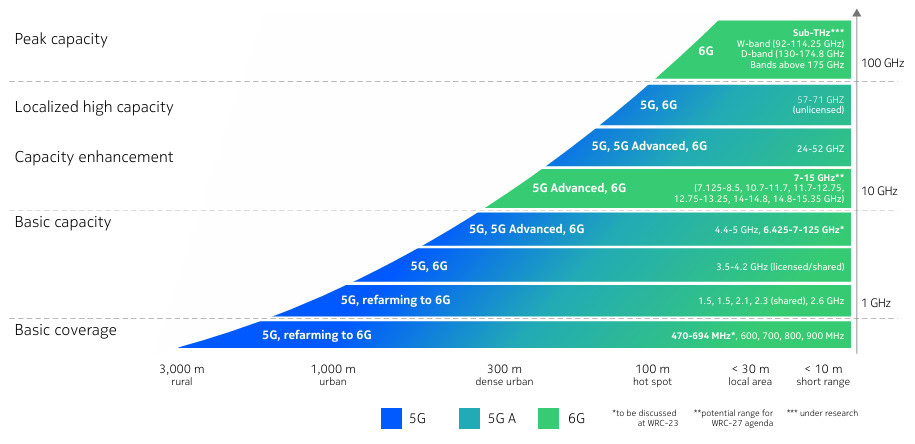
Put simply, wireless networks are running out of clean, widely usable airwaves. Frequencies that travel far and offer robust indoor coverage are already heavily occupied, forcing carriers to look higher up the spectrum, where bandwidth is plentiful, but coverage becomes more difficult and expensive. Efforts have been made to repurpose old spectrum, but there’s only so far and fast that approach can take carriers.
5G aimed to alleviate this problem through the use of new sub-6GHz and high-frequency mmWave spectrum. The former has proven widely successful, but mmWave adoption has been spottier, and where it has been deployed, it’s limited to high-density urban areas. 6G wants to take another whack at the issue with new 7-15GHz spectrum (sitting just above existing mid-band, and tentatively known as cmWave) and potentially even sub-THz local networks for extremely data-intensive use cases.
While this may help, astute readers will note that we’ll still be relying on existing low-band for blanket, long-distance coverage. 6G will need to be able to leverage existing 5G low-band spectrum to ensure sufficient coverage from the get-go. This spectrum was already occupied by 4G when 5G rolled out, and investors don’t want to revisit the agonizing 4G / 5G NSA / 5G SA transition when it comes to 6G.

The key to making this work is supporting data from multiple frequency bands across network types simultaneously, by leveraging multi-RAT spectrum sharing (MRSS). Today’s 4G/5G networks utilize Dynamic Spectrum Sharing (DSS) for a similar effect; however, it has been hampered by latency issues. MRSS enables the simultaneous use of the same frequency band for both 5G and 6G, simplifying the migration between the two standards and eliminating the bottleneck observed with 4G/5G and low-band availability.
However, a significant problem is that 5G has not been as profitable as the major carriers anticipated. US carriers invested tens of billions into new 5G spectrum auctions, not to mention equipment for new technologies like mmWave. Yet, 5G hasn’t made a substantial improvement to carrier profitability. In fact, carriers are increasingly prioritizing network efficiency to keep these costs in check.
Convincing these same carriers to commit to another expensive spectrum cycle is far from guaranteed. Without a clear consumer revenue opportunity, 6G investment is likely to be measured, incremental, and tightly focused on efficiency rather than headline-grabbing capabilities.
5G’s track record: A cautionary tale
Robert Triggs / Android Authority
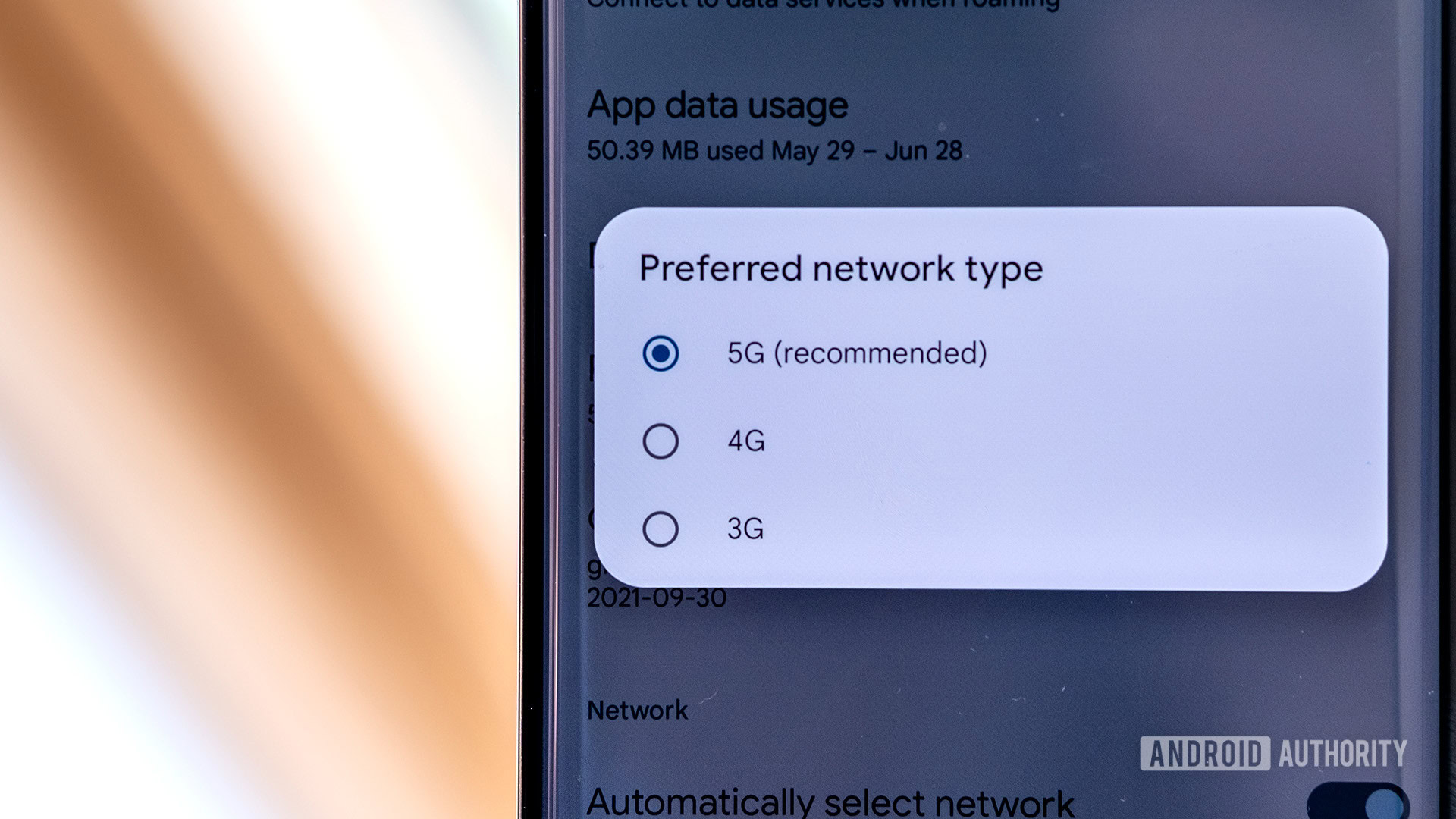
The growth in spectrum availability and usage efficiency is likely the biggest takeaway from 6G. The next-gen network aims to boost both speed and capabilities to power an even greater number of devices, while allocating data in a more efficient manner than ever before. However, we must temper this with the knowledge that although 5G carriers boast over 75% coverage today, consumers are often spending less than 40% of the time actually connected to a 5G network. 6G’s spectrum and coverage claims sound promising, but I would hedge any enthusiasm against the economic reality of rolling out these projects across entire countries.
Carriers won’t invest considerable sums in low-orbit satellites for rural communities or sub-THzWave basestations at concert venues if consumers are unwilling to pay more for the connection. I think it’s likely that most consumers will already consider their current 4G/5G plans to be sufficient for their needs.
If 6G learns from the mistakes of 5G, it stands a better chance of living up to the hype.
Along those lines, 5G’s fatal flaw was that it was a technology looking for a problem to solve. Company executives bigged up smart cities, sprawling internet-of-things connectivity, and virtual reality worlds that never materialized. Early 6G proponents are already lining up to present similar use cases (from virtual reality to mass IoT) and are even resorting to the AI hype train. For example, Erricson promotes the idea of “AI-native networks” capable of executing AI workloads wherever it makes the most sense on the network.
However, executing AI workloads dynamically across the network would require dense deployments of edge compute — effectively mini data centers at or near every cell site — a level of AI hardware investment that remains economically unrealistic for nationwide networks. When it comes to outlandish claims about the future of robotics, holographic media, or AI hybrid supercomputers, I’d gloss over the clear marketing nonsense. Use cases will be built on whatever capabilities 6G can offer in an economically viable fashion; they won’t arise simply because proponents think it might be possible.
Don’t want to miss the best from Android Authority?


At any rate, the first 6G technical specifications are expected to be complete with 3GPP Release 21 in 2028. We’re unlikely to see the first 6G trials until that year, and the first consumer 6G devices may arrive in 2030 or later. That’s certainly far enough away that you shouldn’t worry about basing today’s purchasing decisions on next-gen networking.
Even if your next smartphone lasts seven long years, that’ll still only mark the early adopter stage of 6G, with limited geographical availability and probably few consumer products to pick from. Not forgetting that 5G networks won’t be going anywhere in that time either; in fact, they’ll likely be even better for video streaming, gaming, and whatever else you’ll need on the go. Not forgetting that 5G Advanced will give many of the benefits of 6G over the coming years anyway.
For consumers, the smart move is to judge 6G not by its promises, but by whether it eventually delivers tangible improvements where 5G fell short. We’re still many, many years away from being able to make that call.
Thank you for being part of our community. Read our Comment Policy before posting.