





Hadlee Simons / Android Authority
Whether you’re snapping a family portrait or capturing the city at night, today’s best smartphone cameras are undoubtedly brilliant. Computational photography, multi-lens systems, and ever-larger sensors have pushed image quality to levels that would’ve seemed impossible at the start of the decade. But while most of the attention goes to new software tricks and megapixel counts, some of the most meaningful improvements are happening deeper in the camera stack, helping smaller mobile sensors catch up with larger mirrorless cameras.
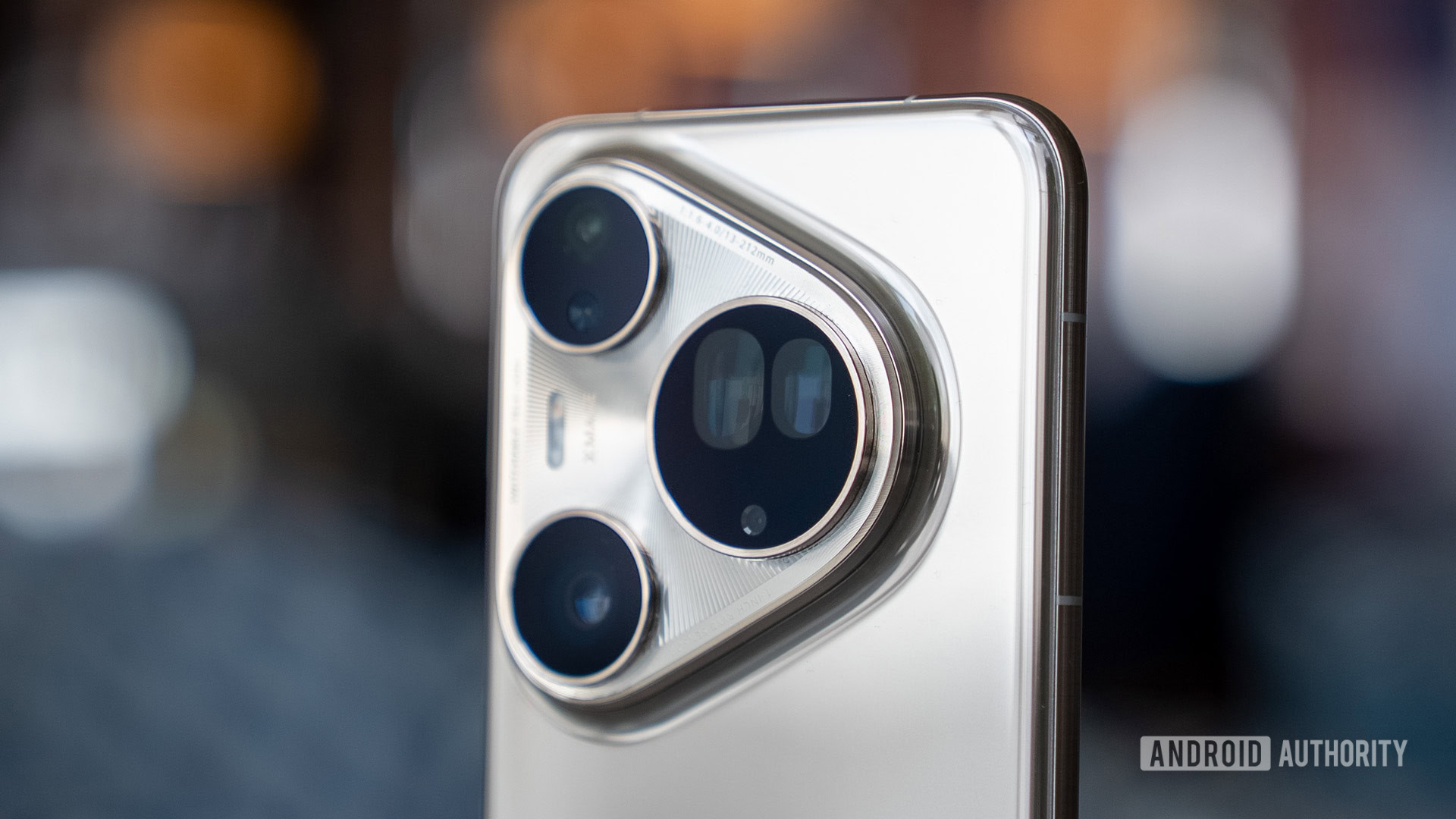
If you’ve been reading through camera spec sheets lately, you might have spotted the term LOFIC appear next to some of the industry’s latest high-end camera sensors. Namely, on the Xiaomi 17 Ultra and HUAWEI Pura 80 Ultra, two powerhouse mobile camera setups. These phones already boast serious camera credentials, but LOFIC isn’t about flashy features or AI processing. Instead, it’s a fundamental change in how sensors handle light.
The acronym might not mean much at first glance, but LOFIC represents a clever hardware solution to one of photography’s oldest problems: capturing both bright highlights and deep shadows in a single exposure. To understand why that matters — and why it’s such a big deal for mobile cameras — we need to start with how an image sensor actually captures light.
What is LOFIC?

Rita El Khoury / Android Authority
LOFIC stands for Lateral Overflow Integration Capacitor, which, surprisingly, hints at what’s going on here. But before we get to that, here’s a really quick primer on how an image sensor actually captures light.
At its most basic level, your phone’s camera sensor consists of small pixels. Inside those pixels is a color filter and a photodiode that charges a capacitor (also sometimes called a well) whenever a photon reaches it. Once a photo’s exposure is complete after pressing the shutter, we measure the capacitor’s voltage as an analog signal to determine how much light reached that specific pixel — and all the other pixels across the sensor (giving us variations in light and dark). We apply a predetermined amplifier value (ISO) to scale the sensor’s voltage outputs, mapping dark and bright areas into a usable range. Choosing the right ISO is often where the trade-off between bright highlights and shadow detail comes into play.
Hopefully, you can see a potential problem here. Too low a gain value risks underexposure and dark values that are all crushed together, while very high gain risks clipping our maximum value. This imposes a rather difficult limit on the dynamic range we can capture in a single exposure; it’s very difficult for a single gain value to expose light and dark perfectly, especially on small sensors. Instead, phone cameras often resort to clever tricks to combine multiple exposures, such as Google’s famous software HDR algorithm or on-sensor dual-ISO gain techniques.

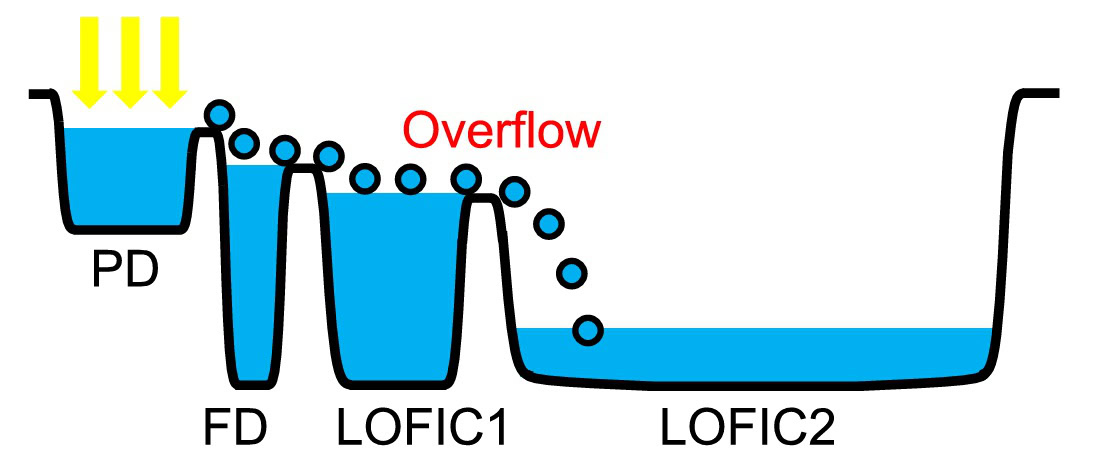
LOFIC takes a different approach by adding extra overflow capacitor wells to the image sensor. You can think of the capacitors as cascaded buckets that can overflow and catch excess charge when the previous photodiode reaches its limit. Once the smaller, more sensitive bucket for low-light conditions fills up, a second bucket continues to capture photon charge in bright areas. Now, when we read values from the buckets, we can use different gain values for each, such as high gain for a shadow-detail bucket and lower gain for highlights, reducing the risk of clipping highlights and thereby extending the sensor’s dynamic range.
LOFIC lets pixels capture accurate highlights and shadows simultaneously.
This is a bit of an oversimplification, as modern image sensors also use capacitor wells for features like Phase Detection AutoFocus and gain selection too, and there are plenty of other factors that go into making a top-quality sensor. Still, the general premise is sound. By splitting raw light-capture information into multiple levels, signal gain can be optimized, increasing dynamic range in a single exposure without relying on software trickery.
How LOFIC actually improves your photos
Paul Jones / Android Authority
Even if the inner workings of LOFIC feel a bit abstract, its goal is simple: capture more of a scene’s real-world contrast in a single shot. That means preserving bright highlights without sacrificing shadow detail — something that’s especially challenging for smaller smartphone sensors.
Traditionally, phones tackle this problem with software HDR, which captures and stacks multiple exposure frames. While effective, this approach struggles with motion, often introducing ghosting, halos, or blurred detail when subjects move between frames (though high-end algorithms can assist with this). Modern dual-ISO (or dual conversion gain — DCG) sensors offer a more robust hardware-based alternative by reading the same exposure at two different gain levels and merging the results. This improves sensitivity and dynamic range while avoiding motion artifacts in a pretty cost-effective setup. However, this hardware is typically limited to two gain stages and seldom operates per-pixel.
| Feature | Software HDR | Dual-ISO | LOFIC |
|---|---|---|---|
| Motion handling | Moderate | Excellent | Excellent |
| Highlight retention | Good | Good | Excellent |
| Shadow detail | Moderate | Good | Excellent |
| Noise in dark areas | Moderate | Low | Very low |
| Single exposure? | No | Yes | Yes |
LOFIC takes a different approach by actually changing the sensor’s ability to measure light. Instead of relying on a single charge well — or even just two gain readouts — LOFIC-equipped pixels use additional overflow capacitors to catch excess charge from bright areas. The result is smoother highlight roll-off, reduced clipping in bright regions, and cleaner shadow detail with lower noise. Because the extra charge is stored before readout, the sensor can apply optimal gain levels to different brightness ranges without amplifying noise or blowing out highlights. In high-contrast scenes, this means less reliance on aggressive tone mapping and fewer HDR artifacts, but it comes at the cost of more complex and therefore more expensive sensor manufacturing.
I’m loath to put exact numbers to any of these technologies, because variations in sensor design and processor support can significantly affect the results. Broadly speaking, smartphones using traditional HDR approaches tend to achieve around 60–90 dB of effective dynamic range, depending on the sensor and the software or hardware HDR method employed. By contrast, OmniVision’s 1-inch OV50X sensor, using DCG and LOFIC, is specified at close to 110 dB of dynamic range at the sensor level — a substantial increase, even if the comparison involves more nuance than raw numbers alone.

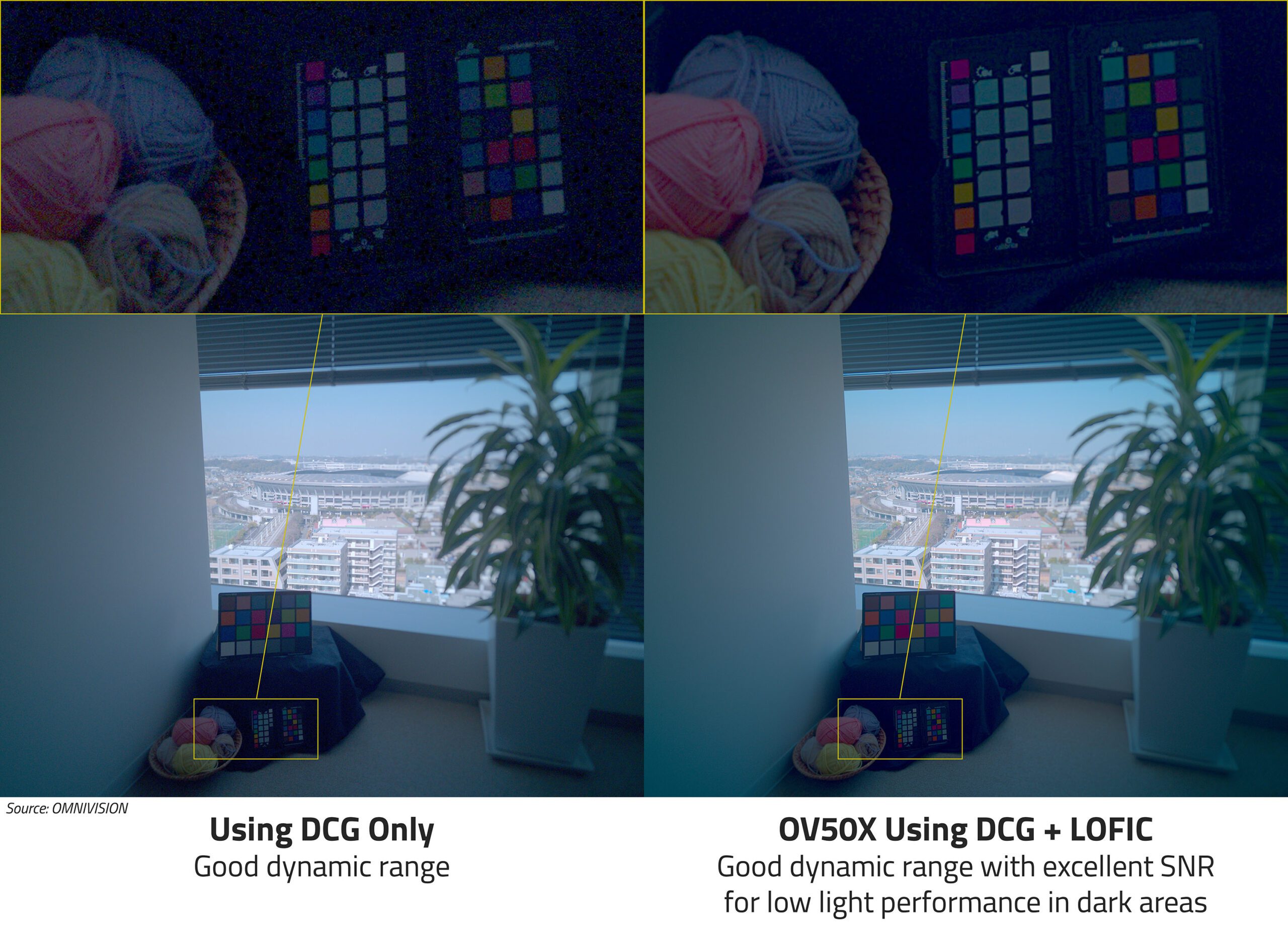
In practical terms, imagine shooting a silhouetted cityscape against a bright sunset. A conventional or even a dual-gain sensor may render the sun and surrounding clouds as flat, blown-out, white shapes, or crush shadow detail into darkness. With LOFIC, the sensor can retain color and gradient in the brightest parts of the sky while still lifting detail from the shadows below. The same principle applies to night cityscapes, where bright streetlights and deep shadowed alleys can coexist without one overwhelming the other.
Because LOFIC operates entirely in hardware and works on a per-frame basis, its benefits also extend to video. Each frame carries a wider dynamic range, helping preserve natural colors, avoid blown highlights, and maintain detail in shadows — even in challenging lighting — without the need for multi-frame processing.
Next-gen imaging is here, but not for the masses just yet

Joe Maring / Android Authority
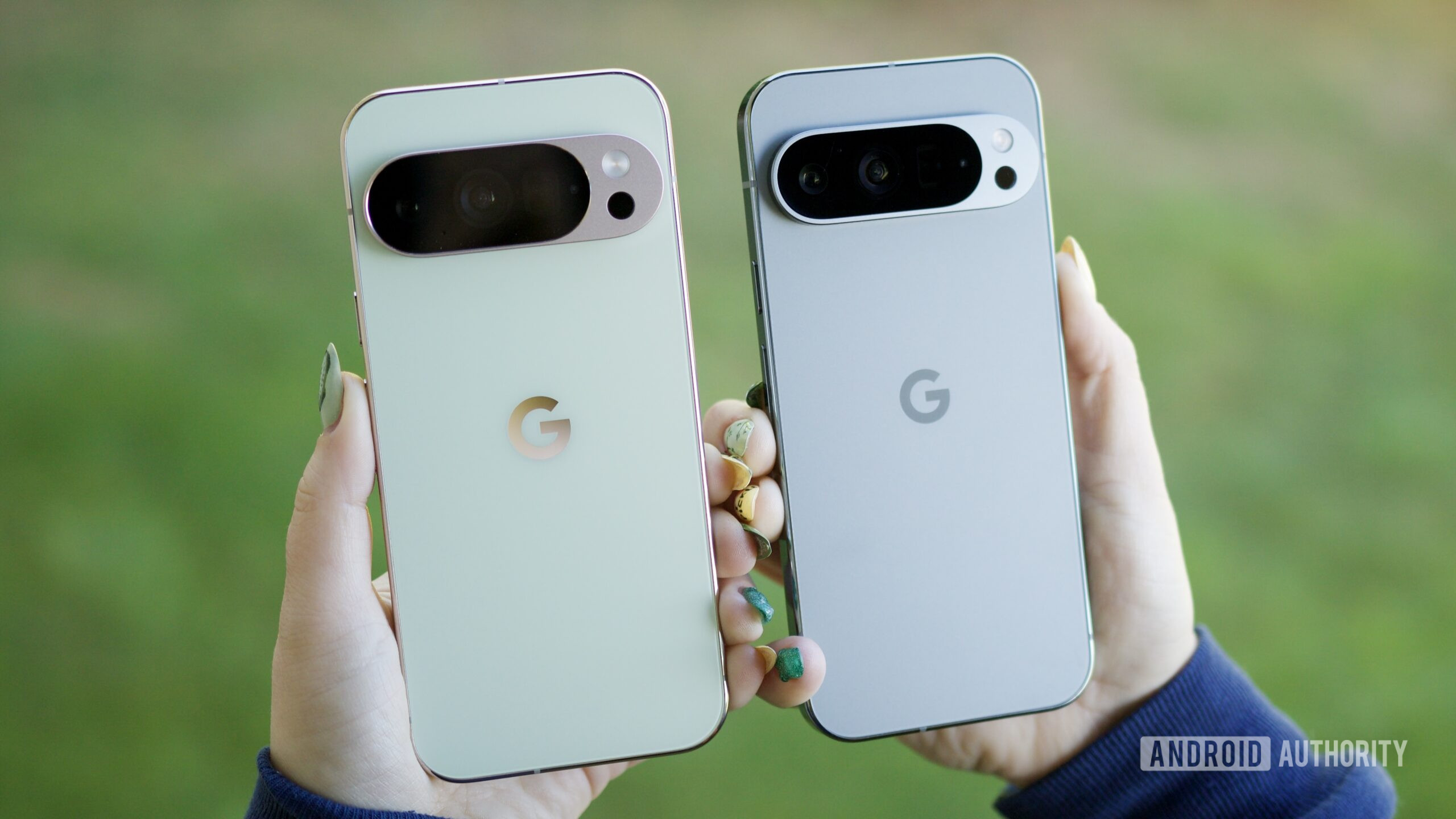
While the LOFIC idea isn’t all that new, it’s an exciting step forward in mobile photography. But like many cutting-edge sensor technologies, it’s not yet widely available outside of a couple of Chinese flagship phones, and might not be for a little while longer. Who knows when the notoriously slow mainstream Western players like Apple, Google, and Samsung will bring the tech to their future flagships?
There are also some inherent limitations. Adding overflow capacitors increases sensor complexity, potentially affecting cost, power consumption, and even heat. While LOFIC reduces the need for multi-frame HDR, extremely high-contrast scenes can still benefit from computational techniques and object segmentation and processing. I don’t expect popular HDR and AI improvements to be going anywhere in the near future. If anything, they’re still complementary to LOFIC. In addition, LOFIC’s capacitors need extra space, and so it is implemented in larger sensors where image quality is already very good. To me, it would be more useful in the light-constrained, smaller-sized sensors we often see used for selfies and long-range zoom. Hopefully, we’ll get there eventually.
Apple, Google, and Samsung might be slower to catch up to the best camera tech.
Looking ahead, though, the possibilities are promising. As hardware improves and LOFIC-style sensors become more common, we could see smartphones capturing dynamic range rivaling that of larger cameras — not just in stills, but also in video. Combined with software innovations, the next generation of mobile imaging may finally close the gap between small sensors and professional-grade photography. That’s why you should keep an eye out for this technology in your next top-tier camera phone.
Don’t want to miss the best from Android Authority?


Thank you for being part of our community. Read our Comment Policy before posting.

