




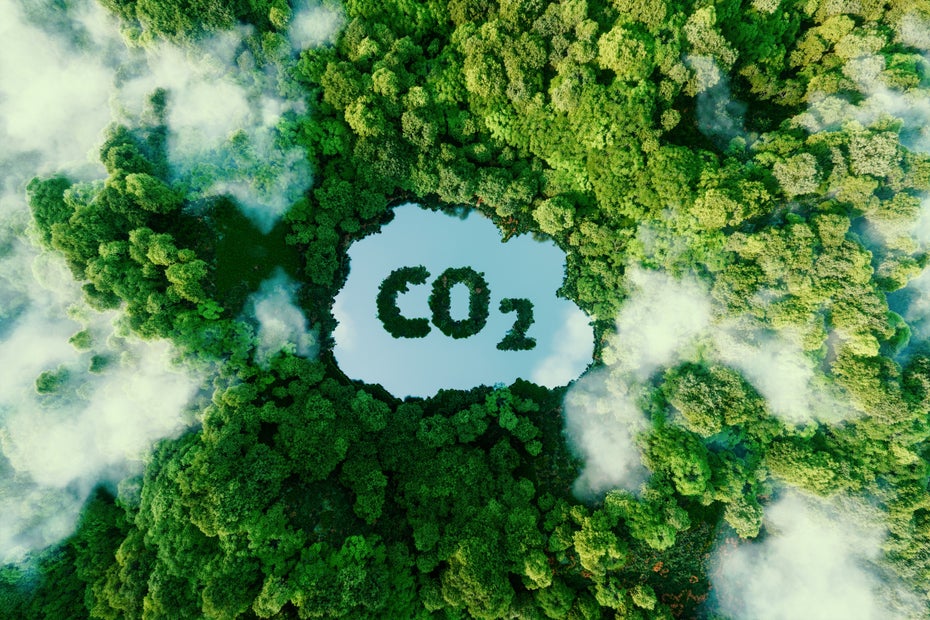
For training language models in data centers or producing chips for AI applications: the expansion of artificial intelligence consumes gigantic amounts of electricity. The combined energy demand of global AI systems is almost as high as that of a country the size of Great Britain.
And since most electricity still comes from fossil sources, the use of artificial intelligence releases CO₂ on a large scale. In 2025, carbon dioxide emissions from AI systems ranged between 32.6 and 79.7 million tons.
AI as a solution to climate change? Study contradicts
In the long term, artificial intelligence can help reduce CO₂, is a common argument. It is often said that AI can ultimately help to analyze processes and measure one’s own CO₂ footprint.
Editorial recommendations
${content}
${custom_anzeige-badge}
${custom_tr-badge}
${section}
${title}
A study by climate scientist Yassine Charabi in the journal Communications Earth & Environment has now critically analyzed this thesis. The tenor of the study: By the time we reach the point where AI offsets emissions annually, we could have already accumulated overall damage that is almost impossible to repair. At least not if you want to achieve the goal formulated at the 2015 UN Climate Change Conference in Paris of limiting the man-made global temperature increase to 1.5 degrees Celsius.
Mathematical model plays out future scenarios
Yassine Charabi designed a mathematical model for his study. Into it he fed data such as global energy forecasts, data center growth rates and hardware replacement schedules. The model also calculated daily electricity consumption and its CO₂ costs as well as the emissions caused by the production of AI chips.
He compared these numbers with the International Energy Agency’s scenarios for artificial intelligence and energy up to 2035.
Average CO₂ emissions of 2.8 gigatons.
Yassine Charabi carried out simulations with his model over 10,000 times. The median CO₂ emissions were 2.8 gigatons.
According to the study, artificial intelligence will only be able to offset the effects caused by its production by the end of 2031. In the best, i.e. fastest, case that the simulations resulted in. But before that, AI technology remains in one area, the Charabi “Carbon Valley”. A valley where advancing AI systems consumes more carbon than it can save.
Each year of hesitation costs 0.45 gigatons of CO₂.
“Increases in efficiency alone do not ensure an absolute decoupling between the expansion of AI and electricity requirements in scenarios with rapid expansion,” says the study.
But according to Charabi, there is one sector in which the use of AI is worthwhile. Namely when integrating artificial intelligence into environmentally friendly technologies. Every year of hesitation to invest here costs 0.45 gigatons of CO₂.
From water to wind: This is the future of sustainable energy production


From water to wind: this is the future of energy production

Top Article
${content}
${custom_anzeige-badge}
${custom_tr-badge}
${section}
${title}


