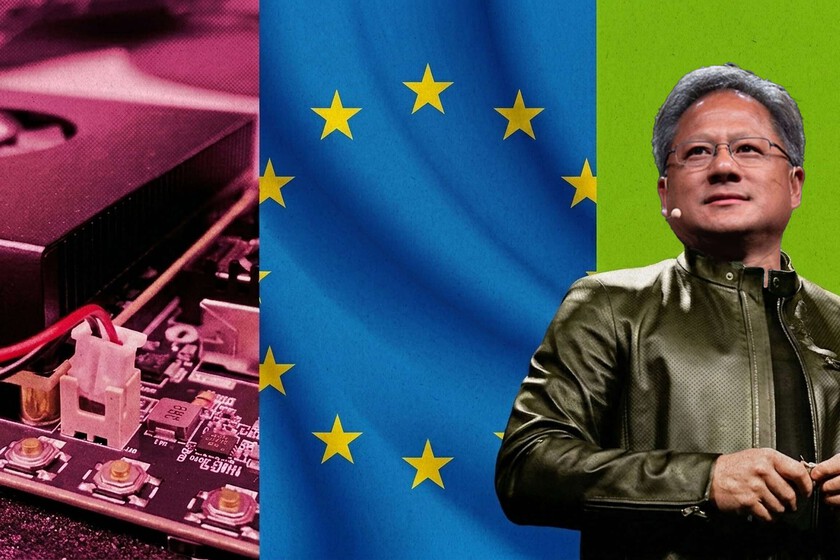
Europe cannot continue to be the technological vassal of the United States. With that powerful message, the CEO of Mistral presented a few days ago a roadmap with which he believes that Europe can take the pulse in the technological race of artificial intelligence. The warning came just as several companies are defining the future of European technological sovereignty, and one of those companies is Euclyd. It is seeking 100 million euros, is backed by one of the ASML bosses and has a clear objective: to stop depending on NVIDIA.
And it’s not the only one.
Euclyd. We have already talked at length about ASML. Although when we talk about the technology industry we have names like Intel, TSMC, NVIDIA or Qualcomm more present, ASML is the Dutch company that manufactures the most advanced machines for manufacturing semiconductors. Without it, the technology industry would not be what it is to the point that China is investing everything in having its own ASML. Well, Bernardo Kastrup is the former director of ASML and, in 2024, he founded Euclyd.
This startup is supported by former ASML CEO Peter Wennink, and, according to CNBC, is looking for financing to raise the necessary capital to start mass manufacturing chips.
100 times more efficient than NVIDIA. In this new round of financing, Euclyd is seeking $100 million and the goal is to create inference chips for AI. These chips are designed so that the models use what they learned in the training phase and are optimized for high speed, low latency and, above all, much lower energy consumption than the training ones.
And that is where the ambitions are maximum. Euclyd, based in Eindhoven, claims that its ‘Craftwerk’ chip system is 100 times more energy efficient for AI inference than NVIDIA’s Vera Rubin chips. This is very good, but the comparison is a bit bulky because Vera Rubin, which is the new generation from NVIDIA, is not a pure training or inference platform: it is optimized to do both.


European movement. But hey, Euclyd is currently raising the money with an eye toward delivering inference chips to its first two customers by 2027. And it’s not the only one. There are others such as the British Olix, Optalysys and Tactile, the French Lago or the Dutch Axelera that have raised more than 800 million euros to date.
This is from the private sphere, since Europe has the FAMES pilot program that has 830 million euros to finance this type of projects. It is an extremely modest amount if we take into account what is moving on the other side of the pond, but between financing chip companies, renewables and European data centers, it is a sign that the feeling that Europe must fend for itself is there.
world movement. The interesting thing is that this does not respond only to Europe’s feeling of technological sovereignty. It goes further, pointing to the great whale of AI: NVIDIA. Whatever company we think of, surely part of its hardware – or all – belongs to NVIDIA. Mistral itself reached a very juicy agreement with the company led by Jensen Huang to be able to acquire thousands of GPUs, but the industry is already seeing what happens when all the eggs are in the same basket.
That is why NVIDIA has its potential greatest rivals among its clients. Meta, Tesla or Amazon buy from NVIDIA, but at the same time they are developing their own chips. The Chinese giants want NVIDIA chips, but they also develop their alternatives with local companies. All of this is creating more shadowy companies such as Texas Instruments, Marvell or Broadcom to do business, since they are the ones that those who do not want to depend so much on NVIDIA turn to.
Google. In fact, just as startups developing AI chips are appearing in Europe, in the United States an ecosystem of companies is developing that are raising billions of dollars. Two examples are Cerebras Systems, which is valued at 23 billion, or MatX, founded by former engineers from Google’s TPU development team.
Google itself, whose TPUs are manufactured by Broadcom, is seeking a deal with Marvell to diversify its inference chip business.

NVIDIA responds. There is a phrase that has always made me laugh, “you think the police are stupid,” and it applies perfectly here. NVIDIA has also been realizing for some time that it must diversify and has stopped pumping obscene amounts of money into just a few companies to support smaller, but promising ones. In this way, it gets clients in the curious circular financing of AI, as well as continuing to be the leader in the segment.
But in addition to investing in others, she invests in herself. In March, a photonics company invested 4 billion to make optical interconnection systems for next-generation data centers. They are also investing more than 18 billion in R&D and winning juicy contracts with both TSMC and Samsung, who manufacture the chips for the company’s AI platforms.
In the end, if all markets have something in common, it is unbridled spending. Europe, China and the United States have embarked on a race in which there is no end in sight and that will perhaps have its greatest test when Anthropic and OpenAI go public this year.
In | Europe thinks that it is the one who wants to become independent from US technology companies. It’s actually the other way around.