The European Health Data Space (EHDS), the electronic patient file (ePA) and the planned European Digital Identity Wallet (EUDI-Wallet) are intended to create a cross-border data space in which, on the one hand, data is exchanged and, on the other hand, care within the EU should function across borders. Germany should now become “EHDS-compliant”.
Read more after the ad
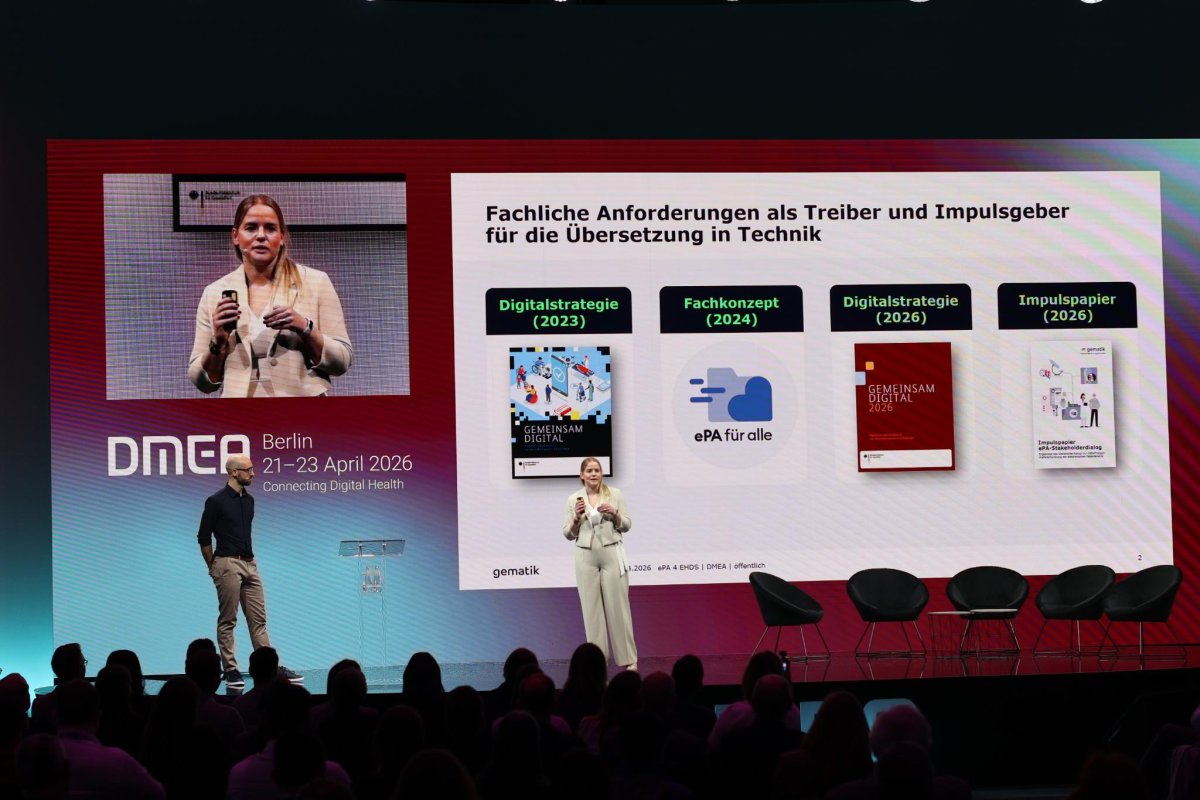
In Germany, the ePA, which has been introduced nationwide since January 15, 2025, forms the basis for connection to the EHDS. Lena Dimde and Charly Bunar from Gematik emphasized on Tuesday at the DMEA health data fair in Berlin that the ePA must be consistently oriented towards care processes. “We are currently embarking on a path with the ePA where we want to move forward with structured data and where we want to improve care processes.” It is crucial that exactly the types of data that are required for care – such as medication data, laboratory results or doctor’s letters – are also included in the EHDS. “That’s totally good, in line with what we want to achieve in Europe.”
A central element for the development of a “European Health Union” is the so-called National Contact Point for eHealth (NCPeH), i.e. the national contact point that enables data exchange between member states. “So by the turn of the year, plus minus, I will be able to redeem a German e-prescription in other EU countries.”
With health insurance app


Sol should be able to use the European patient record.
(Image: heise media)
Kornell Adolph and Inger Koltermann from AOK connect GbR showed how this exchange can take shape. They described how insured people will be able to access their health data using a digital identity in the future and share it abroad. Insured people access their “personal health data room” via their health insurance app, select a European short file – which is due to come in 2027 – and generate an access code that they can show abroad. This short file specifically contains relevant information such as allergies, pregnancy or chronic illnesses and is automatically translated into the local language of the treating doctor via the National Contact Point.
Emilie Passemard from the French Ministry of Health brought in the international perspective: “It’s certainly a very long journey and we don’t have much time for it.”
Still no solution for unconscious people
The EUDI wallet should play a key role in practical use. Janina Buchholz from Bundesdruckerei GmbH, who has already been involved in a concrete implementation, explained: “The European Digital Identity Wallet, in turn, makes it possible to set up solutions and processes quickly, easily and in a user-friendly manner in sometimes extremely complex use cases.” Julian Hartz from the Association of Private Health Insurance companies added: “So that we have more active users, it has to work more easily.” At the same time, he referred to the low distribution of health IDs to date, which, according to the Gematik dashboard, just over five percent are currently using.
Read more after the ad
The audience asked what happens in an emergency when patients can no longer give their own consent. “Something like this is called a breaking-the-glass scenario and it hasn’t been conceived yet,” said Julian Hartz from the Association of Private Health Insurance. This is a “typical data protection consideration”.
Despite the progress, the goal of a common EU infrastructure in a first common data space remains ambitious. “But we don’t have all the detailed regulations yet,” says Bunar from Gematik. Implementation is not only a technical challenge, but above all an organizational and political challenge.
The DMEA 2026 has around 900 exhibitors and will be held at the Berlin exhibition center until Thursday. DMEA 2027 will take place in Munich.
(mack)