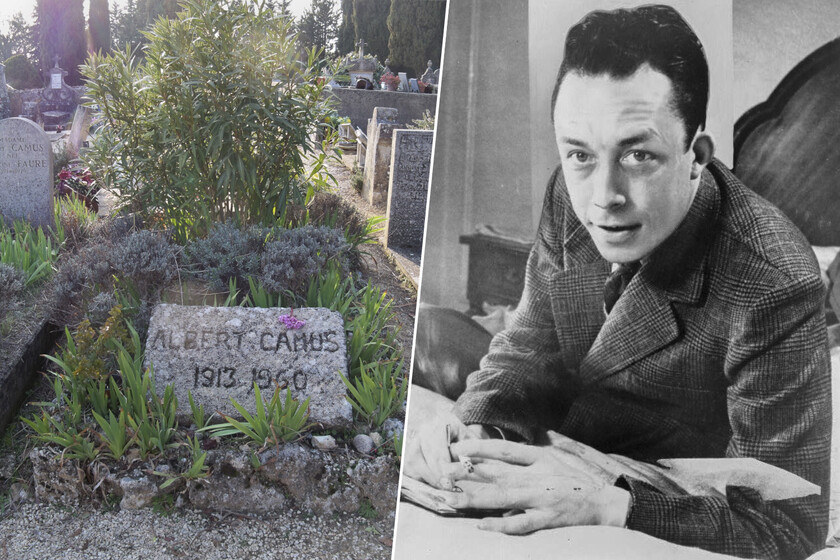
There are times when the line between tragedy, irony, absurdity and cruelty is so fine that it is almost impossible to appreciate it. It happened on the afternoon of January 4, 1960 on France’s Route Nationale 5, near the town of Villeblevin, in Burgundy, when a luxury car left the road and crashed into a plane tree. The impact was so violent that it immediately killed one of its occupants, the famous writer Albert Camus.
That’s the tragic part of the story. The ironic (or cruel, who knows) thing is that this absurd death silenced a writer who had stood out precisely for his depth when analyzing the meaninglessness of the human condition.
A fateful change of plans
They say that Albert Camus didn’t like cars or speed. True or not, the reality is that his initial idea to return to Paris after spending the Christmas holidays in Lourmarin was to take a train. He even bought the ticket, which according to some versions he was carrying in his pocket at the time of his death.
If he finally chose to travel by road it was because Michel Gallimard, his friend and editor, convinced him to return with him and his family aboard his brand new Facel Vega, a French brand of luxury automobiles that fell in love with, among others, Pablo Picasso, Ava Gardner and James Dean.
That change of itinerary (now we know) was a blunder.
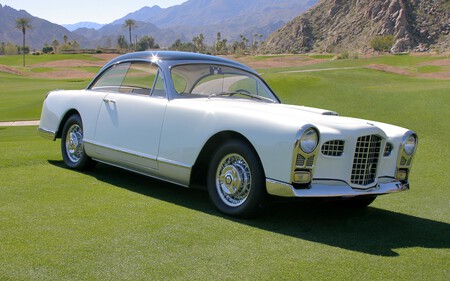

On the afternoon of January 4, 1960, while driving through Burgundy, Gallimard’s Facel Vega FV3B suffered a puncture that caused it to lurch, according to a reconstruction published at the time by the magazine L´Automobile and rescued in 1961 by The Atlantic. What exactly happened? The left rear tire is believed to have burst. The tire slid on the asphalt. The right front wheel went into a ditch. And the car went to the side.
The Facel Vega ended up hitting a tree.
The blow was so strong that the vehicle spun and suffered a second collision with another of the plane trees that flanked the road.
The scene, which the drivers of National Route Number 5 soon approached, gives an idea of the violence of the accident: the engine and gearbox were thrown and the chassis ended up twisted. As for the people who were traveling on board, they all suffered the impact, but not to the same extent.
Gallimard’s wife and daughter were bleeding after being thrown from the back of the car, although they were well enough to call the family pet. The driver was unconscious, so he had to be taken to the hospital, where despite all attempts to save his life (he was even transferred from Villeneuve-la-Guyard to Paris) he died days later.


The worst off was Camus, who was traveling as a passenger in the right front seat. After the first crash and lurch, the Facel Vega was bounced and hit a second log, which hit the door located right next to the writer. It is believed that he died instantly.
When the reporters began to arrive at the scene, after learning that this was not just another accident, but the accident that had deprived French literature of one of its great promises, they found a destroyed dashboard that left two figures to remember: the clock, whose hands read 1:54; and a speedometer stuck at 145 km/hwhich raises the question to what extent speed played a key role in the tire blowout.
“Unforeseen and absurd”
Although Camus was only 46 years old (he had turned two months earlier) he was already a celebrity inside and outside France, both for the scope of his literary work and his prestige as an intellectual, activist and philosopher. As if that were not enough a few years earlier, in 1957, he had become the second youngest writer to win the Nobel Prize in Literature. This great fame explains why French public radio interrupted its musical programming to break the news, which ended up reaching media outlets around the world.
The Korean newspaper The Chosun Daily He dedicated several pages to it and in Spain the news was picked up by, among others, the newspaper ABCwhose correspondent recalled that the blow had been so violent that the car was broken into three pieces.
The chronicle is signed by Federico García-Requena, correspondent in Paris, who chose a headline that went beyond simply informative: “The death, unforeseen and absurd, of Albert Camus.” The term ‘unforeseen’ is obvious, but to understand the term ‘absurd’ (beyond the fact that all deaths on the asphalt are absurd) it is necessary to know more about Camus’ philosophical legacy.
If he explored something in his work, both from narrative fiction (‘The Stranger’) and from the philosophical essay (‘The Myth of Sisyphus’), it is the absurdity, the absolute meaninglessness of human existence. Although for the writer of Algerian origin, assuming that maxim is not equivalent to adopting a defeatist attitude. On the contrary: “This essay considers the absurdity, taken until now as a conclusion, as a starting point“, begins ‘The Myth of Sisyphus’, perhaps the work in which he deepens his vision of existence the most.


“All that can be said is that this world, in itself, is not reasonable. But what is absurd is the confrontation of that irrational and that unbridled desire for clarity whose call resonates in the depths of man,” Camus explains in the following pages.
“The absurd is born from this confrontation between the human call and the unreasonable silence of the world. This is what must not be forgotten. This is what must be clung to, since the entire consequence of a life can be born from it.”
Faced with this suffocating reality, Camus reminds us that embracing the absurd is not equivalent to resignation. On the contrary.
“This rebellion gives life its value. Extended throughout an entire existence, it restores its greatness. For a man without blinders there is no more beautiful spectacle than that of intelligence in struggle with a reality that surpasses it. The spectacle of human pride is unmatched,” he continues. “The world provides the same sum of experience to two men who live the same number of years. It is up to us to have conscience. To feel our own life, rebellion, freedom.”
The great effort Camus devoted to understanding the absurd makes his death even more ironic. At the end of the day, if the writer conveys anything in his work, it is that the universe does not conspire, punish or set traps, in the same way that it does not reward and only offers silence when we search for meaning in our lives. It forces man to give it to himself. Camus did it. And one fateful afternoon in January 1960, death came his way prematurely on a highway in France due to a series of circumstances. without the slightest sense.
If all that were not enough, Camus’s death came with a veneer as tragic as it was ironic. The accident occurred on a straight line, in a section that initially did not present major complications. Hence, in recent years some authors have slipped (without conclusive evidence and amidst the skepticism of their biographers) that what happened in January 1960 was not an accident, but the result of alleged sabotage by the KGB, which would in turn act to punish Camus for his criticism of the USSR.
For experts, such an idea sounds implausible. Not so much because of the possibility that the Soviets wanted to attack Camus, but because the KGB probably had safer methods to end the writer’s life (and career). Furthermore, everything suggests that the trip aboard Gallimard’s Facel Vega was somewhat improvised.
What we do know (or at least that is what the chronicles reported) is that shortly before dying on the road, Camus himself acknowledged that there is no end “more idiotic” than dying in a traffic accident. He made the comment when he received the news that the cyclist Fausto Coppi had died in this way, a mistake in reality, given that it was malaria that killed the athlete.
Only two days after Coppi’s death, it was Albert Camus himself who saw his life end under a tree planted next to a remote road in France. A absurd death for the thinker who most energetically and brilliantly encouraged us to embrace the absurdity of existence.
Images | Wikipedia 1, 2, 3 and
In | What philosopher Jean-Paul Sartre meant when he wrote: “Life begins on the other side of despair”