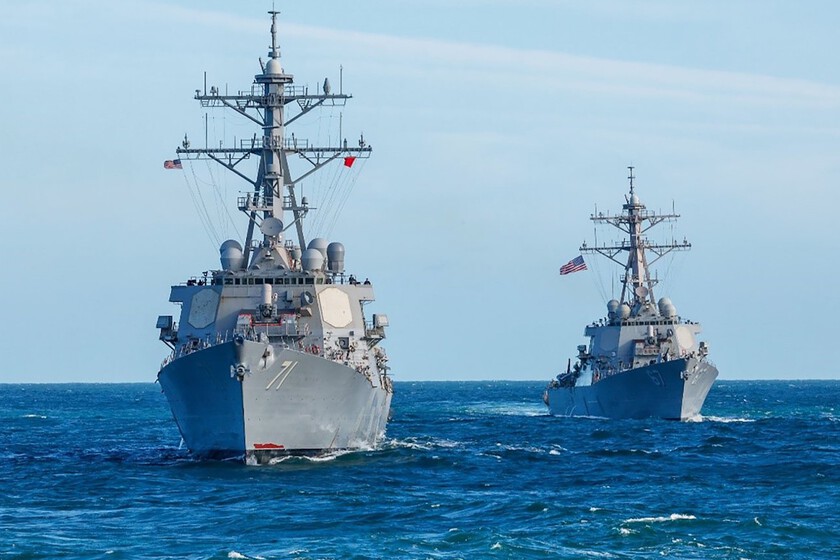
In the late 1980s, during the Iran-Iraq War, the American frigate USS Samuel B. Roberts struck a mine in the Persian Gulf and nearly sank, forcing its crew to fight for hours to keep it afloat in one of the United States Navy’s most memorable emergency operations. The episode left a clear lesson that remains valid today: in certain areas, an invisible threat can paralyze entire routes and change the balance of power without the need for a single shot.
The European plan. The Wall Street Journal reported exclusively that Europe has begun to design its own strategy to reopen the Strait of Hormuz, one of the most critical points in global energy trade, after weeks of war and blockade.
The idea is not to intervene during the conflict, but to prepare a subsequent operation that allows maritime traffic to be reactivated with security guarantees. To this end, a broad coalition of countries willing to provide naval means and coordination is being put together, with the aim of restoring confidence to shipping companies and insurers. There is no doubt, the approach reflects a clear priority: stabilizing the trade flow without being trapped in a direct military escalation.
Mission without Washington. The most striking element of the plan is the intention to exclude the United States from the operation, something unusual in this type of international deployments. The European proposal seeks to rely only on non-belligerent countries, which means leaving out the actors directly involved in the war and reducing the perception of confrontation.
This decision is not only technical, but deeply political, as it responds to recent tensions between Washington and several European capitals. At the same time, it raises internal doubts about whether a mission without American backing will have sufficient weight or deterrent capacity.
Mines, escorts and a delicate balance with Iran. The core of the plan goes through three clear phases: first, unblocking the exit of the trapped ships and then clearing any possible mines deployed in the area. Finally, establish a military escort system that guarantees safe passage.
In this scheme, Europe plays with a specific advantage, its capacity in demining operations, where it has more resources than the United States. However, everything depends on one key factor: Iran’s acceptance, since any operation will require coordination with the coastal countries to avoid incidents. This turns the mission into a diplomatic balancing act as important as the military deployment.

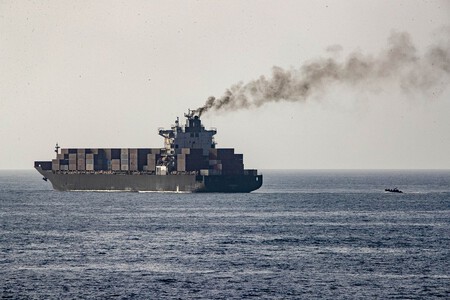

Skepticism. Although specific truces and temporary openings of the strait have been announced, the consensus among experts is that the situation is far from stable. The presence of possible mines, episodes of shooting at ships and political uncertainty keep traffic paralyzed and insurance costs skyrocket.
Hundreds of ships remain blocked, and companies in the sector are unwilling to return without solid guarantees. In this context, European prudence responds to a complex reality: opening the strait is not only a political decision, but a long and risky technical operation.
Europe wants to act, but in its own way. The plan also reflects a desire for strategic autonomy, with France and the United Kingdom at the forefront, leading an initiative that seeks to demonstrate their own capacity in maritime security.
The participation of countries such as Germany or Italy points to a larger scale operation, although conditioned by legal frameworks and parliamentary decisions. Still, internal differences persist over the role that the United States should play and the appropriate time to intervene. In other words, Europe thus tries to project unity while managing its own divisions.
The background: uneasy alliance. In practice, the mission design involves a fairly obvious paradox, because to guarantee the security of the strait, Europe will need to coordinate, directly or indirectly, with Iran, the same actor that has contributed to blocking it.
In other words, the approach reveals to what extent the priority is to avoid a new escalation and rebuild a minimum of operational confidence in the area. At the same time, of course, it suggests a change in “nuclear” approach with respect to Washington, opting for a more negotiated and less coercive path.

A global balance. If you also want, what is at stake is not only the expected reopening of the maritime route sooner or later, but the subsequent stability of an artery through which an essential part of the world’s energy circulates.
From that perspective, the way in which Europe manages this crisis will mark its role on the international stage, as well as its relationship with the United States and regional powers. In an environment of tense alliances and divergent decisions, the European plan for Hormuz is emerging as a very risky bet that combines military capacity, diplomacy and political calculation in an already extremely fragile balance.
Imagen | U.S. NAVY
In | From printing drones to looking at lasers, 300 reports have revealed that Iran’s battle manual has one name: Ukraine
In | While everyone was looking at the Middle East, North Korea has had time to do what Iran has not been able to: go nuclear.