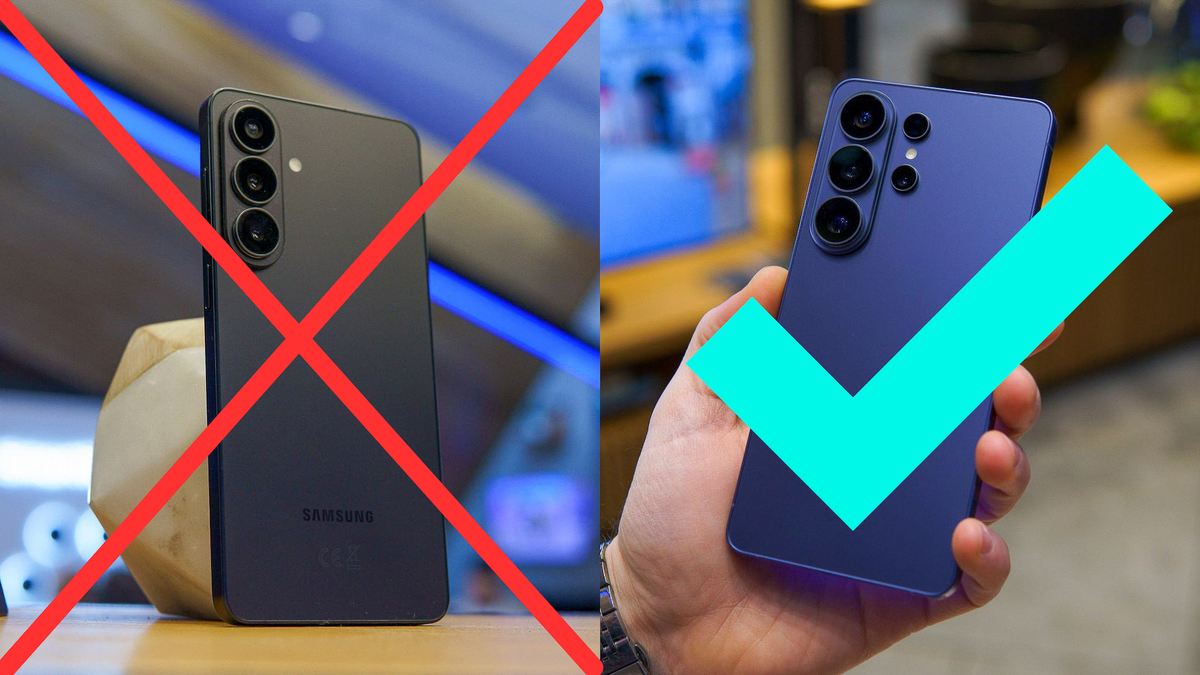
After the Galaxy S26 series announcement, however, it seems even more like an upward nudge in the pricing ladder. The Plus model is now just $200 away from the Galaxy Ultra (only the S26 Ultra didn’t get a price hike) and judging by sales numbers from last year, I expect the new model to be even less popular.
Of course, that’s the case with any middle-of-the-road flagship that sits between the entry-level edition and the ultimate one. But wouldn’t you like to see a smaller Galaxy Ultra instead of a larger Galaxy “normal”?
The Plus is good, but a smaller Ultra would bring much more value
I don’t mean to present the Galaxy S26 Plus as a bad phone. But it is basically the same phone as last year’s generation but more expensive, so what’s really the point of it now? Of course, you get the Snapdragon 8 Elite Gen 5 (in the US), but does that upgrade really justify $1,100?
What does that give you? Here are the main benefits of the Galaxy Ultra:
| Galaxy S26 Ultra | Galaxy S26 Plus |
|---|---|
| Gorilla Glass Armor 2 | Gorilla Glass Victus 2 |
| Anti-reflective coating | No anti-reflective coating |
| Privacy Display | No Privacy Display |
| Built-in S Pen support | No built-in S Pen support |
| Sharper and 200 MP main camera with better low-light performance and HDR | 50 MP main camera |
| Sharper 50 MP ultrawide camera that’s better in low light | 12 MP ultrawide camera |
| Dual telephoto setup: 50 MP 5x and 10 MP 3x zoom | Only 10 MP 3x zoom |
Now, with a smaller Ultra, you’d get a smaller display and likely less battery life than the Galaxy Plus, but the benefits outweigh the downsides by a landslide. Even if one or two of these upgrades don’t tickle your fancy, then the rest probably will.
Apple and Google have moved on
The iPhone 17 Pro and iPhone 17 Pro Max offer virtually the same experience. Apple has not compromised the smaller Pro by any means compared to the larger one. It has the same processor, the same telephoto camera, the same cooling and just as much RAM.Google recently did the same with its Pixel phones and introduced a smaller Pixel Pro model next to a Pixel Pro XL. The high-end models are already the most popular ones among buyers, so I think it makes sense to have more choices when it comes to the Pros and Ultras out there.Unfortunately, in Samsung’s case things are still as they were ages ago. If you want the full Galaxy experience you must buy the largest phone in the lineup. Ultra equals big, but that seems like an outdated approach in 2026.
With the price hikes, a smaller Ultra makes even more sense
There has been a major shift in the business of manufacturing phones. Component costs have jumped—largely due to AI—and even companies like Samsung can’t (or don’t want to) protect the current prices.
Samsung kept the Galaxy S26 Ultra at the same price but raised the Galaxy S26 and S26 Plus by $100. That shift makes the lineup feel even more skewed toward the Ultra, especially when the Plus now sits at $1,100.
At that price, I find it harder to justify the value of the Galaxy Plus. Heck, it was hard for me to justify it when it was $1,000. If I am already spending four figures, I would much rather pay $1,200 for a smaller Ultra than $1,100 for a Plus model that lacks most of the meaningful upgrades.
Samsung appears to be steering buyers in that direction. This year, the company devoted far less stage time to the standard and Plus variants, while nearly all headline features were reserved for the Ultra (more so than in previous years).
At the end of the day…
A 6.3-inch Galaxy S Ultra would give buyers the opportunity to fall in love with all the benefits that come with the cutting-edge tech Samsung has to offer.
One of my favorite features on the new Ultra model is the Privacy Display, as well as the Gorilla Glass Armor 2 and its anti-reflective properties that came with the previous generation. If I want that feature, however, I am forced to get a large phone, even though I prefer regular-sized ones. This applies to all other Ultra-related benefits I mentioned earlier.
The Galaxy Plus used to be acceptable because it offered that lengthy battery life and big screen experience at a lower price, but it was at the edge of being too expensive. Now that it has hit the $1,100 mark, it just seems like a poor decision. Replacing it with a slightly more expensive phone that offers a lot more in return would be better both for Samsung and for buyers.