




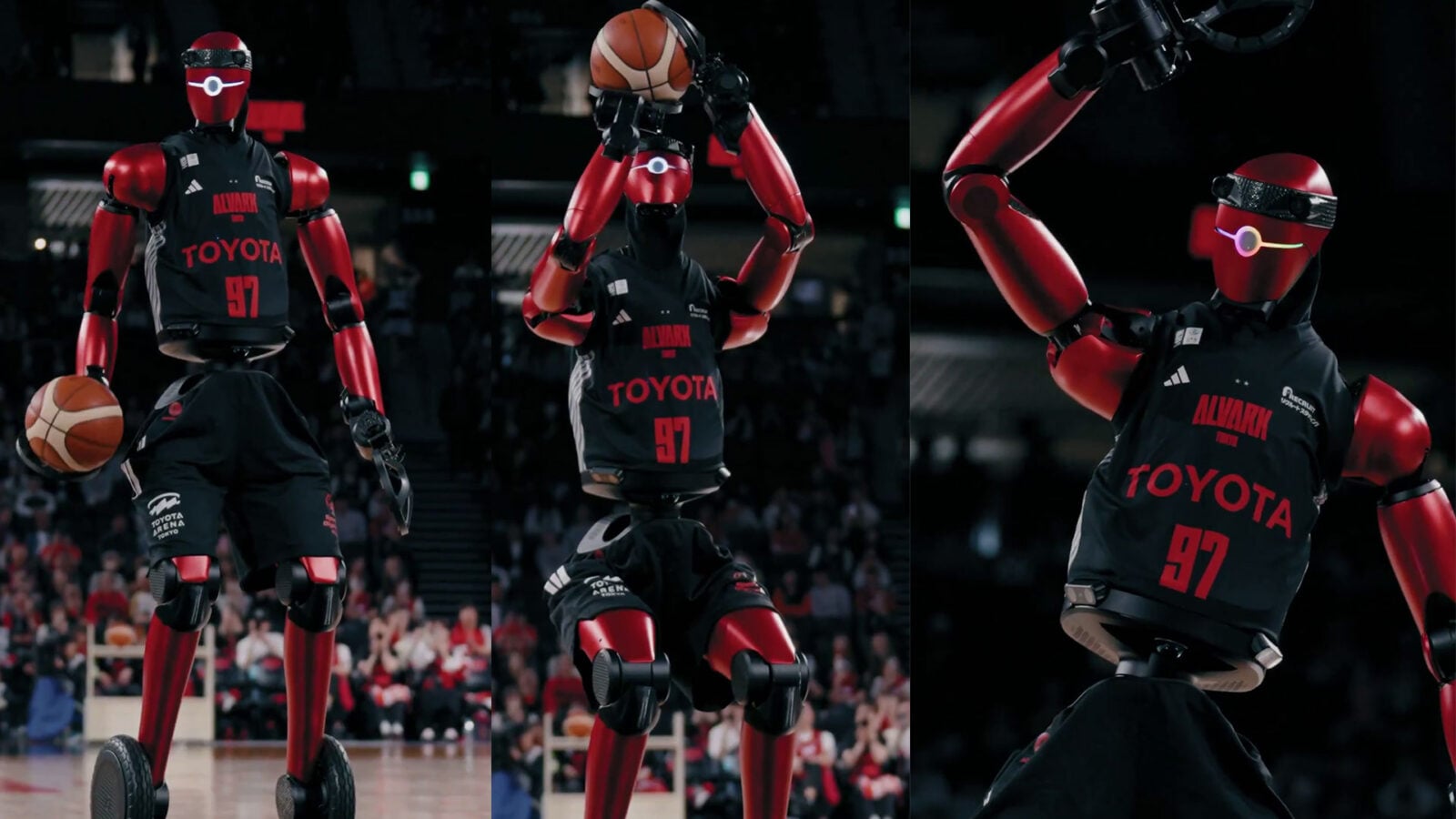
Announced on April 12, 2026 in Tokyo, CUE7 is much more than a robot capable of scoring baskets. Behind the sports demonstration lies a major technological breakthrough in Toyota’s work on artificial intelligence and humanoid robotics.
On April 12, 2026, during halftime of a B.League match at Toyota Arena Tokyo, something unusual happened on the floor. An imposing robot slowly took up position in the center of the field, before the eyes of a Japanese audience who held their breath. It was CUE7. The seventh generation of Toyota’s basketball robot made its first appearance before the general public.
So human that I watched it twice…👀
New AI basketball robot “CUE7” unveiled at TOYOTA ARENA TOKYO 🤖#AlvarkTokyo#GRITUP#B league https://t.co/JzbvErCx4y pic.twitter.com/qgONqftbDC— Alvark Tokyo[ALVARK TOKYO](@ALVARK_TOKYO) April 13, 2026
CUE7 advanced to the basket, completed three dribbles, then made his free throw. He then moved to the other end of the court to attempt a three-point shot. The ball skimmed the circle without going in, but the crowd responded with cheers. It wasn’t the result that counted, it was the gesture.
An architecture redesigned from top to bottom
On a physical level, the transformation compared to CUE6 is radical. CUE7 goes from 120 kg to 74 kg, adopts a structure with two inverted wheels (one per foot) instead of four, and measures 2.19 meters. This gain in lightness improves the stability and fluidity of movements, while making the robot less sensitive to imbalances during rapid movements. Its hands have also been designed specifically to hold a ball, and lidar sensors are embedded in the torso to gauge the distance and angle of the basket in real time.
Reinforcement learning at the heart of the project
Compared to the previous generation, the real qualitative leap lies in control. Where CUE6 relied on preset programs with partial AI adjustment for firing, CUE7 uses a hybrid system mixing reinforcement learning and model predictive control. Concretely, the robot trains in a simulator by repeating the same gestures thousands of times, in varied conditions, until it finds the optimal strategy. The latter is transferred to the real machine, using the so-called Sim2Real method.

Toyota had also anticipated this development. At the end of March 2026, the manufacturer published on its Frontier Research page an interview with two researchers from its development center, who precisely detailed their work on walking and dribbling for humanoids, citing CUE as the targeted direct application. The move from laboratory demonstration to the public stage in April is therefore not an internal surprise: it was the next step in a roadmap already underway.

A broader test bench
Toyota says it bluntly: the CUE series is not a marketing gimmick. Born in 2017 as a voluntary initiative by group employees, the CUE series quickly demonstrated its capabilities on the international scene: in 2019, CUE3 established a first Guinness record with 2,020 consecutive free throws without failure, before CUE6 beat in September 2024 the record for the longest shot ever made by a humanoid robot, from 24.55 meters in Nagakute. CUE7 is part of this continuity, but with a broader ambition.

Tomohiro Nomi, head of the humanoid robotics research group at Toyota’s Frontier Research Center, assumed this ambition during his presentation: “There is a common perception that Japan is losing to China when it comes to physical AI, but we have created something that is no match for the rest of the world”.
With CUE7, Toyota doesn’t just play basketball. It also stakes its credibility on the future of humanoid robotics.
👉🏻 Follow tech news in real time: add 01net to your sources on Google, and subscribe to our WhatsApp channel.
Source :
The Mainichi


