




The director of National Center for Supercalculation from Shenzhen, Lu Yutong, lifted the veil on the Lingshen projectan initiative that goes against industry habits. The ambition is simply colossal: to build the first exascale class supercomputer based exclusively on a architecture CPU-only.
The stated goal is to reach a new milestone in power while relying on a 100% Chinese technological sectora demonstration of force in a context of economic warfare.
How is the architecture of the Lingshen so radically different?
The uniqueness of the Lingshen supercomputer lies in its architecture exclusively CPU. It claims to achieve phenomenal computing power without resorting to graphics accelerators (GPU) which are nevertheless the spine of all modern supercomputers.
Current giants, like the American leader The Captaincombine the power of central processors (CPU) and GPUs to extremely parallelize calculations. Lingshen is betting on distributing this immense load on 47,000 processors alone, an approach previously considered ineffective on this scale.
This decision is similar to a philosophical break. It could be dictated by the desire to circumvent technological sanctions which deprive China of the most advanced GPUs.
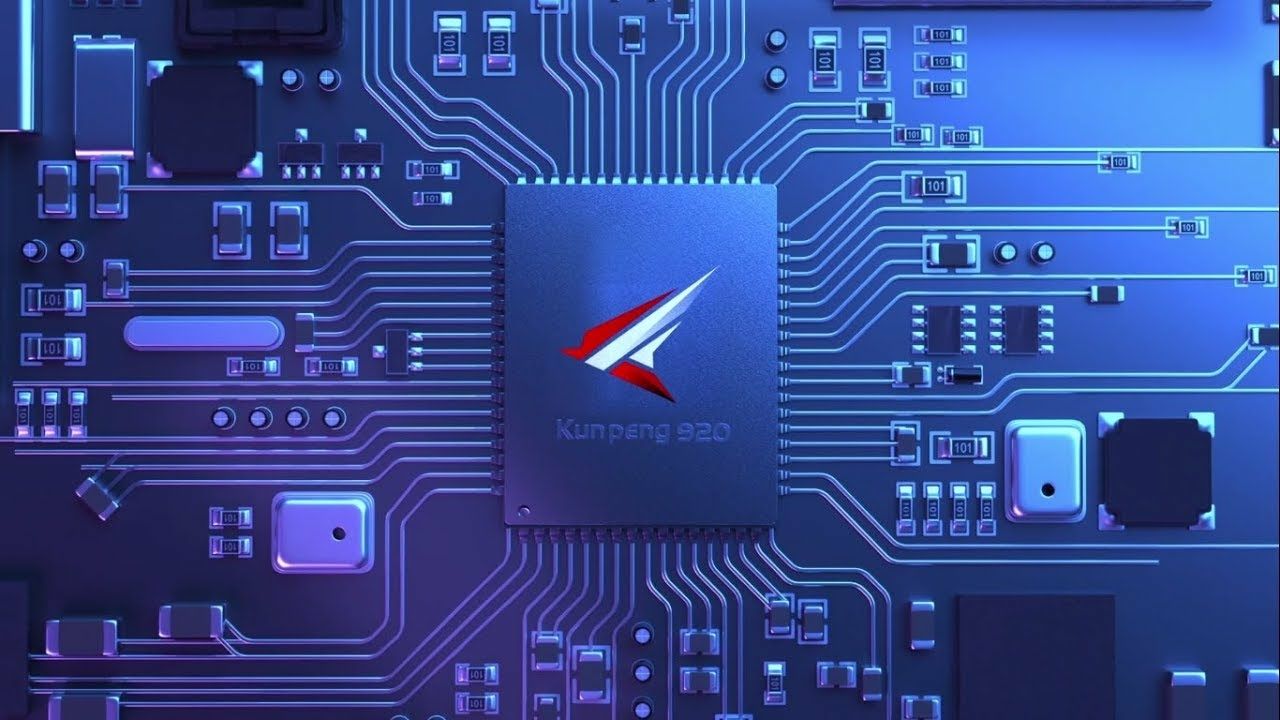
By forcing innovation on its own chips, the country is developing a sovereign ecosystem. It is easy to imagine that future Huawei processorsor other national founders, could be at the heart of this system, creating an architecture optimized for types of calculations perhaps less suited to the massive parallelization of GPUs.
How does Lingshen measure up to American champion El Capitan?
On paper, the Chinese promise is attractive. Lingshen aims for sustained performance of more than 2 ExaFLOPS. This theoretical figure would exceed the official score measured on the Linpack benchmark (a reference test to classify these machines) of the current world number one, the American El Capitan, which displays 1,809 ExaFLOPS.

However, El Capitan is a very real, operational and proven machine, whose peak performance theoretical close to 2.79 ExaFLOPS. Lingshen is, for the moment, only an announcement, a concept on a presentation.
The value of 2 ExaFLOPS gives an order of magnitude of the ambitions for the Lingshen project but it remains to be seen how far it will be able to go and with what workloads.
Is this Chinese technological bet really credible?
The credibility of the Lingshen project is greeted with polite skepticism by the international scientific community. Achieving such computational density and energy efficiency with a purely CPU approach is a technical and thermal challenge considered monumental.
The doubts relate not only to the feasibility of the architecture but also to the deployment schedule which remains a complete mysterysome sources mentioning a commissioning which would not take place for five years.
Beyond raw performance, it is perhaps the statement of intent that matters most. By charting its own course, China is sending a strong signal of resilience and independence in the face of trade restrictions.
The success of the project is not necessarily reaching the 2 ExaFLOPS announced. The real victory for Beijing would be to prove that it can design, produce and operate a high-performance computing ecosystem from A to Z, totally liberated Western technologies.


