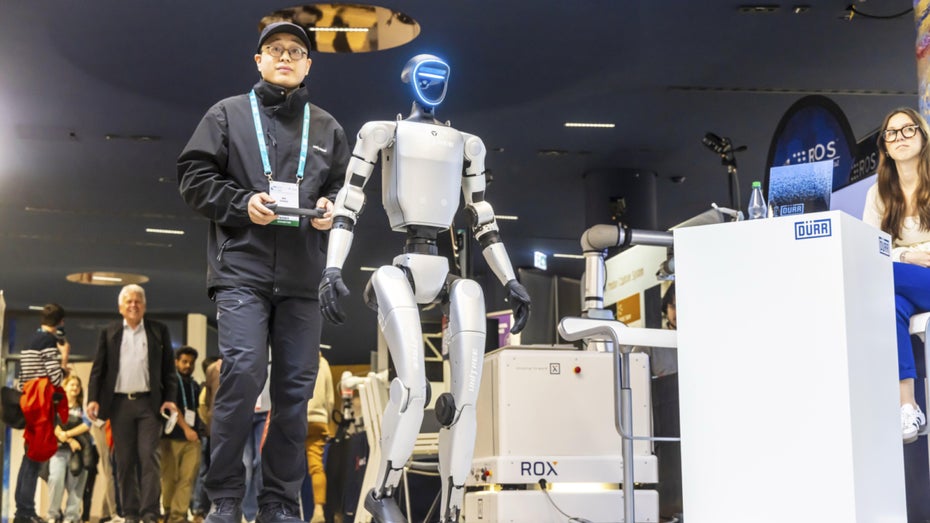
Roboter von Unitree (Foto: picture alliance / imageBROKER | Arnulf Hettrich)
A humanoid robot named Pemba has reached the summit of the Chimborazo volcano in Ecuador. The 6200 meter high mountain posed extreme challenges for the modified version of the Unitree G1 robot. As Humanoids Daily reports, the expedition served the specific purpose of testing whether such systems are suitable for independently collecting environmental data in remote areas.
The engineer Pablo Berlanga Boemare is behind the Pemba project. His vision: Humanoid robots will one day take on surveillance tasks in remote nature reserves and replace the networks of stationary cameras and sensors used to date.
Boemare knows the problem first hand. As the founder of Geologic Dome and through his previous work with World Wildlife Fund (WWF) conservation initiatives, he knows that monitoring wildlife, environmental change, poaching and illegal deforestation requires sustained commitment. He hopes that robots could carry out this task autonomously in the long term.
Extreme conditions as an endurance test
Before humanoids can take over, they must first withstand such extreme conditions. This includes strong temperature fluctuations, from which the electronics and drive elements must be protected. The engineers therefore built special thermal management systems and ventilation components into the G1. They also protect the joints from snow and cold.
Editorial recommendations
${content}
${custom_anzeige-badge}
${custom_tr-badge}
${section}
${title}
The manufacturer Unitree has already demonstrated that this works with a robot in the Chinese region of Altay in Xinjiang. There the machine withstood temperatures down to minus 47.4 degrees Celsius. By climbing Chimborazo at 6200 meters, Pemba proved what is still possible with modifications.
However, the machine was not completely autonomous. The 16-hour climb to the summit was subject to restrictions: the robot could not manage gradients of more than 30 degrees independently. On steep passages, human expedition members had to carry the machine, which weighed around 35 kilograms. The robot would therefore have to be adapted so that it can also master steep sections of terrain independently. Further expeditions are now planned, something to Mount Everest.

Top Article
${content}
${custom_anzeige-badge}
${custom_tr-badge}
${section}
${title}