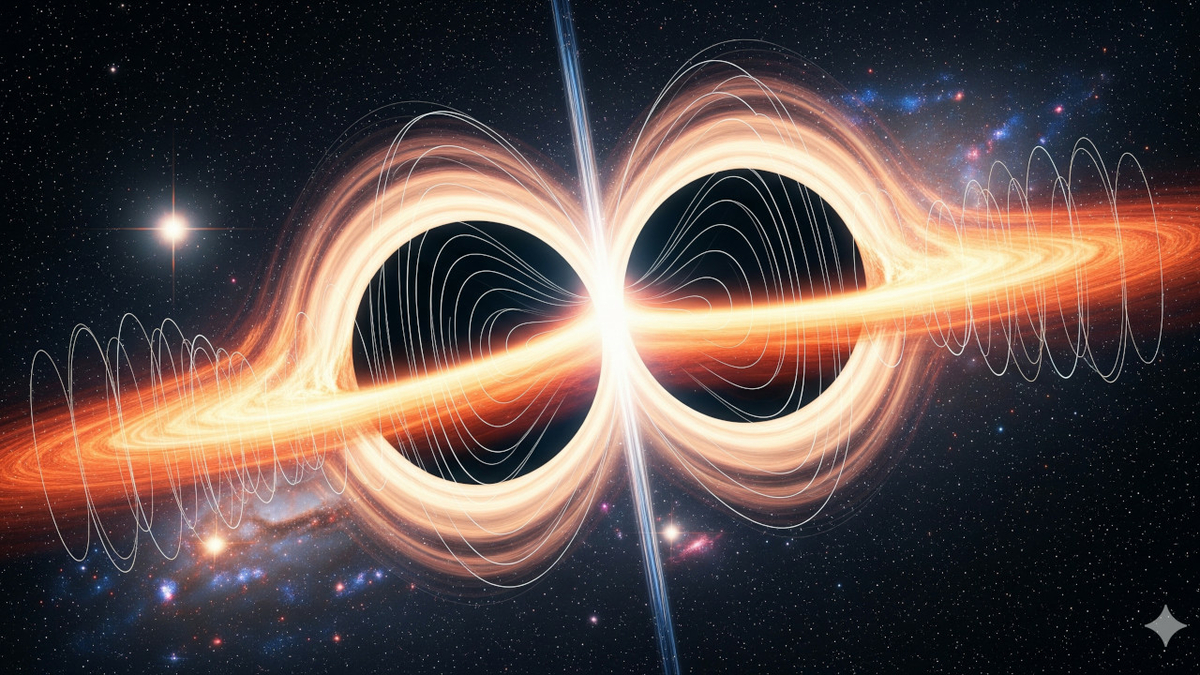
A team of physicists from MIT and Europe developed a model to identify the signature of dark matter in the gravitational waves. By analyzing 28 signals, they found that one event, GW190728matched the profile of a black hole merger that took place in a dense cloud of dark matter, rather than in the expected vacuum of space.
Published in the journal Physical Review Letterstheir study looked at public data from observatories LIGO-Virgo-KAGRA. Their intention was to look for a specific “footprint” that dark matter would leave on the gravitational wavesthese undulations of space-time. And they found a lead. A serious lead.
How could black holes reveal dark matter?
The answer lies in a phenomenon called “ superradiance “. This concept predicts that if particles of dark matter very light (called scalars) pass near a rapidly rotating black hole, they can steal some of your energy of rotation.
This energy transfer amplifies them, creating an extraordinarily dense cloud of dark matter around the black hole.
It’s this cloud that changes the game. When two black holes orbit around each other in this “fog” of dark matter, they do not behave as if they were in a vacuum.
The cloud exerts a gravitational frictionsubtly modifying their orbital dance and, consequently, the shape of the gravitational wave emitted during their merger. The researchers’ model predicts precisely what this distorted signature looks like.
What concrete evidence was identified in the data?
The team screened 28 of the clearest gravitational wave signals detected to date. For each, they compared the real signal to two models: one simulating a merger in a vacuum, the other in a dark matter cloud. Of the 28 events, 27 corresponded perfectly suited to the vacuum scenarioas expected by classical physics.
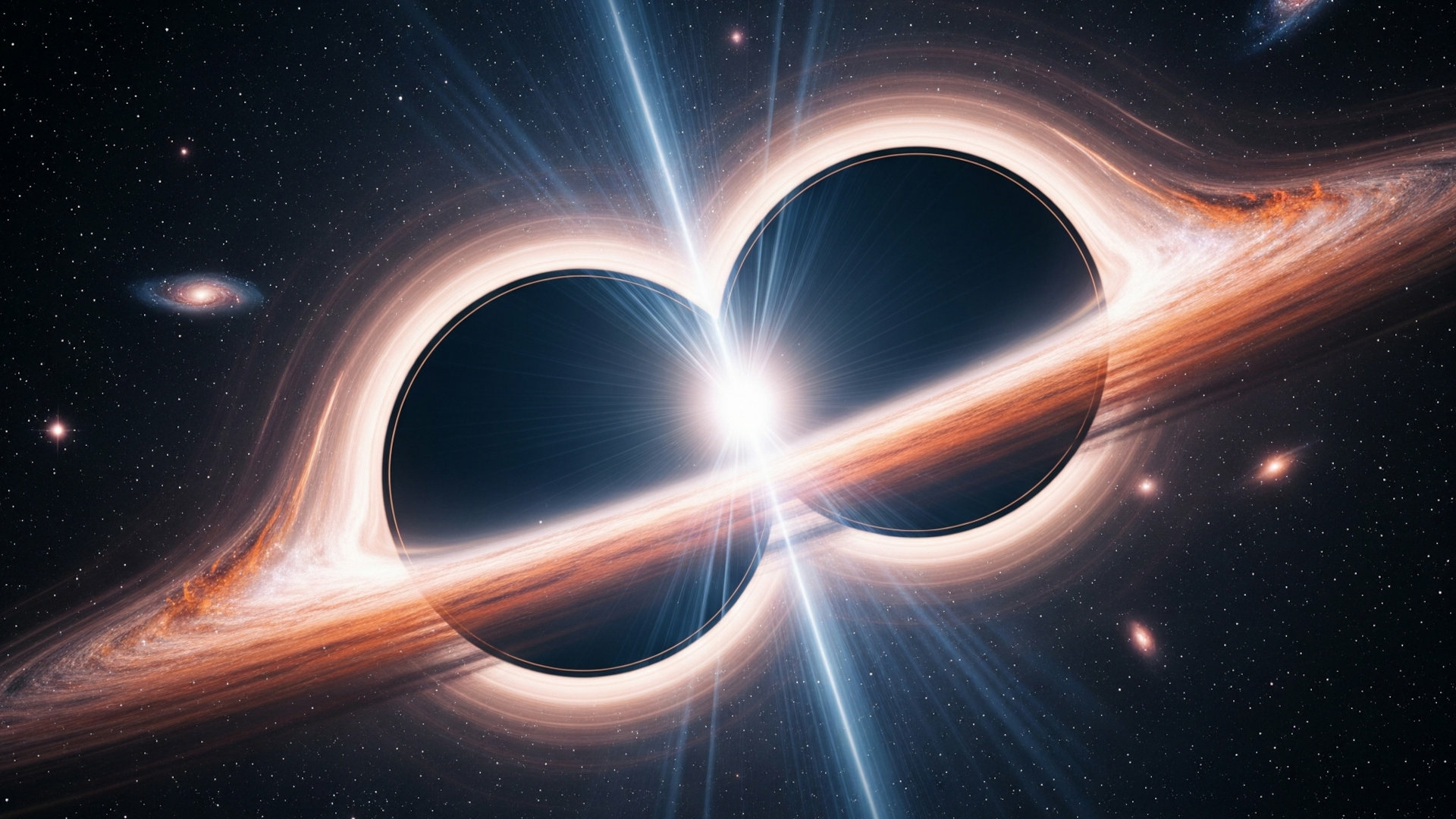

But a signal, called GW190728 and detected on July 28, 2019, stood out from the crowd. This particular signal shows a “preference” for the model including dark matter. In other words, the shape of this wave is more consistent with a merger which would have occurred at the heart of a cocoon of dark matter than with a merger in empty space.
This is the first time that such a correspondence is observed, even if it remains only an index and not proof.
Is this the end of the great cosmological mystery?
You have to remain careful. Researchers, like Josu Aurrekoetxea of MIT, insist that “ statistical significance is not high enough to cry discovery ».
This is not the official announcement of the detection of dark matter. The major implication lies elsewhere. Until now, we could have detected such events without even knowing it, simply classifying them as “classic” black hole mergers.
This new model provides the missing tool to spot hole merger phenomena in a potential dark matter environment. As detectors like the LVK network continue to accumulate ever more precise data, the likelihood of finding an even more compelling signal increases.