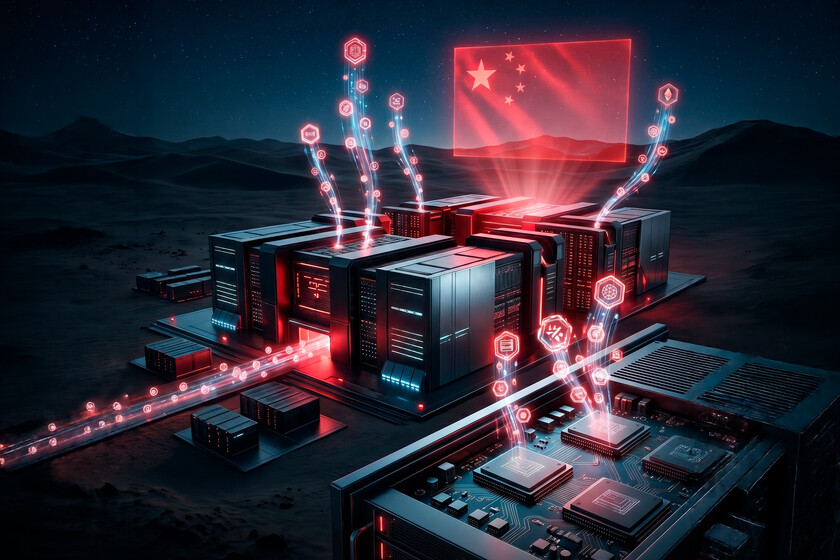
The AI race is no longer explained just by looking at which company launches the most powerful model or who gets access to the most advanced chips. That part is still important, but it doesn’t tell the whole story. What is beginning to emerge is a much broader dynamic to ensure the necessary resources to continue competing. China is pushing that idea with a formula it has called “token factories.”
In action. The most recent example comes from Wuxi, a city in eastern China’s Jiangsu province. According to Global Times, Honflex and the Wuxi High-tech Zone have promoted the province’s first Huawei Ascend 384 computing supernode there. The idea is to use that infrastructure as a starting point for a large-scale installation aimed at offering AI capacity measured in tokens to the market.
Demand grows. If more and more applications use language models and AI agents, someone has to stably provide the capability to run them. Xinhua points out that at the end of March 2026, daily requests for tokens in China exceeded 140 trillion, more than 1,000 times more than at the beginning of 2024 and 40% more than at the end of 2025. This is where the concept of “factory” makes a little more sense.
Meaning of the label. In practice, AI data centers already function as token factories. They execute models, receive requests and return responses. What changes here is not so much the technical nature, but the way of converting it into an industrial product. It presents computing power as something measurable and sellable for those companies that need AI without building the entire infrastructure on their own.
In detail. The Wuxi facility will start with four Huawei Ascend 384 servers. The promise here is to create a high-performance cluster based on domestic chips and models. In parallel, China Mobile announced on May 17 that it had built a computing center in Hubei for the center of the country with locally developed AI infrastructure and intelligent computing capacity exceeding 2,200 petaflops.
A reading of technological sovereignty. In both projects, emphasis is placed on Chinese infrastructure, Chinese chips and national models. There are no mentions of American technology as the basis of the deployment, nor of NVIDIA chips, although the American company continues to be a global reference in AI hardware and has had a very relevant role in China. This framing fits with the Asian giant’s efforts to gain autonomy in a strategic technology. The initiatives also seem to point in that direction.
The race continues. If we take the launch of ChatGPT in November 2022 as the starting point of this new AI race, little time has passed on the calendar, but a lot has passed in the industry. The US is not exactly the same actor as it was then, neither is China, and in between we have seen export restrictions, regulatory comings and goings, development of national alternatives and growing pressure to secure the technological base that allows us to continue competing. In this context, the concept of “token factories” appears. Now we have to wait to see if it will translate into a real advantage.
Images | with Nano Banana
In | If the question is whether AI data centers end up increasing temperatures in a region, the answer is: 2.2ºC