It happened a few years ago in Iceland, when authorities were forced to temporarily close access to a natural canyon after thousands of visitors hiked it off the marked trails, damaging the vegetation and eroding the terrain in a matter of weeks. What had been an almost unknown corner for years suddenly became a viral phenomenon, leaving an unexpected impression: a remote landscape transformed into an overflowing place in a very short time.
Now it’s Norway’s turn.
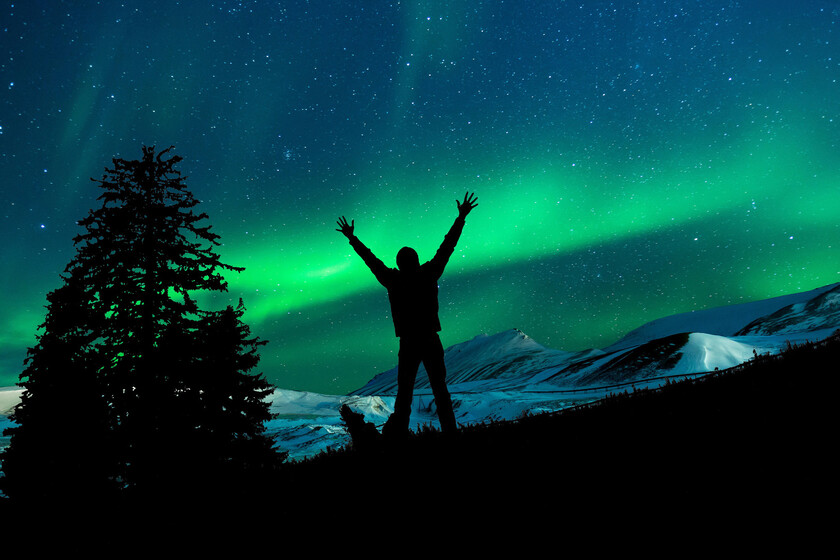
From quiet city to saturated destination. What for years was a peaceful northern town has transformed into a global phenomenon: Tromsø has gone from being a medium-sized university city to receiving massive waves of visitors attracted by this new hype in the form of the northern lights.
The growth, driven largely by social media, has overwhelmed local capacity to the point that, in high season, tourists far outnumber residents. We are talking about collapsed streets, strained services and constant pressure on infrastructure that reflect how tourism has turned the environment into something very different from what it was.
The rise of a business without control. The problem arises because, at the same time, a parallel industry of unregulated guides has emerged that operate outside the law, taking advantage of the low barrier to entry and high demand.
With a car, a mobile phone and access to aurora tracking apps, these operators offer improvised routes that compete with legal services, eroding both the local economy and the quality of the experience. In fact, they reported in the New York Times that the authorities estimate that a significant part of these activities escapes official control, generating income that does not revert to the community and multiplying the problems.

Mass tourism turned into operational chaos. The result is a scenario where the search for auroras has become unpredictable, with convoys of vehicles traveling along roads, constant route changes and a general feeling of disorder.
Specialized police teams patrol the city and its approaches in search of these illegal activities, but clandestine operators adapt quickly, sharing information and using tactics to evade controls. This constant game between surveillance and evasion has turned the activity into something much more complex than a simple tourist excursion.
Failed experiences and feeling of being scammed. As a result, for many visitors, the promise of a unique experience has translated into frustration, deception or unexpected situations, with stories of tours that are not completed, guides who disappear and keep money, or even police interventions in the middle of the tour.
The contrast between the idyllic image of the destination and the reality experienced by some tourists has begun to leave its mark on the reputation of the place. What should be a memorable natural experience sometimes becomes a chaotic and unreliable process.
A destination converted into an extreme theme park. All of this has led to a deeper transformation: one where the northern lights are no longer just a natural phenomenon, but the center of an intensive industry that functions almost like an outdoor theme park.
The pressure to capture that perfect moment has turned the activity into a constant race against time, weather and competition, raising the risk and tension with each outing. Thus, what was once pure contemplation now becomes increasingly closer to an experience. extrema where improvisation and business weigh as much as nature itself.


The impact on those who live from the phenomenon. They recalled in the Times that for legal and experienced operators, the situation has changed radically, facing unfair competition that reduces prices and deteriorates standards.
What should be a season of celebration has become a struggle to maintain business viability in a saturated environment. Another one, as has already happened in Iceland and its volcanoes or more recently in Everest, a change that reflects a broader reality: when tourism grows uncontrollably, even the most spectacular destinations can end up trapped in their own success.
Image | PXHere
In | Touristification has made Mercadona find itself with a rival in Barcelona: 24-hour supermarkets
In | There is something worse than Everest turning into a mountain literally full of shit: scam rescues