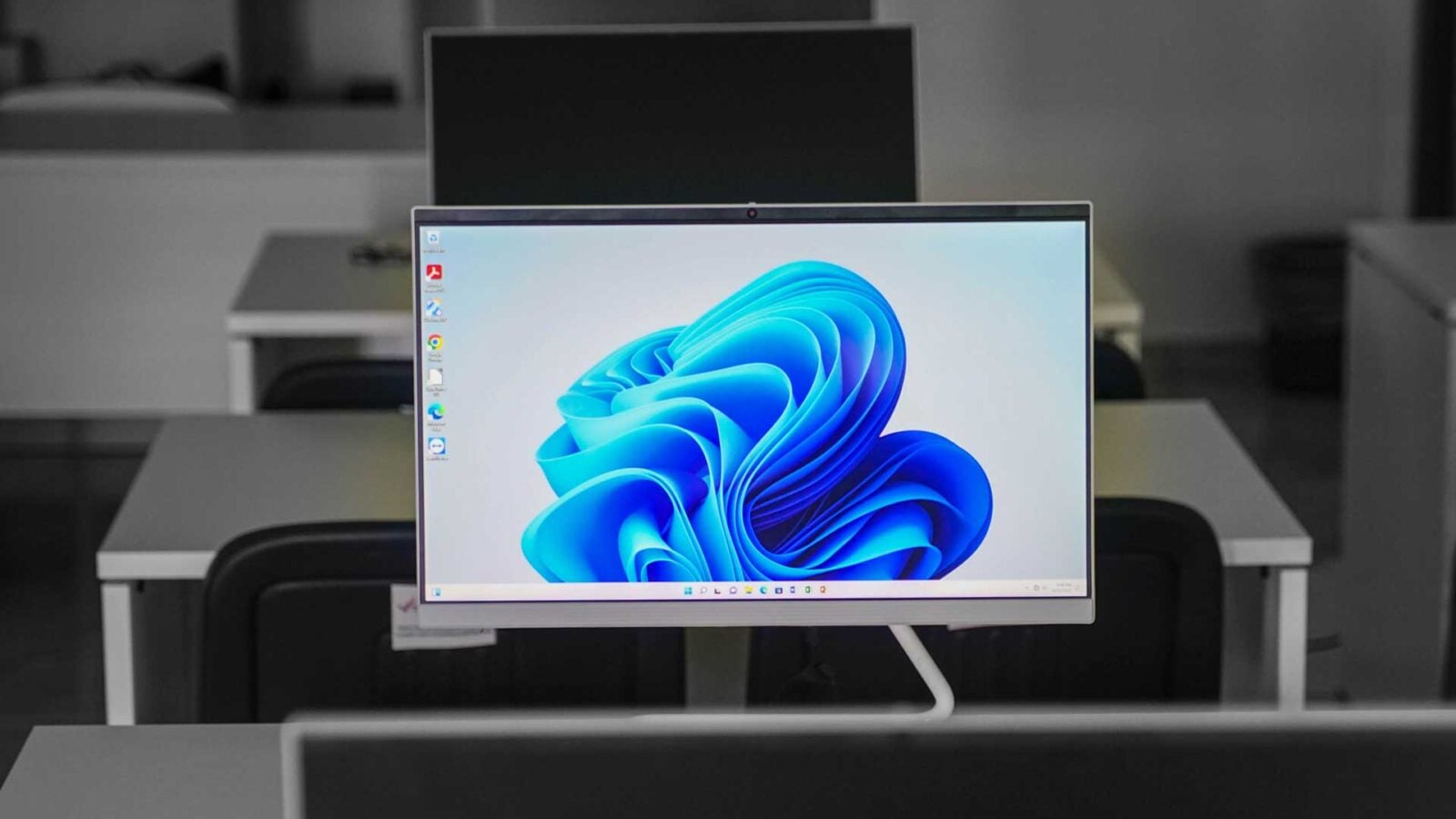
Windows has fallen below 60% of the global market share according to Statcounter, at least if we take the main figure. We explain to you why you should take this with a grain of salt and why another figure, 72%, is also circulating.
Has the reign of Windows on desktop computers just come to a symbolic halt? Yes, if we look at the main figure put forward by Statcounter and widely used this week. Maybe a little less, if we look at the numbers a little more closely.
According to the latest global data from Statcounter, Windows market share fell to 56.55% in June 2026, falling below 60% for the first time in several years. A system which has long dominated its competitors with a comfortable lead, usually running between 60 and 70% in recent months. Meanwhile, Linux continues its slow but steady progress.
Statcounter credits the free system with 4.39% global market share in June, one of its best recent performances and a figure that keeps it firmly above the symbolic 4% threshold. Apple, however, remains far ahead in this area: by adding the old OS Chrome OS brings up the rear with 1.21%.
An “unknown” category that raises questions
These figures, however, deserve to be qualified, and not only for the usual reason that Statcounter measures web activity via page views on more than a million sites equipped with its tracking code, and not a real count of machines installed around the world.
A more troubling detail was spotted in the same data: the category of “unknown” operating systems now weighs 21.45% of the total, compared to only 8.16% in May 2025. This spectacular increase raises a legitimate question, namely whether AI-linked web crawlers could distort part of these statistics, with Statcounter claiming to make “every effort” to eliminate bot activity from its measurements. It is also possible that tightening privacy settings or adopting more protective browsers will prevent Statcounter from collecting certain information, which could have the effect of underestimating Windows’ real share.
A recalculation that sheds light on the data
One point deserves to be clarified for anyone consulting the Statcounter site directly: the platform’s interactive graph does not display the same percentages as its own summary table. Hovering over the June 2026 curve, Windows appears credited with 72%, a figure much higher than the 56.61% announced higher on the page. However, this is not a contradiction: by downloading the raw data from the graph, we see that it simply excludes the “Unknown” category from the calculation and redistributes market shares between only the identified systems.

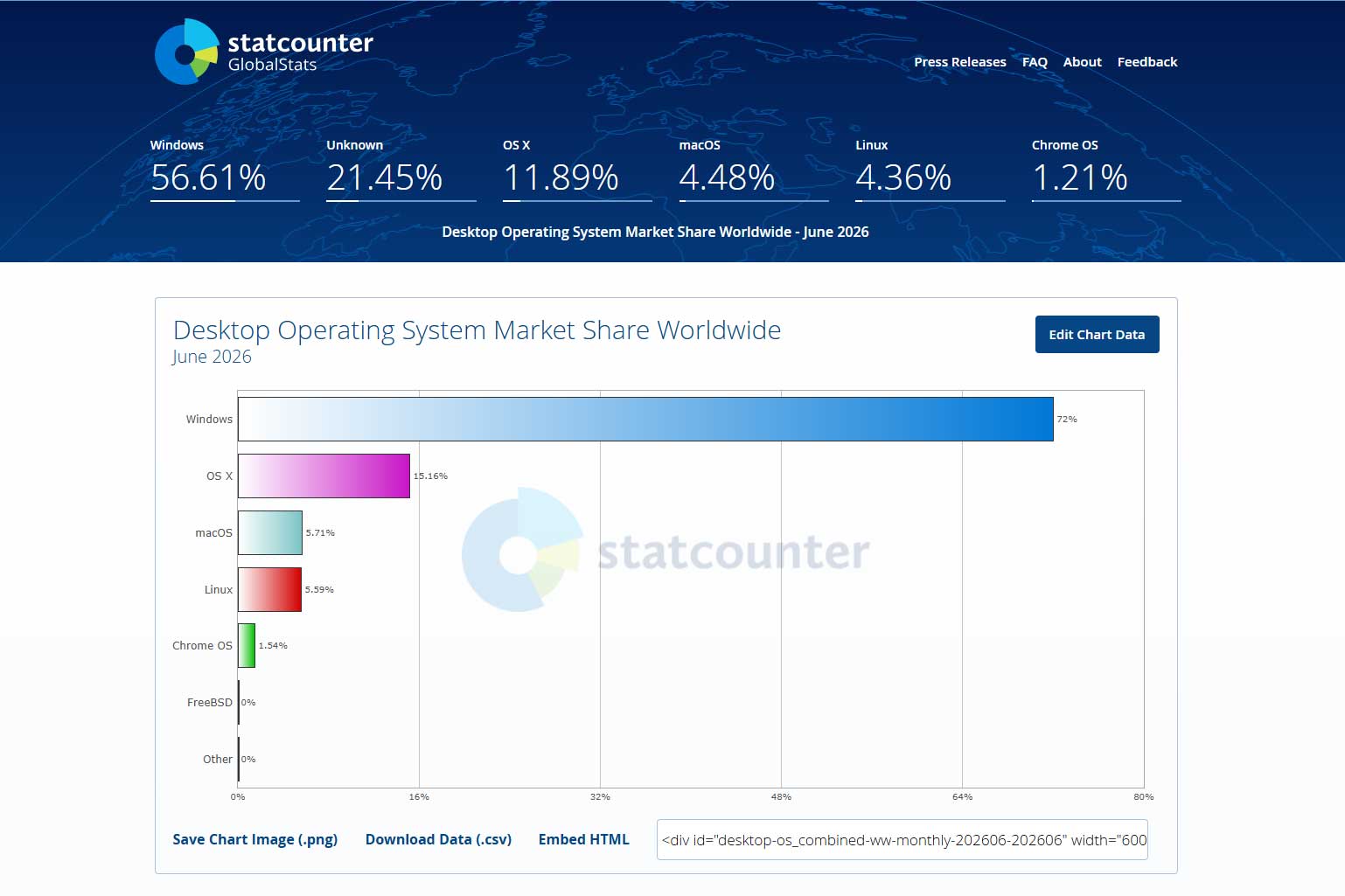
Once this recalculation is applied to the figures in the summary table, Windows returns precisely to 72%, OS The two series are therefore coherent with each other; they simply answer two different questions, the raw market share on the one hand, and the market share among the only identified systems on the other.
A real decline, but less spectacular than it seems
The blogger Korben took the analysis further by comparing these figures recalculated over one year. In June 2025, Statcounter credited Windows with 70.13% in its summary table, with an “Unknown” category at only 9.17%. Once this figure was also recalculated by excluding the unidentified, Windows then stood at 77.22%. Over one year, the real drop would therefore be more of the order of 5 points (from 77.22% to 72%), and not the 13 points that a comparison of raw figures alone suggests. The decline is real, but less spectacular than a superficial reading of the two summary tables suggests. On this same basis, Linux would increase from 4.50% to 5.59% in one year, while Apple would be the big winner of the period, going from 16.90% to 20.87%.
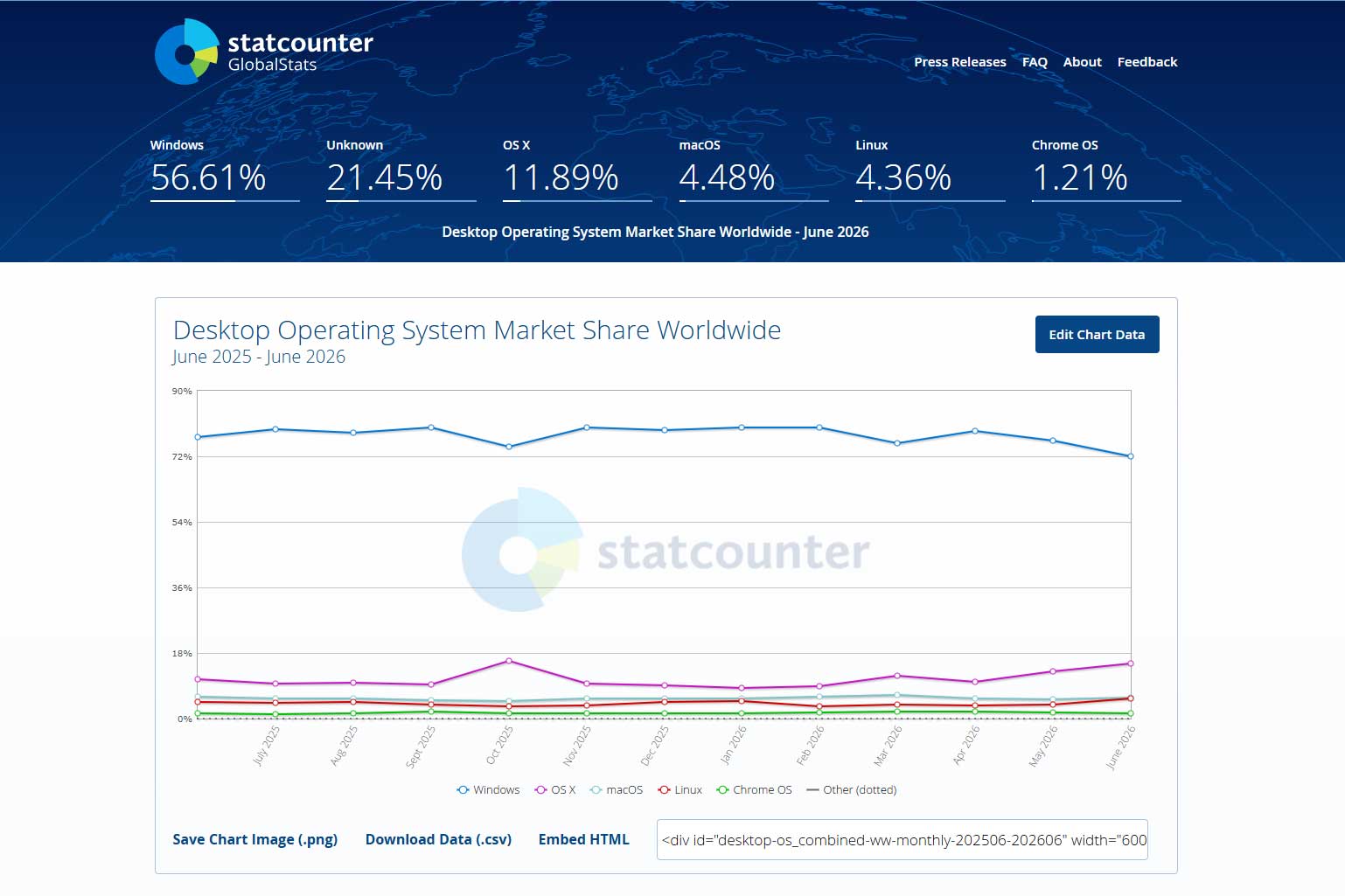
Also note that the “Unknown” category continues to climb beyond June: it would already reach 23.67% of visits in July 2026 according to Korben, a level which calls for caution regarding the reliability of the measurement as a whole. Statcounter also specifies in its documentation that its statistics remain subject to revision for 45 days after publication, which means that the figures for June 2026 could still change until mid-August. The platform has already experienced significant measurement errors in the past: in October 2025, for example, it had credited Windows 7 with 9.61% market share for the month of September, before silently correcting this figure to 1.62%.
Steam Deck and Windows 11 weariness
Several factors could nevertheless explain the progress of Linux in the long term. The availability of the Steam Deck and the continued improvement in game compatibility under Linux have made the system more visible to the general public, usually reluctant to venture outside of Windows or macOS. Distributions like Ubuntu, Fedora, Linux Mint, Arch and even openSUSE now offer more advanced experiences than before.
On the Windows side, some users would express a certain weariness with the high hardware requirements of Windows 11, concerns around data confidentiality, and Microsoft’s continued push towards online services and artificial intelligence integrated into the system.
The fact remains that Windows remains, by far, the most used operating system on desktop computers in the world. But a market where Microsoft falls below 60% and where Linux remains above 4% creates a landscape that is significantly less closed than even a few years ago, provided that we keep in mind the methodological limits of these measures.
👉🏻 Follow tech news in real time: add 01net to your sources on Google, and subscribe to our WhatsApp channel.


By: Opera
Source :
Linuxiac