




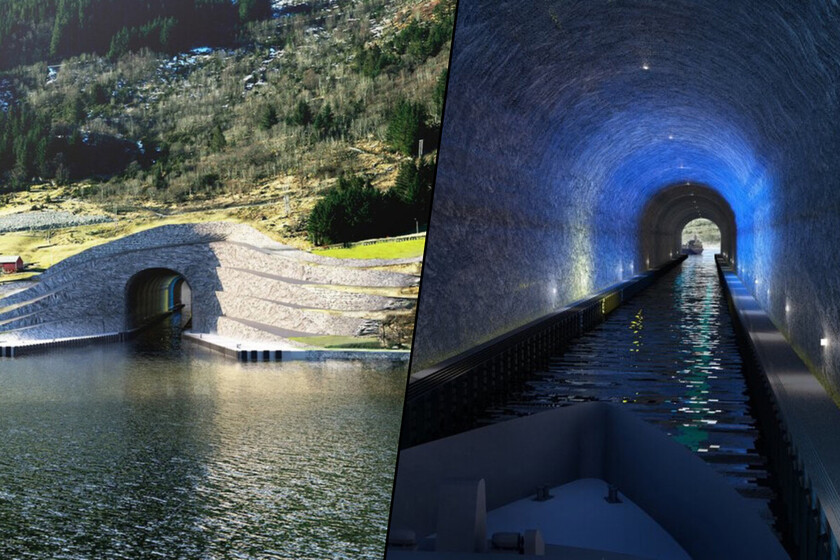
The project has lurched back and forth for decades, but Norway has finally kicked off one of its most amazing engineering feats: the Stad Ship Tunnel. It is the first tunnel in the world designed for ships to navigate inside. After many years of debate, a budget that kept growing and a failed attempt to cancel it by the Government, the project is resurrected with approved financing and works scheduled to start in early 2027. We will tell you all the details.
What you are looking to solve. The Stad Peninsula, on the west coast of Norway, is one of the most dangerous areas for navigation in the entire country. With no nearby islands to act as a natural barrier, the Stadhavet Sea has very rough waters, as for about 100 days a year it has waves that can exceed 30 meters arriving from several directions at the same time.
That’s a problem for ships, as both fishing boats and cargo ships are forced to wait days (and sometimes weeks) until the weather eases enough to safely navigate the peninsula. Being late when transporting fish has serious consequences, since perishable products spoil, the railway network collapses as an alternative and companies in the sector lose money.
“If we are going to export salmon from Trøndelag to the mainland, we cannot risk it getting stuck in Stad due to bad weather. Because it would arrive on the mainland as rakfisk (Norwegian fermented fish) and not as sushi,” said Tore O. Sandvik, regional mayor of Trøndelag.
The boat tunnel. The answer that has been gaining weight for years has been to drill into the mountain. The Stad Ship Tunnel will cross the narrowest point of the peninsula (just 1.7 kilometers) between Moldefjord and Kjødepollen, in the Vanylvsfjord. With its 36 meters wide and 50 meters total height (33 meters free from sea level to the roof), the tunnel will be able to accommodate everything from small fishing boats to ferries and cruise ships, including ships on the Hurtigruten coastal route. The ships would pass through the tunnel in about 10 minutes, at a speed of 8 knots.
Century and a half of history. The first plans to cross the Stad peninsula date back to 1874, although the technology of the time condemned it to being considered a utopia. In the eighties the Norwegian government took up the idea, and in 2013 the tunnel finally managed to enter the National Transportation Plan. In 2021, Parliament gave the project the formal green light and talk began about the imminent start of works. But there was a problem: money.
Lots of fights. The tunnel budget has been its biggest enemy. From the initial 267 million dollars it went to estimates of 325 million, then to 690 million in 2023 and finally to about 780 million dollars (around 8.6 billion Norwegian crowns) according to the most recent data. In October 2025, Prime Minister Jonas Gahr Støre announced the cancellation of the project as part of the presentation of the 2026 state budget. “The cost will be so high that we consider it not responsible to continue with the project,” he declared then. The argument was that the country preferred to prioritize other areas, such as health, defense, or municipal investment, rather than assuming that expense.


Green light. The Støre Government did not have a majority in Parliament to impose the cancellation, and the pressure between the parliamentary opposition and that of more than 500 companies in the fishing, maritime, tourism and industrial sectors ended up tipping the balance. Center-left parties reached a budget agreement that includes financing to start construction.
“We are ready to initiate the necessary processes to facilitate the start of works in early 2027,” said Einar Vik Arset, director general of the Norwegian Coastal Administration (Kystverket). About 15 million dollars will be allocated for the initial phase, within a total budget estimated at around 888 million dollars (about 8.6 billion Norwegian crowns).

How it will be built. “The selected contractor will then be able to begin preparations with the aim of starting work in early 2027,” said Harald Inge Johnsen, project director. The Norwegian Coastal Administration has already evaluated the offers of three finalist consortiums: AF Gruppen, Eiffage Génie Civil and the consortium formed by Skanska and Vassbakk & Stol.
If the schedule is met, the tunnel could be inaugurated around 2032. Of course, the excavation will require removing nearly three million cubic meters of rock and earth.
Why it is unique in the world. As El Confidencial points out, boat tunnels have existed since 1679, when the Malpas tunnel was opened in the French Canal du Midi. But all of them serve inland waterways (canals and ports) and have never been designed for ocean shipping traffic. The Stad Ship Tunnel will be the first in its category. According to estimates from the Norwegian Government itself, the infrastructure also promises to reduce fuel consumption and emissions by up to 60%, by eliminating long waits and forced detours around the peninsula.
In | Building tunnels is very good, but in China there are regions that are doing other things: cutting mountains in half


