An international team of scientists, grouped within the Society for the Protection of Underground Networks (SPUN), published a study that changes our perception of soils.
Using artificial intelligence to analyze more than 16,000 soil cores taken from every continent, they produced the first ever global map of arbuscular mycorrhizal fungi.
These organizations form vital partnerships with more than 70% of land plants. The purpose of this mapping? Quantify this hidden biomass and understand its essential role for the planet.
How big is this underground fungal network?
The scale of this network is simply astronomical. Researchers estimate its total length to be 110 quadrillion kilometersthe equivalent of approximately 10% of the diameter of our galaxy, the Milky Way.
In terms of mass, these networks of microscopic filaments collectively weigh approximately 300 megatonsor four to six times the mass of the entire human population.
It’s like a gigantic ball of wool invisible which, once unrolled, extends over cosmic distances.
How do these fungi work with plants?
This collaboration is one of the oldest and most successful in the living world, dating back to 450 million years. It is a true underground economy based on mutually beneficial exchange.
Plants, through photosynthesis, capture carbon from the air and provide part of it to fungi. In return, the fungus deploys its tiny tubular filamentscalled hyphae (ten to twenty times thinner than a human hair), to explore the ground.
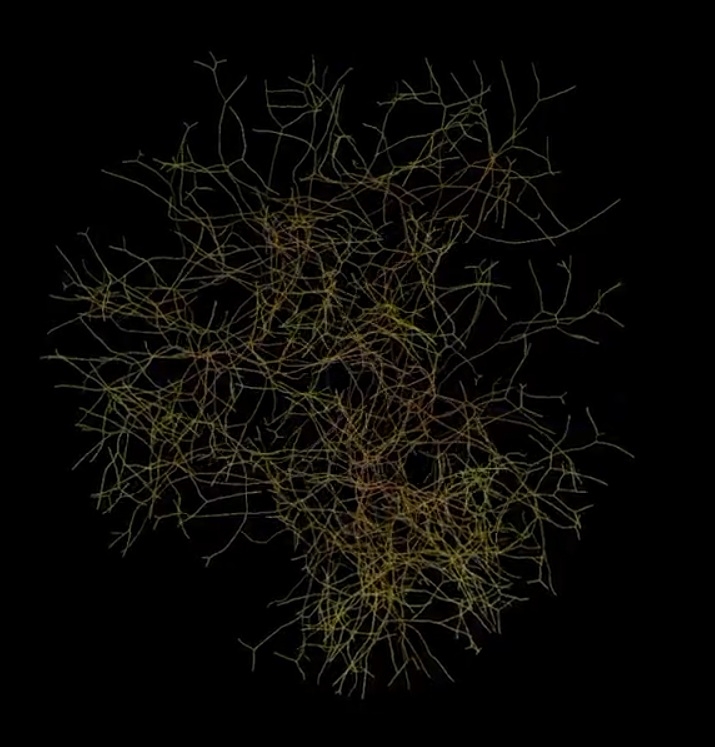

Underground fungal network (credit: SPUN)
These hyphae act as a massive extension of the plant’s root system, increasing its nutritional reach up to a hundred times. They draw essential nutrients from the soil such as phosphorus and nitrogen, which the plant struggles to obtain on its own, and deliver them to it.
The exchange takes place in complex structures called arbuscules (resembling miniature trees within the root cells themselves), true beating heart of this symbiosis. The health of these fungal networks is therefore directly linked to the vitality of visible ecosystems.
Why is this mapping so important for our future?
This map reveals that the fungal network is a major and hitherto underestimated player in the climate regulation. By absorbing carbon from plants for growth, these fungi help store approximately 4 billion tonnes of CO2 into the ground each year, the equivalent of 11% of global fossil fuel emissions.
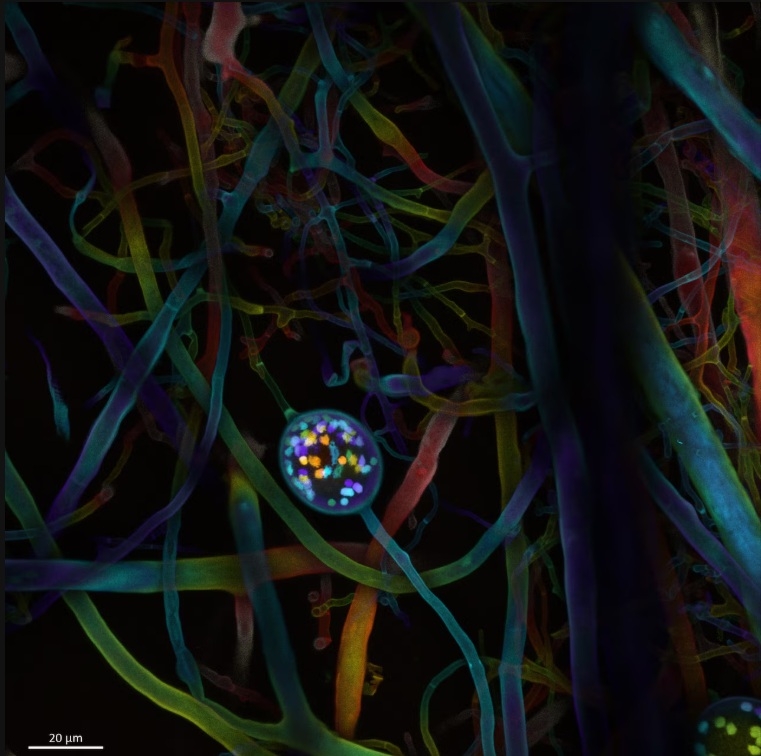

Observation of the fungal network and a spore
(Credit : Vasilis Kokkoris, VU Amsterdam/AMOLF/SPUN)
When the hyphae die, this carbon remains trapped underground. The map shows that wild grasslands, such as the Tibetan steppe or the Everglades, are biomass hotspots fungal, representing 40% of the global total.
Protecting these areas then becomes an absolute priority. These ecosystems, often perceived as less “noble” than forests, are in reality underground carbon sinks of formidable efficiency.
Understanding their distribution is a real lever against climate impact current, telling us where to focus our conservation efforts.
What are the threats and next steps?
The mapping highlights a major threat: l’agriculture intensive. Densities of fungal networks in croplands are on average 47% weaker than in wild ecosystems.
Practices such as plowing literally tear apart this living infrastructure, while the massive use of fertilizers and fungicides restores the symbiosis less necessary for the plantwhich then stops “feeding” its underground partner.
SPUN’s goal now is to use this map as a political tool. They plan to present this data to governments to advocate for the creation of specific protection zones for fungal biodiversity “hotspots”.
The challenge is to rethink our agricultural practices to work with these invisible allies rather than against them, which could reduce our dependence chemical fertilizers and improve the overall health of the planet.