




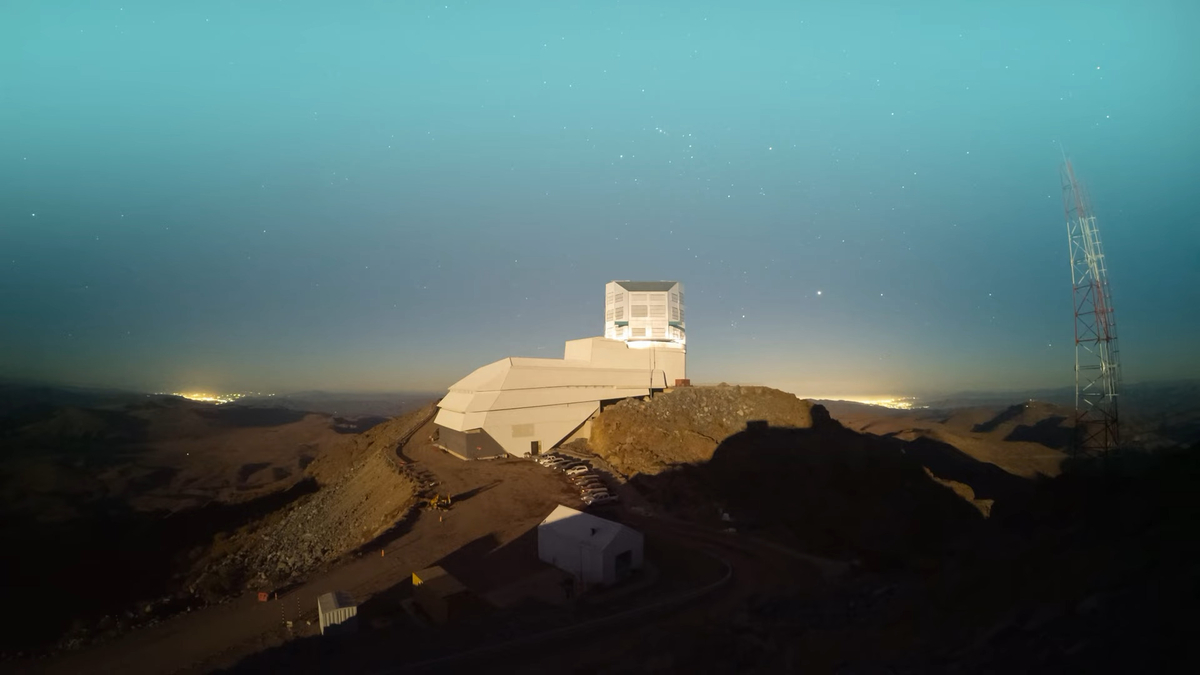
Perched at the top of Cerro Pachón in Chile, theVera C. Rubin Observatory leverages its cutting-edge technology and has started its flagship project, the Legacy Survey of Space and Time (LSST). This event is the culmination of twenty years of work and international collaboration. It marks the beginning of a new era for astrophysics.
What is the Legacy Survey of Space and Time?
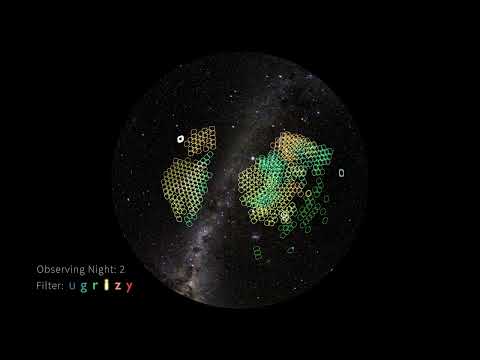
The LSST is an observation campaign which aims to create a sort of time-lapse movie of the Universe. Over a period of ten years, the telescope will scan the entire sky visible from the southern hemisphere every few nights.
Each point in the sky will thus be observed around 800 times, making it possible to detect the most subtle changes, from star explosions to asteroid movements.
To accomplish this feat, the observatory is equipped with the largest digital camera in the world, equipped with a 3,200 megapixels. This instrument can capture a new detailed image of the sky every 40 seconds. This cadence is combined with a very wide field of vision.
What mysteries does the observatory hope to solve?
One of the main goals is to probe the nature of the dark universein particular dark matter, the invisible substance that seems to hold galaxies together, and dark energy, the enigmatic force that accelerates the expansion of the Universe.
The LSST will also transform our knowledge of the Solar System, positioning itself as the most powerful asteroid detection tool ever built.
During its commissioning phase, the observatory has already discovered more than 11,000 unknown asteroids, including 33 near-Earth objects. The final catalog is expected to contain millions of new objects, providing an unprecedented census of our cosmic neighborhood.

An observatory for everyone
Each night, the Rubin Observatory collects approximately ten terabytes of data and generates up to seven million alerts reporting changes in the sky.
These alerts are transmitted in real time to automated systems that sort them so that astronomers around the world can respond quickly and observe events like supernovas with other telescopes.
Once the ten-year survey is completed, the entire data set, containing billions of objects and countless measurements, will be made accessible to the public. scientific community and to the general public.


