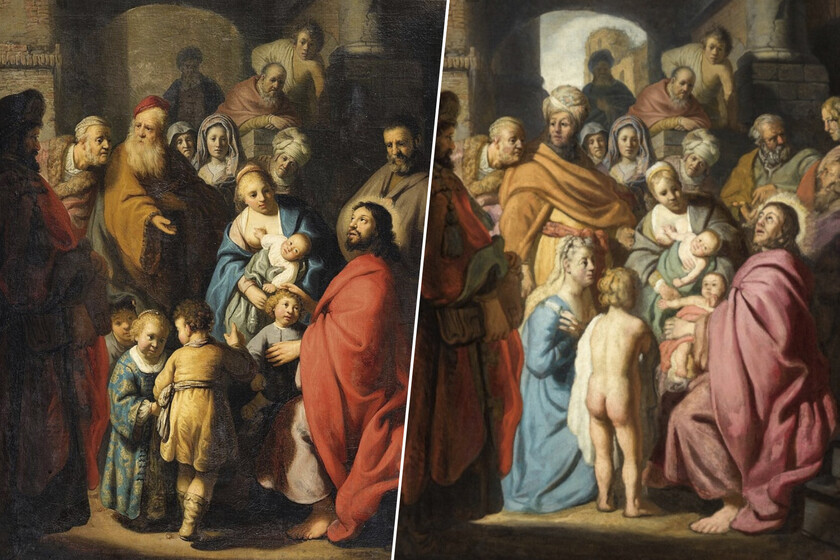
The fact that he has been dead for more than three and a half centuries does not prevent Rembrandt Harmenszoon van Rijn, one of the great geniuses of baroque painting, from continuing to surprise historians. And in the most unexpected ways. In 2014, one of his youthful works appeared by surprise at an auction held in Cologne. Now, with its attribution already confirmed, the experts in charge of cleaning the canvas have had another surprise: under a subsequent layer of paint they have discovered a man with a dark complexion, a black beard and a large turban.
It was once painted by Rembrandt himself, but someone decided to retouch the figure to turn it into a venerable old man with a white, wrinkled face, gray beard, and a traditional Dutch cap. The question is obvious: Why?
Isn’t that a Rembrandt? The painting Let the children come to me It was probably painted around 1627, when Rembrandt was 21 years old. However, it did not rise to fame until almost 400 years later, well into the 21st century. To be more precise, we must go back to May 2014, when the canvas was included in an auction held in Cologne with a vague business card.
Its owners presented it as a piece of the “Dutch school” dating back to the mid-17th century and sold it for 1.5 million euros. It was a good pinch, but it ended in pocket change when some time later it was confirmed that in reality that anonymous 125 x 109 cm canvas (with frame) was neither more nor less than a work from Rembrandt’s youth. Sotheby’s recently put it up for auction again with an estimated value of between 9.3 and 14 million euros.
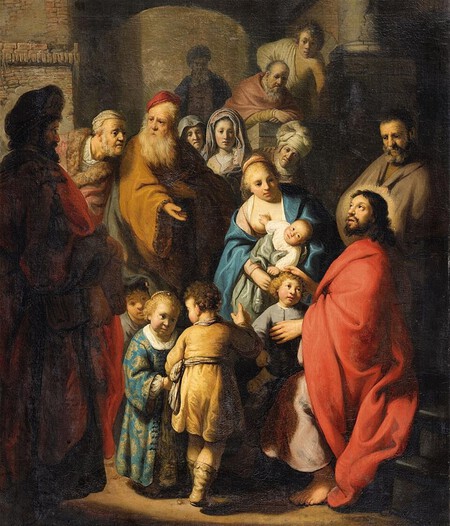

The work before the restoration, with the added modifications.
And the (other) surprise arrived. Such a record would have been enough to give the painting a prominent place in Rembrandt’s legacy. Recently, however, Sotheby’s revealed that the canvas hid another secret. What we have seen so far was not exactly what the Leiden artist painted, but an adulterated version by a hand less skilled with brushes, an artist contemporary with Rembrandt. There are those who even have a name: Claes Cornelisz Moeyaert.
Given that experts believe that the Dutch painter left the work “partially unfinished”, working hard on the upper part of the painting and sketching the lower part, it is understandable that someone would want to finish it. The intriguing thing is that in doing so that anonymous hand did not simply follow Rembrandt’s design.
In addition to finishing the canvas, he repainted it, erasing, adding and modifying it to taste. We know this because in recent years technicians have studied the work with X-rays and have dedicated themselves to carefully eliminating overlapping layers.
Does it change that much? Yes. It takes a look at the photos that were released of the painting at the time and those released by Sotheby’s following the last auction to prove it. The motif of the painting is the same: the biblical scene, recorded in the Gospels of Mark, Matthew and Luke, in which Jesus uttered his famous phrase: “Let the children come to me.” If we look closely, however, differences can be seen between its status in 2014 and 2026.
The elimination of the repaintings changes the color, has made some figures emerge and eliminated others. A boy in the foreground who was wearing an ocher suit now looks how Rebrandt must have seen him, with his back bare. However, the most powerful alteration is another: we now know that one of the central figures in the scene was a dark-skinned man with a turban who the artist who retouched the work completely modified, turning him into a venerable old man.
For some unknown reason, the original exotic turban ended up becoming a red Dutch hat and the black beard became a long, gray beard.

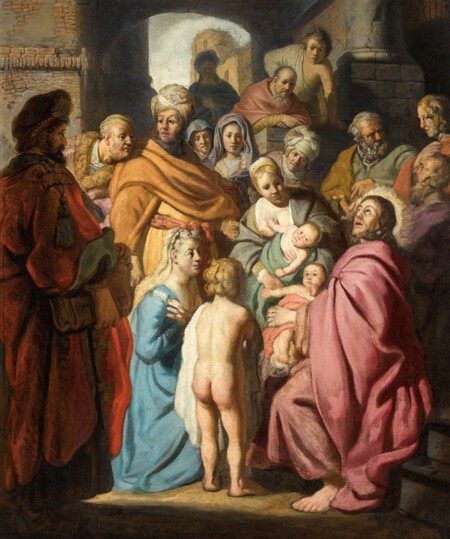

The work already restored and as presented by Sotheby’s.
More than a detail. That detail has caught the attention of media outlets from half the planet. And it’s normal. There are those who believe that if Rembrandt initially opted for a man with a turban, surely Muslim, it was not for an aesthetic reason. He wanted to capture what he saw in part in his own country in the 17th century, a multicultural environment, marked by religious rivalries, the coming and going of thousands of refugees and the social tensions that this generated in the streets.
As historian Andrew Graham-Dixon recalls, “in 1627, when Rembrandt began the painting, Leiden was going through a humanitarian crisis.” “The Thirty Years’ War was at its peak and hundreds of thousands of people were arriving as refugees in the Dutch Republic,” he adds. It is estimated that approximately 10,000 refugees arrived in Leiden in 1626 alone.
…and more than paint. Was that context transferred to Rembrandt’s canvas? Did you want to capture the spirit of what you saw on the streets of your city, the position that in your opinion should be maintained towards refugees arriving from other places?
“It depicted a mass scene of Christ welcoming children and families. It was very controversial at the time. There were people in Leiden who did not want to welcome them,” Graham-Dixon elaborates. “What we gather is that Rembrandt was on the side of humanitarian aid. So I think this is more than just a painting. It’s a statement of his moral stance.” The truth is that in the work we see a crowd in which the Jewish and Christian religion are represented.

“It looks familiar”. The figure wearing a turban is not the only surprise. Experts have identified in it a self-portrait of Rembrandt himself, who represented himself at the top, as a young man who appears to be looking at the scene perched on a pillar, although in reality he is looking at us.
“His physiognomy is familiar to us thanks to the numerous painted self-portraits, drawings and engravings that he made over 40 years. During his time in Leiden alone he made no less than 14 different ones,” say Sotheby’s experts.
A family portrait? Not only that. The Dutchman also used to resort to models from his own family, something that seems to have also been applied in Let the children come to me. Experts believe they have identified a portrait of his mother and father, as well as other members of his close family circle.
“In no other image does Rembrandt manage to reunite his family so completely,” the experts say. The reason? A theory shared by the auction house is that since the painter had just returned to Leiden after training in Amsterdam with the renowned Pieter Lastamn (1583–1633), he wanted to demonstrate to his parents that the money invested in his training had been worth it.
Images | Wikipedia and Sotheby ́s
In | 400 years ago, a man committed the crime of dismembering Da Vinci’s legendary notebooks. That bug has just been fixed