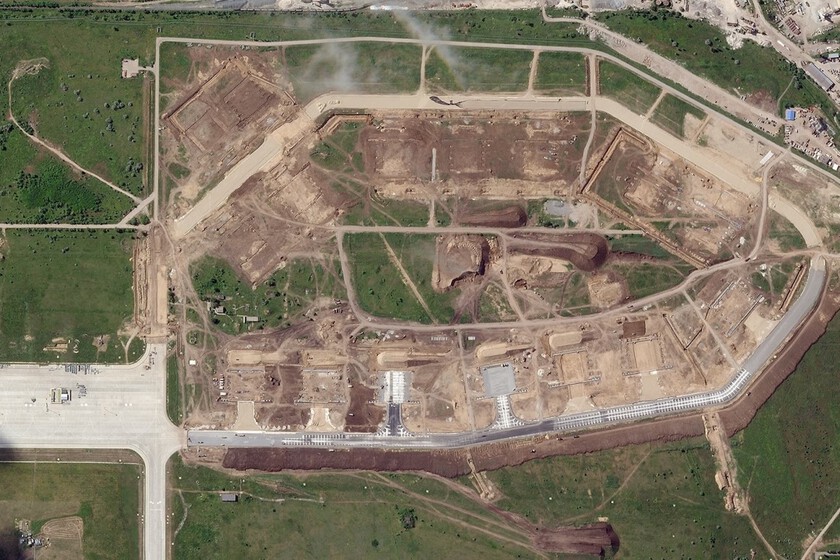
In October 1962, in the midst of the Cuban Missile Crisis, the Soviet Union ordered a large part of its nuclear bombers to disperse and hide for fear of a surprise attack by the United States. It was one of the few times in history when Moscow assumed that even its most sensitive strategic assets might not be safe at home. More than sixty years later, that old logic of vulnerability has returned.
The image that summarizes a change. For decades, Russian strategic bombers were a military rarity: nuclear machines parked in the open, visible from satellite, relying on Russia’s territorial depth and the logic inherited from the Cold War. The Tu-95s and Tu-160s were part of the most sensitive core of Moscow’s military power, and yet they never needed mass shelters.
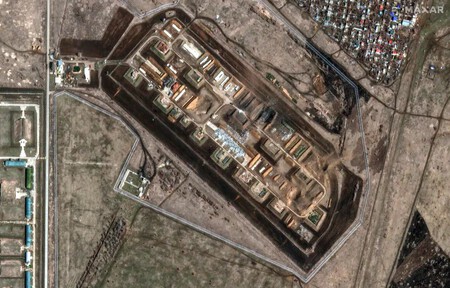
That’s changing, because new satellite images show something unprecedented: Russia is building huge fortified hangars at the Engels Air Base air base to protect its strategic fleet. It’s not just a work of engineering. It is proof that Ukraine has achieved something that seemed unthinkable just three years ago: forcing Russia to bunkerize one leg of its nuclear triad.
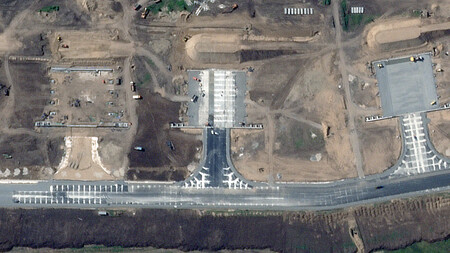

Engels: the heart of the Russian nuclear air arm. Engels is not just any base. It is one of the nerve centers of Russian strategic aviation and is home to the 22nd Heavy Bomber Division, including the only operational squadron of Tupolev Tu-160s and several Tupolev Tu-95MS. A good part of the cruise missile attacks against Ukraine take off from there.
We are talking about irreplaceable devices: the Tu-95 has been out of production for decades and the industrial reactivation of the Tu-160 is advancing extremely slowly. Therefore, losing one is not losing a plane, it is losing a central piece of the Russian nuclear balance. That’s also why the fact that they now need to hide them under concrete says a lot about how war has changed.

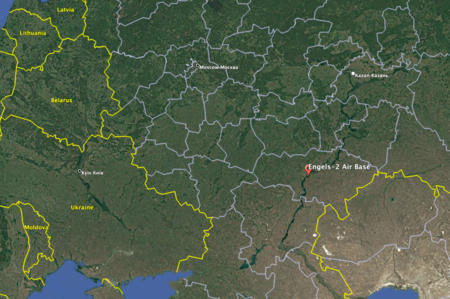

Ukraine has broken strategic depth. The great transformation of this conflict has been psychological rather than physical. For decades, Russia’s geographic depth was its greatest shield. Engels is almost 500 kilometers from the Ukrainian border. Once, that distance was equivalent to absolute safety, but not anymore.
We have been counting, Ukrainian drones have repeatedly hit fuel depots, arsenals and logistical areas linked to the base. In 2022 there were already attacks. In 2025, massive fires caused by drones once again demonstrated that even strategic assets could be hit. Perhaps most important is not just the material damage, it is that Ukraine has collapsed the idea of the Russian inner sanctum.

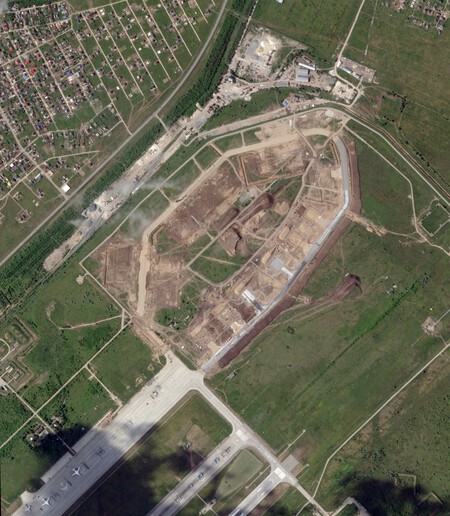

Image from June 20 shows the massive construction project in the northeast corner of the base
From tires to silhouettes painted on concrete. The evolution of Russian defenses tells a story of forced adaptation. First they dispersed planes, then they built retaining walls between aircraft to limit explosion damage. And later almost improvised measures appeared: tires on the wings to confuse sensors, old planes used as decoys and silhouettes painted on landing strips to fool drones and satellites.
All of this reflected an uncomfortable reality: Russia had no doctrine to protect strategic bombers against cheap and persistent threats. Now that improvisation gives way to something much more serious: seventeen giant shelters under construction, designed specifically for their nuclear bombers.


Satellite view of damage caused by a Ukrainian drone strike on a weapons depot in Engels in March 2025
The Cold War returns, but in reverse. TWZ analysts recalled that the most striking thing is that this did not even happen during the Cold War. In that period, the nuclear threat was existential, but the logic of deterrence and the practical impossibility of cheap precision attacks made this level of physical protection unnecessary.
Today the change comes from below: not so much through intercontinental missiles, but rather through relatively cheap drones capable of crossing hundreds of kilometers. It is a strategic turnaround in the war scenario. Ukraine, without a strategic air force or nuclear capacity, has forced the second atomic power on the planet to physically reconfigure the protection of its nuclear air arm.
Nuclear bombers underground. That said, structures do not guarantee immunity. A heavy cruise missile could penetrate them depending on its final design. But that’s possibly not the point. The objective is to raise the cost of the attack, make identification more difficult and protect against drones, cluster munitions or secondary explosions.
In essence, Moscow is accepting that the threat is no longer sporadic, but structural. That changes how you operate, plan and distribute resources. Even if you like, it is a symptom, because when a nuclear power begins to build shelters to protect assets that it previously displayed without concern, it is in some way admitting that its strategic environment has worsened.
Lesson to the rest. The Russian case is already being closely watched in the United States. There, bases such as Barksdale Air Force keep bombers such as the Boeing B-52 Stratofortress practically exposed, something that has generated growing debate after recent incidents with drones. The conclusion is uncomfortable and global: the era in which air superiority or distance was enough to protect strategic aircraft is dying.
Ukraine has demonstrated this starkly. It has taught that modern warfare allows a weaker actor to threaten assets of maximum value with cheap, persistent and difficult-to-intercept tools.

The invisible victory in kyiv. Beyond the front, the maps and the kilometers gained or lost, there are other types of victories that are measured in another way. Forcing Russia to cover its nuclear fleet with concrete is one of them. It is not a visible destruction, nor a territorial advance nor a flag over a conquered city. It is something deeper: changing the strategic behavior of the enemy.
Engels’ satellite images teach precisely that. For the first time since the end of the Cold War, Russia is acting as if its nuclear bombers are no longer safe at home. And that simple fact, alone, says a lot about the real scope of the war Ukraine is fighting.
Imagen | Planet Labs, Google, Maxar
In | In its mad race to the future, Ukraine is already replacing human soldiers with tank robots with machine guns
In | In 1964, the US devised a missile with a nuclear engine and abandoned it for fear of radiation. Now Russia has it back