




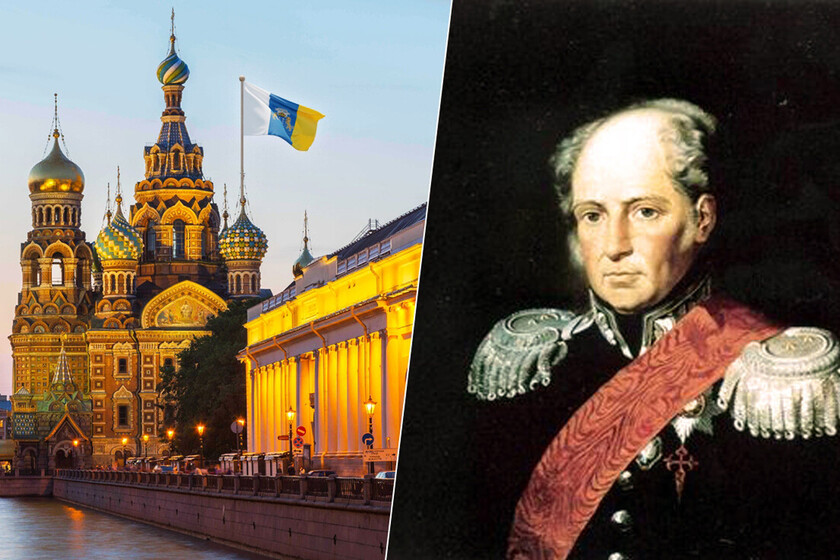
Between the winters of his native Puerto de la Cruz and those of Saint Petersburg there are a few degrees of difference; But neither that, nor the change in culture, language or landscapes stopped Agustín de Betancourt from turning back when in 1808 he decided to pack his bags and move to the Russia of the Tsars. He had fallen into disgrace in the eyes of the all-powerful Godoy, in Spain he had nothing left but family and memories, he had been in Paris for some time and had influential friends, so… What could he lose?
Nothing.
And so it was.
His steppe adventure would bring him significant profits; but above all to Russia itself. So much so that if you walk around Saint Petersburg you will find several statues in his memory.
The country of the tsars, that of the Alejandros y Nicolaseswhich today we associate with pageantry and alambic constructions, would probably have been somewhat less brilliant if it had not been for the genius of Agustín de Betancourt, the inventor who during the early part of the 19th century gave shape to his particular “Russia made in the Canary Islands”. Especially in the capital, Saint Petersburg.
From Augustine to Agustinovich
That of Agustín de Betancourt y Molina (1758-1824) is one more name in the long list of national geniuses from whom Spain—before and after him, for one reason or another—did not know how to take full advantage. It happened to Isaac Peral, Mónico Sánchez, Ángela Ruiz, Emilio Herrera… and Betancourt.
In his case, yes, in a peculiar way.
At the beginning of the 19th century, the situation of the Canarian engineer in Spain was enviable in its own way. He came from a good birth, he had made a career between Madrid, Paris and London, earning the trust of the counts of Floridablanca or Aranda and he enjoyed a well-established prestige with his work on steam engines or the optical telegraph which he had designed with Claude Chappe.

As, in addition to being a man of action, he was also a man of letters, Betancourt had also encouraged the creation of the School of Roads and Canals, inspired by the École des Ponts et Chaussées in Paris.
Despite all this prestige and status, their situation at the dawn of the 19th century was not what one would call comfortable. In 1805, a report with his seal on the Genil River had earned him the distrust of none other than Manuel Godoy himself, a strong man in the kingdom of Charles IV. That circumstance and the scenario that was emerging internationally encouraged Betancourt to liquidate his properties in Spain and move first to Paris—where Napoleon came to tempt him—and then to Russia.

There, in Saint Petersburg, he managed to gain the favor of the best godfather imaginable: Tsar Alexander I, who probably saw in the canary a genius more than valid for the development of his country. What Spain had let go, would be used in the Russian empire. If the future was not tempting for Agustín in Madrid, perhaps it would be in Madrid. 3,000 kilometers from there.
So he collected his belongings, settled his pending matters in France and embarked for Saint Petersburg. There they waited with open arms for Agustín “Agustinovich” Betancour.
Persuaded perhaps by his prestige or the interviews with Augustine himself, the tsar soon showed his confidence in the canary. One of his first orders was the modernization of the Tula cannon factory, a strategic cog in the military apparatus of the Russian Empire. Betancourt was not new to the task and he knew how to take advantage of his knowledge of the double-acting steam engine and the operation of the Yndrid factory to give a twist to the ancient Russian system.
Happy
The result must have convinced the tsar. Only in this way can we understand that throughout the following years Augustine was in charge of tasks of capital importance for Russia and accumulated greater and greater prestige. In a matter of a few years, the former engineer who was at odds with Godoy became lieutenant general of the Russian army and general director of Communications.
In Moscow he took on the task of building a new Equestrian Exercise Room and around the same time he was in charge of what may have been his greatest contribution—and the most profound—to Russian urban planning: designing a new commercial precinct capable of taking over from the fair that had been held near the Makaevsky Monastery since the 16th century. Its old center had burned in 1816 and the Russian Government wanted to recover it… but with greater packaging and in a better place, more accessible and capable of achieving greater projection.

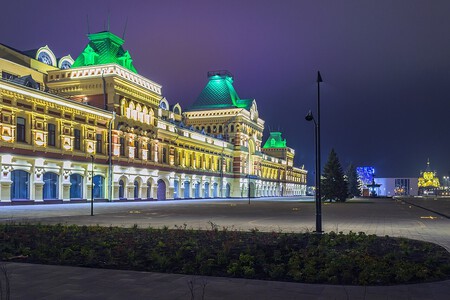

The responsibility of deciding where and how and coming up with the overall design fell on the canary’s shoulders. The site opened its doors in July 1822 with a huge fair that brought together more than 200,000 merchants and helped for years to develop the Volga region and the wealth of the empire. That Betancourt did not do badly in his endeavor is demonstrated by the fact that upon his death the Russian merchants installed a plaque of gratitude on his grave. Two hundred years later the footprint of the Tenerife native in Nizhny Novgorod it is still deep.
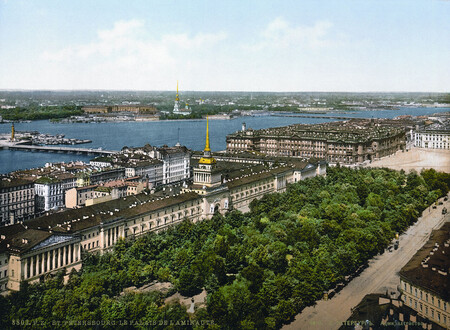
Although the Nizhni Novgorod complex is perhaps its greatest urban heritage, the city in which it was used most thoroughly and in which it left the greatest impact is Saint Petersburg. There, in the capital of the empire, he showed his talent in at least half a dozen capital works for the metropolis: the new paper currency factory, the dredging of the port, several bridges and Saint Isaac’s Cathedral.
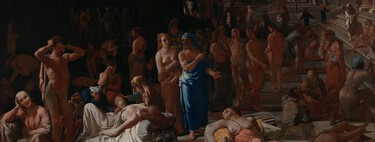
As the Orotava Foundation recalls, in March 1816 Betancourt took on the task of setting up a new money paper factory in Goznak, on the banks of the Fontanka canal, and for two years he was in charge of supervising the works. His involvement was not limited to the building: he organized its areas and machinery, designed banknotes and favored the modernization of the antiquated Russian ruble manufacturing system, which until then had made it an easy target for counterfeiters.
Over the years he also built several bridges over the Neva River and helped make Saint Petersburg today one of its most photographed buildings: Saint Isaac’s Cathedral. Although the father of the temple is the architect Auguste de Montferrand, Betancourt’s collaborator, the Canary Islander took on the task of completing the foundation with piles, designing the scaffolding and the complex system of cranes that allowed the raising of the red granite columns that distinguish the building.

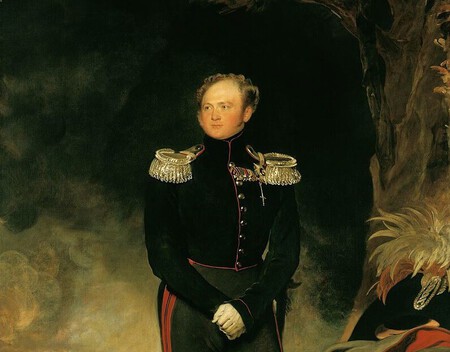

Tsar Alexander I.
It was not the only time that Betancourt put his mechanical ingenuity at the service of the capital. With the purpose of dredging the landfills in the port of Kronstadt, the fortified island that acted as a maritime defense for the capital, Betancourt designed special machinery. Its mechanism, which operated thanks to a steam engine, was released in 1812 and did not require repairs until 1820. His good eye allowed him to understand the potential of waterways of Russia and, from his responsibility in the government, encouraged him to reinforce them with docks, retaining walls, locks and dredges.
Ironically, his years in Russia did not end very differently from what had happened to him in Spain. Despite the success of the Nijni Novgorod fair, its expenses and the irregularities of one of its collaborators, added to other factors, such as its sympathies for the liberal revolutions in Spain, clouded its relationship with the tsar in the early 1820s.
The Agustinovich who in his day did not even need to make an appointment to meet with the tsar ended up dismissed on a practical level and in 1824 requested a retirement which was granted without problem. His mark remains in Saint Petersburg. The one that helped give luster to the city of the tsars. And Spain was lost along the way.
Images | Alexey Trefilov y Wikipedia (1 y 2)
In | In the 19th century, a US millionaire set out to invade countries on his own: he founded two republics of which he was president
In | The strangest dog in the world comes directly from the underworld and is a deity in Mexico: the story of the “xolotl”
In | The masterpiece of European castles: a red brick mass built in 1274 to Christianize Poland


