Players from the Spanish and Argentine teams were running on the MetLife Stadium grass, but there were those who experienced the World Cup final yesterday as a fight between two different protagonists, with geopolitical resonances. On the one hand, Spain has become one of the great international supporters (of course the most media-friendly) of Palestine. On the other, an Argentina led by a ruler who boasts of being “the most Zionist president in the world” and who before the game had received the public support of the Israeli prime minister.
This tension that transcends strictly sports was clearly experienced on Sunday on the networks… and also in the Middle East, especially in Jerusalem.
Football and more. If there is an event capable of emptying streets and beaches in the middle of July and bringing together millions of people around a screen, it is a World Cup final. This virality helps to understand that the tournament often transcends the sporting sphere to fully penetrate the economic, political and symbolic sphere.
It happened yesterday. And it’s quite understandable. If we add to the magnetism of the World Cup the geopolitical context, that the match was played in the US and that the protagonists of the final were Spain and Argentina, led by governments that have shown clear support respectively for Palestine and Israel, the extra-sports seasoning of the match was guaranteed. It was sport. And it was political.
Prime Minister Benjamin Netanyahu met in his office with the Ambassador of Argentina to Israel, Rabbi Shimon Axel Wahnish, and wished great success to the Argentine national team in the World Cup final taking place tomorrow.
Ambassador Wahnish presented the Prime Minister with… pic.twitter.com/2x3pYAxA9b
— Prime Minister of Israel (@IsraeliPM) July 18, 2026
Crisis of tweets. The demonstration of the extent to which this was the case came through X, where Israel and Palestine made it clear which team they supported.
The first message came on Saturday from the official account of the Israeli Prime Minister. In it, several photographs of Benjamin Netanyahu with the Argentine ambassador Shimon Axel Wahnish were published in which the Israeli leader holds the albiceleste shirt. And if the image was not clear in itself, it was accompanied by a message publicly sent by Netanyahu to President Javier Milei: “We support Argentina in many ways, including tomorrow.”
That tweet already circulated on Saturday, on the eve of the game, but it has done so again in the last few hours after the official account of the State of Palestine recovered it to include it in a new publication. In it he basically does two things: he shares the poster created by the RFEF to announce Spain’s victory and accompanies it with the Palestinian flag, the Spanish flag and two hearts. All this (remember) along with Netanyahu’s original message supporting Argentina.
🇵🇸 ❤️💛🇪🇸 https://t.co/sVxBtRwMxu pic.twitter.com/NIFjEh884l
— State of Palestine (@Palestine_UN) July 19, 2026
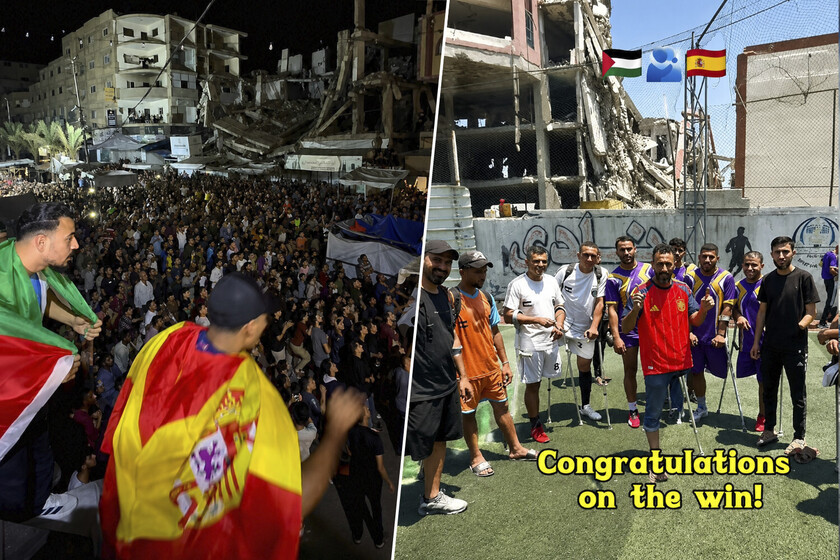
Network thing, right? Not quite. It is true that the exchange of messages via Similar scenes can also be followed on networks, such as in a video shared on IG by Ya7ya_sager.
In Ramallah the party gathered thousands of people to follow the game, including Spanish diplomatic personnel. It wasn’t just about love of football or a question of affinity towards one team or another. The symbolic background is deeper.
Two areas, two hobbies. Maria Trapaderne, from the EFE agency, tells in a chronicle how Jerusalem remained divided in the match that was played at the MetLfife in New Jersey. The Western zone turned to Argentina. The East, with a majority Palestinian population, mobilized with the Red.
The chronicler tells how at the New Gate of the Old City you could see terraces full of people with the Red shirt and red flags. “The eastern side supports Spain because Spain has actively supported Palestine, while Argentina has supported Israel and has fostered brotherhood between both countries,” summarizes Guad, a young Palestinian who followed the game.
@millennium Among the ruins of Gaza, the population celebrated Spain’s victory against Argentina, giving it the victory of this 2026 World Cup, waving flags of both peoples in the streets. Gazans support Spain as a sign of gratitude for the humanitarian and political support of that nation, which was the first in Europe to formally recognize the Palestinian State. Gaza Palestine Spain World Celebration
♬ original sound – MILLENNIUM – MILLENNIUM
@.gaza_al_irada_fc 🇵🇸❤️ From Gaza to Spain… Congratulations to the Spanish National Team on your well-deserved achievement! Football unites hearts beyond borders. We play with hope, resilience, and respect—and today we celebrate your success. Wishing you even more victories ahead. Congratulations, Spain! 🇪🇸⚽ #Spain #España #Football #Respect #FromGaza
♬ original sound – gaza_al_irada_fc
Why this polarization? To understand it, you need to dust off the newspaper archive. Both the recent and the oldest. Argentina and the Palestinian people have important ties, which include both migration ties and Buenos Aires’ decision to recognize Palestine as a State in 2010. However, the current president of the South American country, Javier Milei, has stood out for his closeness to the Israeli Executive headed by Netanyahu.
At the beginning of 2024, shortly after his election, the Argentine leader traveled to Israel, where he could be seen crying in front of the Western Wall, and he has proclaimed himself “the most Zionist president in the world.” Not even Messi has been spared from controversies related to Israeli propaganda.
Reviewing figures. The link between both territories can be measured in figures. In 2005 the newspaper The Nation published that the Capital and Greater Buenos Aires were home to around 244,000 Jews and in the country as a whole they numbered around 300,000, making them the largest Jewish community in all of Latin America.
In addition to these ties, the historical link between Buenos Aires and Tel Aviv goes back decades: Argentina was the first country in Latin America to recognize the Jewish state and it supported it in the Malvinas War.
Long live Spain 🇪🇸 https://t.co/B2RX3wWked pic.twitter.com/d1U4qdUvIW
— State of Palestine (@Palestine_UN) July 14, 2026
And on the part of Spain? Above all, the support of the Pedro Sánchez Government for Palestine in the last two years stands out. In 2024, the Executive decided to recognize the Palestinian State, alleging “a matter of historical justice with the legitimate aspirations” of its people. Since then, the Government has also officially condemned the Israeli attacks in the Gaza Strip and has been very critical of the decisions of the executive led by Netanyahu.
Regarding Gaza, Spain has also adopted its own tone, much stronger than that of the rest of its community partners, just as it did in 2025 in its refusal to raise its investment in defense to 5%, as Donald Trump demanded. As if that were not enough, last year’s Vuelta Ciclista made it clear that the rejection of Israel’s position in Gaza permeates part of Spanish society.
The clearest example came a few months ago from the hands (literally) of Lamine Yamal, who celebrated Barcelona’s victory in the League by waving the Palestinian flag, a gesture that publicly celebrated the authority of the region.
Imagenes | TikTok and Instagram
In | FIFA has managed to distort football to the extreme and the proof is the disconcerting half-time show