




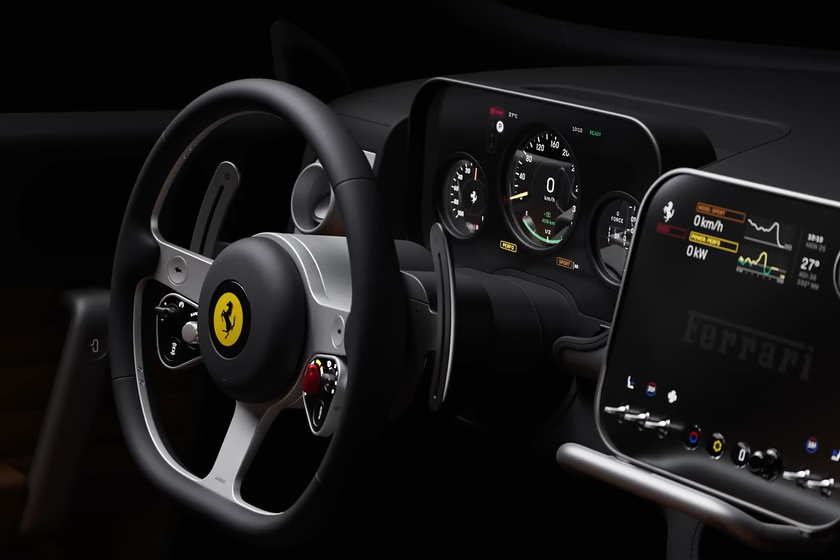
“A large touch screen it doesn’t work in a car. That’s unquestionable.” Jony Ive was this blunt recently in an interview published by Top Gear. We’re not just talking about the former head of Apple design, but also about the figure that Ferrari has turned to, together with LoveFrom, to shape the interior of the Luce, the first production electric car in its history. The movement is not minor: it has an enormous symbolic load for the brand and, at the same time, opens the door to a proposal that seems to move away from one of the most repeated formulas by the industry. Now, in addition, we know a little better where that path is going.
After some first previews published in February, Ferrari has once again shown the interior of the Luce in a new video and this time the material is much more useful to understand what the brand is trying to do. The first glance already suggested that we were not looking at a conventional cabin and opened the door to very different readings. This second tour, however, allows us to go a little further than the initial impression: it is no longer just about seeing a striking design, but about beginning to understand how Ferrari wants the driver and car to relate to this long-awaited vehicle.
The interior of the Ferrari Luce points just in the opposite direction to the screen fashion
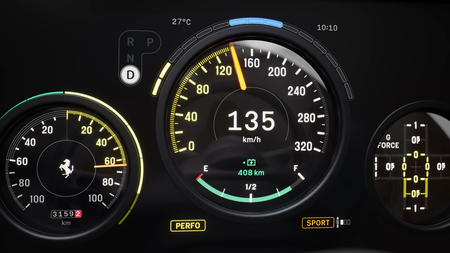
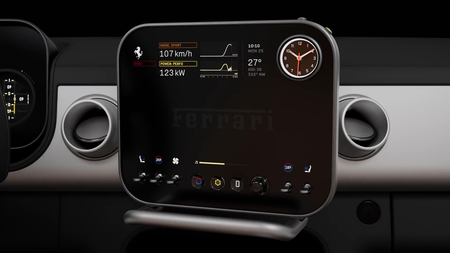
If we look at what Ferrari teaches in this second tour, the interior of the Luce seems built around a fairly clear idea: returning prominence to physical interaction. The central screen is present, yes, but it does not dominate the dashboard nor is it presented as the absolute great center of the car; in fact, it appears integrated next to physical controls for various functions. Added to this is a digital display behind the steering wheel organized into three configurable dials and an ignition sequence that starts when a specific key is inserted into the center console. The video, however, does not allow us to categorically state that there is no tactile interaction, but everything points in that direction.
Ive’s words help us read this proposal much more precisely. In his recent conversation with Top Gear he stated that the large touch screen not only seems like a debatable solution, but also directly unsuitable for real use inside a car. He even defined it as an “easy” and “lazy” response. If we take that frame and look at the Luce video again, the idea gains coherence.

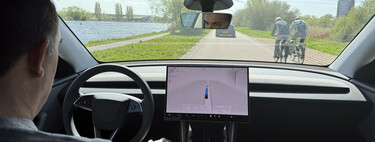
If we look back, a good part of the industry has followed the same idea of modernity for years: fewer buttons, more screen surface and almost all functions concentrated in a large central panel. Tesla had a lot to do with that turn. Not only did it help turn the electric car into a desirable product, it also pushed a very specific way of understanding the interior. That is why Ferrari’s movement is so interesting. Just when it is time to enter this new stage, it seems to have preferred explore a different direction.

Ferrari indicates that it will be an electric car with a 122 kWh battery, an 880-volt system and a range of close to 530 kilometers according to European tests. The video, for its part, shows 0 to 100 km/h in 2.5 seconds. There is, however, one big piece that remains to be fully revealed: its final exterior appearance. The launch will arrive on May 25 in Maranello, before starting production at the end of 2026 and deliveries at the beginning of 2027.

There will be time to discuss whether this bet ends up working as well in practice as it suggests on paper. But what Ferrari has revealed so far already allows us to draw a provisional conclusion: the Luce does not want to limit itself to being the first electric car in the house, it also aspires to open a different conversation about how a car should feel inside. And that, in an industry that for years has pushed almost en bloc towards total screen, is already quite significant.
In | We have normally accepted that cars have become rolling screens. China is tired


